

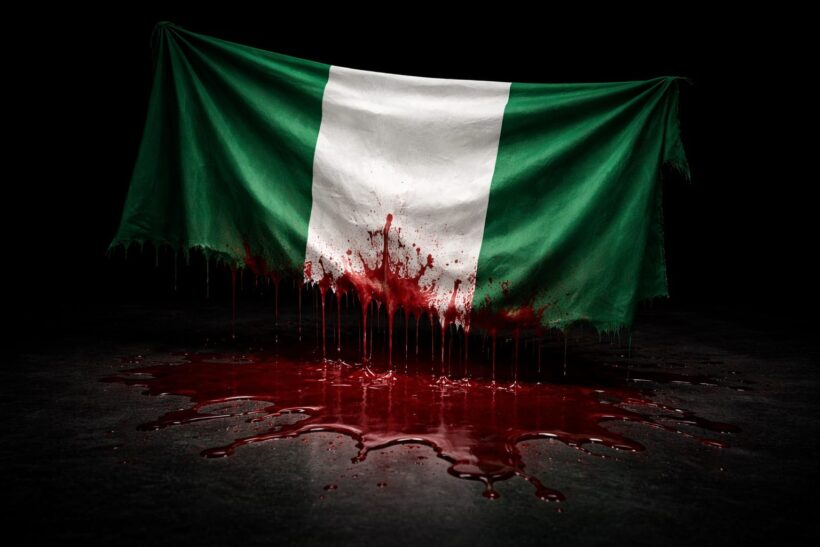
In Africa’s most populous country, burned villages, executed bodies and mass displacement expose a crisis that cannot be explained solely by religious fanaticism or local criminality. In a nation rich in oil and strategic for the global energy market, extreme violence coexists with geopolitical interests, external militarization and an economic model that has left the State without the tools to protect its own population.
In the states of Benue, Plateau, Borno and Zamfara, the testimonies repeat themselves with only minor variations: armed men arrive at night, shoot at point-blank range, set fire to mud-and-zinc homes, kill those who attempt to flee and abduct the young. Survivors describe the smell of burning wood mixed with burning flesh. Children hiding under beds listen as their parents are killed. Women run into the bush carrying babies while bodies remain lined up in dirt courtyards.
These are not isolated incidents. They are recurring massacres. And they are taking place in a country that produces enough oil to be a key player in the global energy market.
A State rich in resources, poor in protection
Nigeria is one of Africa’s largest crude oil producers. From the Niger Delta to the export corridors of the Gulf of Guinea, oil has been the backbone of its economy. But oil revenue did not build a protective State. It built a dependent economy, a rent-seeking elite and deeply unequal territories.
While crude is extracted in the south to supply international markets, rural communities in the north lack basic infrastructure, adequate healthcare and effective security. Energy wealth did not translate into territorial cohesion.
The result is a State with strategic revenues but limited capacity to guarantee everyday security.
The massacres: more than terrorism
Boko Haram and its splinter faction ISWAP have led a brutal insurgency in the northeast for years. Suicide bombings, mass kidnappings, attacks on villages. But current violence cannot be reduced to ideological jihadism.
Armed gangs, local militias, farmer-herder conflicts and criminal networks that kidnap for ransom all operate within a mosaic of overlapping violence. The victims do not belong to a single religion. Muslims and Christians die. Apolitical farmers die. Children die.
In many villages, attackers remain for hours. Security forces do not arrive. When they do, they come late, to count bodies.
The question is not only who is shooting. It is why the State does not protect.
Oil, extractivism and structural abandonment
Nigeria’s economic model is tied to crude oil. Dependence on primary exports made the country vulnerable to international price fluctuations. Decades of structural adjustment programs promoted by international financial institutions reduced public spending and constrained social investment.
Markets were liberalized, subsidies were reduced, strategic sectors were privatized. On paper, efficiency was the goal. In practice, many regions were left with fewer services and diminished State presence.
From a critical perspective, the result was a fiscally constrained State with fewer tools to invest in education, youth employment and rural development. In regions already marked by explosive unemployment and marginalization, the absence of opportunity fueled armed recruitment.
This is not an abstract theory. It is a visible causal chain: less social State, more space for armed actors.
External militarization and useful war
Once Boko Haram was integrated into the global “war on terror” narrative, Nigeria became a strategic partner of Western powers. The United States, the United Kingdom and France provided training, intelligence and equipment.
Official discourse speaks of security cooperation. But the pattern is familiar: prioritize the military dimension over social reconstruction.
Arm, train, coordinate operations. Without rebuilding destroyed schools. Without reforming agrarian structures. Without guaranteeing youth employment.
Violence becomes a useful stage to justify military presence, strategic agreements and consolidation of energy alliances.
This is not security. It is consolidating an armed bloc that guarantees functional stability for geopolitical interests, even if everyday stability for peasants never arrives.
The Sahel’s instability as laboratory
Nigeria is not isolated. The partial collapse of neighboring Sahelian states, French interventions in Mali, competition among powers for regional influence and the circulation of weapons following the Libyan war created unstable cross-border corridors.
Regional militarization did not eradicate violence. It displaced it, fragmented it and made it more sophisticated.
Weapons circulate more easily than drinking water in many villages.
Human cost: statistics are an insult
Speaking of thousands of deaths reduces horror to numbers. Violence is experienced in concrete scenes: mothers identifying mutilated bodies, communities burying dozens in improvised graves, children who stop speaking after witnessing executions.
More than two million people have been internally displaced at different stages of the conflict. Overcrowded camps, disease, malnutrition, improvised schools.
Oil continues to flow. Tankers load crude. International markets receive stable supply.
In the villages, what flows is blood.
Internal and external responsibility
Being critical does not mean absolving Nigerian elites. Systemic corruption, State capture by local interests and mismanagement of oil revenues are decisive factors.
But it is equally impossible to ignore that the extractive model was historically shaped by international corporations and asymmetric agreements. That militarization received external impetus. That global strategic priorities rarely placed the dignity of farmers in Benue or Borno at the center.
Violence was not designed in a foreign laboratory. But the ecosystem that enables it was nourished by global decisions.
A country useful while it bleeds
Nigeria is useful as an energy supplier. Useful as an anti-terrorism partner. Useful as a geopolitical actor in West Africa.
The uncomfortable question is whether the stability that interests global powers is the stability of oil flows or the stability of everyday life for its inhabitants.
When a resource-rich State produces recurring massacres and mass displacement, the problem is not only internal. It is structural.
Conclusion
The massacres in Nigeria are not a tribal accident nor a simple religious war. They are the lethal intersection of structural inequality, extractive economic model, weakened State capacity and international militarization.
The human cost is not collateral. It is central.
If the global response continues to prioritize armed alliances and energy security over social reconstruction and territorial justice, violence will continue to mutate.
And while crude oil leaves through the Gulf of Guinea, the world will continue consuming energy produced in a country where entire villages can disappear overnight without altering the price of a barrel.



