

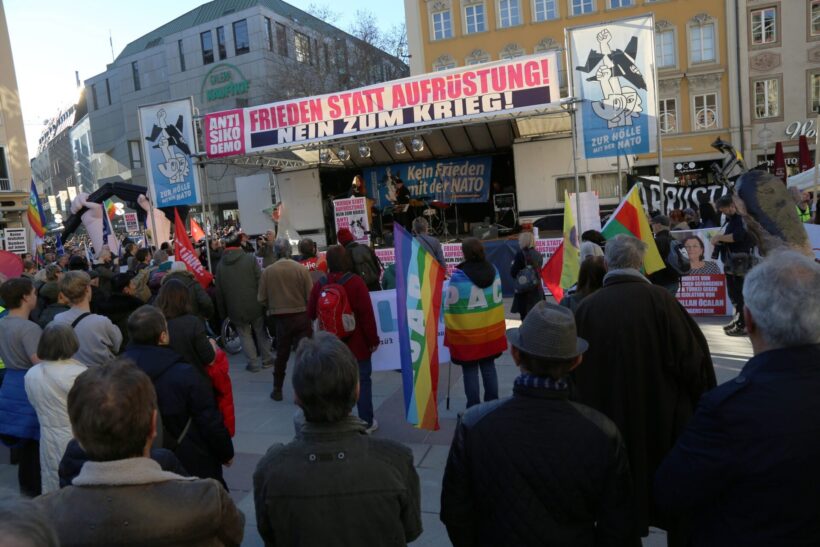
Alliance defense only makes sense if what is to be defended is not destroyed. However, the current arms race is leading to greater insecurity and increasing the risk of war in Europe.
By Rolf Bader and Klaus Moegling
Angelika Wilmen, peace officer at the medical organization IPPNW, sums it up: “One person’s security is another person’s insecurity. They feel threatened and arm themselves. The result is an arms race. Security is not created by deploying missile defense systems or medium-range weapons, but through dialogue, disarmament, and arms control.”
The defense budgets of NATO countries are set to rise well above 2% of gross domestic product in the future. The target set by NATO has now been met, but NATO experts believe it is not enough to finance the equipment. By 2035, budgets are set to rise to a whopping 5% (including the infrastructure required for military conflict).
For Germany alone, for example, this means well over 200 billion euros, every year – according to August Pradetto (2025):
“In truth, this armament follows a transatlantic stereotype and an instinctive reflex, fueled by fear, old bloc thinking, and an inability to rethink one’s own misconceptions. This rapid armament is based on worst-case threat scenarios and assumptions that are largely disconnected from reality.”
Termination of the New START Treaty
For the first time since 1972, there are now no effective restrictions on the nuclear programs of the two superpowers. The New START Treaty has also been terminated without replacement.
NATO’s so-called “nuclear sharing” in Europe includes concrete nuclear warfare options with far-reaching consequences: nuclear weapons could be used in a ‘surgical’ and limited manner. In terms of armament technology, this development is leading to the miniaturization of nuclear weapons with high accuracy, and in terms of security policy, to a downgrading of the “nuclear threshold.”
The US, Russia, and the PRC—alongside smaller nuclear powers—are in the process of “modernizing” their nuclear weapons with considerable investment, thereby making them even more dangerous.
Within a few weeks of the New START treaty’s termination, the operational nuclear arsenals of the US and Russia could be significantly expanded. According to US peace researcher Jennifer Knox (2026), a doubling would be possible in a relatively short time:
“The resulting arms race, the lack of insight into each other’s plans and arsenals, and the end of formal bilateral consultations brought about by the treaty’s verification system would further destabilize relations between the United States and Russia, increase the risk of nuclear conflict due to miscalculations or misunderstandings, and waste resources that neither country can afford to squander.
A renewed nuclear arms race between the United States and Russia could also prompt China and other nuclear powers to expand their arsenals, leading to a deterioration in global security.
This significantly increases the risk of an accidental nuclear war due to false reports or technical failure. Added to this is the danger and unpredictability of integrating AI into weapons systems (Moegling/Bläsius 2024).
US cruise missiles in Germany from 2026
At the end of this year, a drastic military policy measure is expected to be taken in Germany, with potentially fatal consequences.
In a brief “Joint Declaration” that received little media attention, the US government and the German government (Olaf Scholz) agreed on the deployment of American medium-range systems in Germany on the sidelines of the NATO summit in New York in early July 2024: In 2026, Tomahawk cruise missiles, SM-6 missiles, and new hypersonic weapons are to be stationed in Germany alone. These conventionally armed weapons have a range of over 2,000 km and can reach targets in Russia in just a few minutes while flying at low altitude, destroying Russian nuclear missiles and other nuclear infrastructure. This could prompt Russia to use its nuclear missiles before it loses them (“use them or lose them”).
The arms project was decided without a simultaneous offer of negotiations to Russia, as was the case with the NATO Double-Track Decision under Helmut Schmidt. A densely populated country such as Germany could become a target for Russian missiles (Erhart 2024). Russia has already made threats to this effect. During a naval parade in St. Petersburg, Putin made clear threats in view of the planned missile deployment, according to ntv:
“Putin emphasized at the parade that the missiles, which could also be equipped with nuclear warheads in the future, would put important targets in Russia within range. Government and military facilities and important industrial plants could be hit within ten minutes. Russia would respond ”in kind.“ Russian warships could also be equipped with missiles in response.”
However, it should not be overlooked that Russia has also stationed hypersonic missiles, such as the nuclear-capable Iskander missiles, in Kaliningrad, approximately 500 kilometers from Berlin. Russian hypersonic missiles, such as its “wonder weapon” Oreschnik, have already been used in the war in Ukraine. This clearly shows how important an offer of joint disarmament would have been in the context of the planned missile deployment.
The German peace movement is now using the US missile deployment at the end of 2026 as a central occasion for rallies and appeals (see, for example, the peace appeal regarding the planned deployment https://www.change.org/p/gegen-die-atomare-bedrohung).
Conclusion
The vulnerability of modern industrialized nations results from a synergy of vulnerability and the destructive effect of weapons. The military defense of modern industrialized nations is caught in an insurmountable contradiction, because they are structurally indefensible. Germany’s power supply alone cannot be protected against cyberattacks or attacks. The consequences would be social chaos and loss of control. Therefore, states and their societies can only survive and function in conditions of peace. The dilemma of structural indefensibility is a fact and requires instruments that prevent war under all circumstances. Instruments that contribute to the de-escalation of conflicts through crisis prevention and diplomacy.
The task of the Munich Security Conference would be to focus on arms control as a matter of urgency after the end of the New START Treaty. The goal must be to restore a security order based on diplomacy and international cooperation. Restoring, protecting, and preserving the international arms control architecture is currently the most urgent task. In September 2026, the member states of the United Nations will meet in New York for the Nuclear Non-Proliferation Treaty Review Conference. After the end of the New START Treaty, it will be important for the international community to at least reaffirm the treaty’s goals and obligations. A one-year extension, as proposed by the Russian government, would also be important in order to negotiate a new START treaty, for which attempts would have to be made to win over the People’s Republic of China. The INF Treaty, which expired in August 2019 and prohibited all land-based conventional and nuclear missiles with a range of between 500 and 1,500 kilometers, would also have to be renegotiated and reinstated.
Given the current geopolitical situation, the Security Conference should advocate for strengthening the United Nations and upholding the UN Charter, international law, and human rights.
Rolf Bader, certified educator, former officer in the German Armed Forces, member and former managing director of the German section of International Physicians for the Prevention of Nuclear War/Physicians in Social Responsibility (IPPNW).
Klaus Moegling, retired political scientist, taught at various universities and teacher training institutions, most recently at the University of Kassel as a professor in the Department of Social Sciences. He was involved in the peace and environmental movements as well as in educational initiatives. Website



