

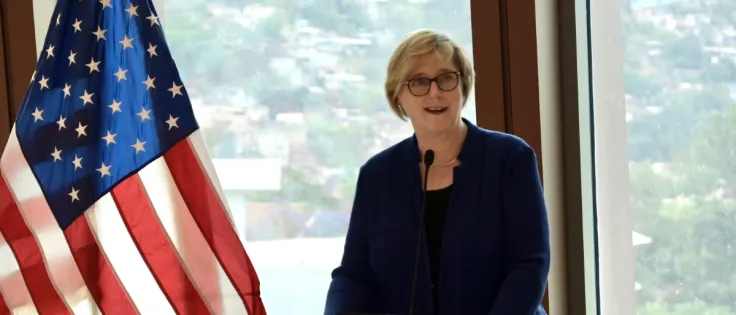
Laura Dogu, newly appointed US envoy to Venezuela, is described by the Los Angeles Times as an appropriate choice because she “navigated crises” in Nicaragua and Honduras during periods of “social and political volatility.” What the LA Times fails to add is that it was precisely Dogu’s job to create crisis and volatility in both countries.
By Roger D. Harris and John Perry
In Latin America she is widely regarded, for good reason, as the “US ambassador of interventions and coups.”
The LA Times appears entirely relaxed about a US diplomat’s job being to meddle in the internal politics of a country whose president the US has just kidnapped in an operation resulting in the murder over 100 people and involving the bombing of key public buildings and health facilities.
Dogu enters the fray “leveraging her experience with authoritarian regimes” and her “deep Latin American expertise.” The LA Times implies that her job is likely to be proactive, looking for ways to ease out the Chavista government and replace it with one more to Washington’s liking, even if that takes a while.
Nicaragua
Signaling that this is the case, the LA Times reporter asked right-wing opposition figures from Nicaragua for their opinions of Dogu, presumably on the basis that she is charged with working with similar quislings in her new role. Predictably, they praised her, admitting to having had clandestine meetings with her when she was based in the country and noting her public support for opposition groups.
Dogu was US ambassador in Managua from 2015 until October 2018, a period coinciding with the preparations and then the coup attempt that began in April 2018 and was defeated in July. At the start of her term, she had relatively cordial relations with the government. That changed after President Daniel Ortega was reelected in 2016 with an increased popular mandate. It became clear to Washington that electoral means to oust the Sandinistas lacked sufficient public support.
Instead, as the State Department admitted, the US concentrated their efforts on “civil society” groups led by opposition figures, “limiting their contact” with the elected government. It later emerged that, in the run-up to the April 2018 insurrection, millions of dollars were spent promoting such groups.
When the coup attempt fizzled, President Ortega explicitly identified Laura Dogu, as Washington’s representative, of being “the leader and financier of this conspiracy, the destruction, the fires, the torture, the disrespect for human dignity, the desecration of corpses, and other acts carried out with cruelty against all Nicaraguans marked by the great sin of being Sandinistas.” Within three months, Washington replaced her.
Honduras
In Honduras, Xiomara Castro of the progressive Libre Party became president in January 2022. Laura Dogu arrived in Tegucigalpa as US ambassador just three months later.
The Center for Political and Economic Research (CEPR) catalogued some of her egregious interferences including with energy and tax reforms, creation of a Constitutional Tribunal, replacement of the attorney general, and the building of a prison.
By 2023, Dogu was already drawing criticism from the Honduran foreign minister, who asked her to “stop commenting on internal Honduran matters.” He criticized her again for similar reasons, in December 2024, after she held a series of meetings with NGOs critical of the government.
In August 2024, President Castro complained about Dogu, after the US diplomat criticized Honduran officials for meeting with their counterparts in Caracas. The ambassador characterized this meeting as “sitting next to a drug trafficker.”
Then after a conflict with Dogu over Honduras’s extradition treaty with the US in September 2024 and a spate of rumors about the president’s family, Castro warned that a coup attempt was underway. Dogu concluded her term in Honduras before the presidential elections at the end of 2025, where the US did decisively interfere.
Venezuela
The LA Times ingenuously commented that Dogu was “an unusual pick signaling a strategic shift in US policy.” It was neither. US policy remains regime change, but the tactics have shifted in response to the successful and unified resistance of the Bolivarian Revolution.
Venezuelan analyst Francisco Rodriguez noted: “Laura Dogu presented credentials as diplomatic representative of the US to the government of [acting President] Delcy Rodríguez today, that would count as an act of formal recognition.”
As for Dogu being “an unusual pick,” her record, as shown above, suggests a continuation of business as usual. CEPR put it bluntly: “Dogu’s appointment suggests that the administration sought someone with experience in aggressively interfering in a host country’s domestic affairs.”
There is nothing unusual about that. Between 1898 and 1994, the US perpetrated coups and government changes in Latin America at least 41 times. Dogu now presides over just another such attempt. The only reasons Washington itself hasn’t suffered a coup, Latin Americans quip, is because there is no US embassy there.
Far from breaking with the past, Dogu actually invokes it: “We never left the Cold War in Latin America,” she said.
Dogu recently tweeted: “Today I met with Delcy Rodríguez and Jorge Rodríguez to reiterate the three phases that @SecRubio has outlined regarding Venezuela: stabilization, economic recovery and reconciliation, and transition.”
The comment drew an immediate repudiation from the aforementioned Jorge Rodríguez, president of Venezuela’s National Assembly. The failure by Dogu to refer to him and acting President Delcy Rodríguez by their formal titles is a disrespectful snub. He characterized her remarks as “diplomatic blackmail” and a “colonial roadmap.” The Venezuelan leadership may have a gun held to their heads, but they continue to respond militantly.
For now, Dogu is concentrating on the “stabilization and economic recovery” phases of the Rubio dictate. The more contentious third phase will be “transition.”
In a telling pivot from its previous myth-making that the “opposition [is] more unified than ever,” the LA Times now admits that Dogu is just the right official to be foisted on Venezuela because of her experience navigating “fragmented opposition movements.” The opposition to the Chavista government has long been fractious despite hundreds of millions of dollars pumped into “democracy promotion” by the US.
Contrary to the myths in the corporate press, María Corina Machado and her hand-picked surrogate Edmundo González Urrutia may not be the people’s choice in Venezuela. No lesser authority than Donald Trump himself commented that Machado “doesn’t have the support within or the respect within the country.”
If the claims that the opposition won the July 2024 presidential by a 70% landslide were credible, why didn’t González present his evidence when summoned by Venezuela’s supreme court? Failing to do so left no constitutional basis for him to be declared the winner.
But that was the whole point of the Washington’s interference in backing an astroturf opposition with more traction inside the Beltway than in Caracas. The US objective was not to win the contest but to delegitimize Venezuelan President Nicolás Maduro. The deadly sanctions – illegal unilateral coercive measures – were explicitly designed as collective punishment to erode Maduro’s authority with his compatriots.
And when that failed and the Bolivarian Revolution prevailed, Washington escalated further, culminating in the January 3 kidnapping of a constitutional head of state. That military action formed part of its hybrid war, accompanied by sustained demonization of Maduro before the US public.
Conclusion
Laura Dogu’s appointment ultimately signals not innovation but continuity: a recalibration of tactics in pursuit of the same objective that has defined US policy toward the Bolivarian Revolution for decades – regime change through pressure, attrition, and delegitimization. Whether branded as “stabilization,” “economic recovery,” or “transition,” the underlying premise remains that Venezuela’s political future should be shaped in Washington, not Caracas.
Yet the record in Nicaragua, Honduras, and Venezuela itself suggests that external coercion has limits. Dogu’s mission will test not only Venezuela’s resilience but also the durability of the unremitting US strategy of Latin American interventions.
Roger D. Harris is with the Task Force on the Americas and the Venezuela Solidarity Network. Nicaragua-based journalist John Perry writes for the London Review of Books, FAIR, and CovertAction. Both authors are active with the Nicaragua Solidarity Coalition.



