

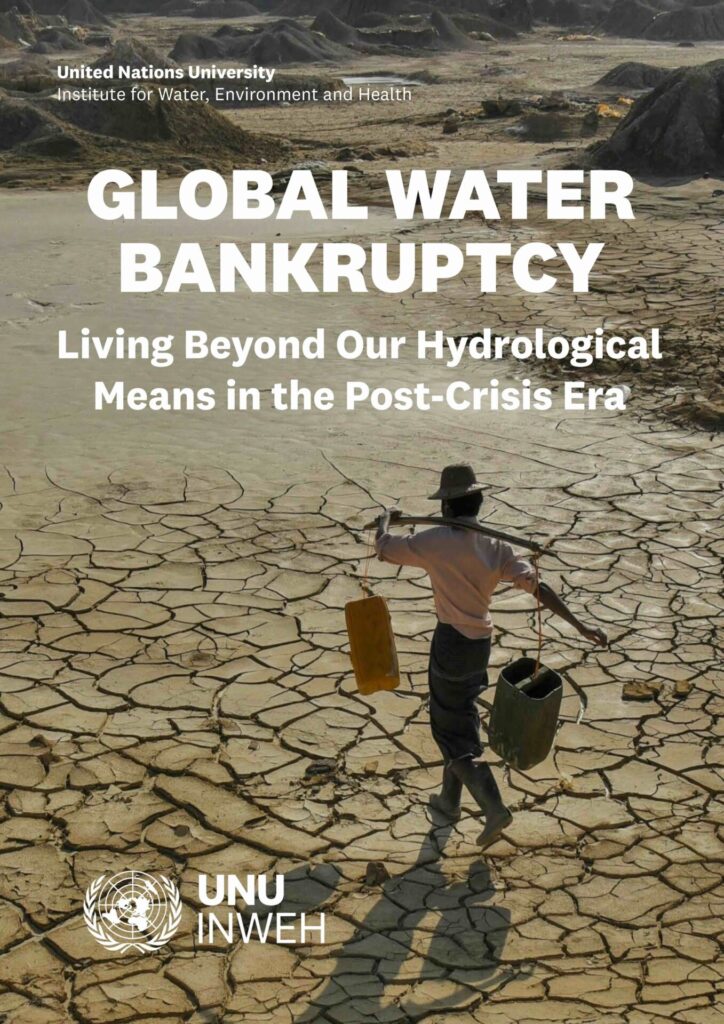
Regarding the new report by the United Nations University (20 January 2026), Global Water Bankruptcy: Living Beyond Our Hydrological Means in the Post-Crisis Era. Questions.
1. A report for a new global water agenda?
The report (72 pages), published by the United Nations University, states several times:
“Terms such as ‘water stress’ and ‘water crisis’ are no longer sufficient to describe the new global realities regarding water. Many rivers, lakes, aquifers, wetlands and glaciers have passed the point of no return and can no longer return to their initial state. The term ‘temporary crisis’ is no longer appropriate in many regions.”
“The global water cycle has exceeded planetary safety limits. Just like the climate, biodiversity and terrestrial systems, freshwater has been pushed out of its safe operating space.”
The UNU report draws on the analyses of the international research group at Stockholm University led by Johan Rockström on the nine planetary boundaries that must not be exceeded, one of which specifically concerns water (1), as well as on the message of the book Bankrupting Nature, published in 2012 by Earthscan. Seven boundaries, including that relating to water, have indeed been exceeded.
The United Nations University report concludes that “the world is living beyond its water means…” and that “we need to move from a strategy of managing water crises to one of managing the failure of the human and natural water system”.
This idea is well documented by an impressive amount of data, accompanied by eye-catching figures and graphs, spanning over thirty pages.
2. The “new normals” and the prioritises of the new global water agenda
The report argues that managing water failure requires populations and their leaders to accept the new realities of life, called “the new normals”, such as the irreversibility of the quantitative and qualitative reduction of natural water capital and other natural assets essential for life.
This gives rise to the “national” and international priorities proposed as guidelines and validation of the new global water agenda for managing water failure, namely:
According to the report, realistic and binding recognition of global water failure can promote more effective implementation of internationally agreed goals (in particular Sustainable Development Goal (SDG) 6) as part of an adaptation strategy that goes beyond sectoral mitigation strategies.
Under these conditions, water can become “a bridge to peace, climate action, biodiversity protection and food security in an increasingly fragmented world”.
I believe readers will find it interesting to read the report in order to fully understand, among other things, the reasons for my disappointment, which has led me to temper my initial enthusiasm somewhat. The fact is that this observation of global water failure is no longer valid due to the great silence surrounding it regarding the analysis of causes, implications and consequences, as well as responsibilities and those responsible.
This silence no longer allows it to be considered correct. On the contrary, it is a source of invalidation and loss of credibility for the analyses and priorities of the new global water agenda proposed to the UN.
3. The great silence
The great silence concerns many fundamental aspects necessary for understanding the nature of water failure and its position within the global failure of the governance of life on Earth. The silence on responsibilities and those responsible leaves failure without mothers, without fathers, without accomplices—thus in a state of general impunity.
Yet, over the last 70 years, we have witnessed major upheavals in economic, social, political and technoscientific systems that “have changed the world”, particularly in terms of water and life policies, leading to the fragmented, violent and deeply unequal world of 2025.
Our goal is not to put anyone on trial or find culprits. Rather, it is to try to “see” the critical changes in the world, the key challenges, and the appropriate solutions in the general interest of all the inhabitants of the Earth.
Silence 1. On the inequality of water failure
The report does not state that water failure is unequal (and unfair). Due to its economic, political and technocratic power, part of the world’s population suffers only marginally from water scarcity and loss, as well as from shortages of other essentials for life such as soil, forests, biodiversity and air. Furthermore, as it is composed of the main owners, producers, consumers and polluters of the planet’s natural resources, this part has been able to use various means to shift the main negative effects onto the most vulnerable and weakened social groups and countries.
This is well documented by the water footprint and ecological footprint, which respectively measure the amount of water and annual renewable biotic capital consumed by the populations of each country, region and city to meet their needs and manage their waste (2). In this regard, a particularly illuminating index of inequality is “Overshoot Day”, that is, the day of the year when a country’s population has “consumed” all the natural resources available in a year and begins to use the planet’s resource stock (3).
Silence 2. On the question of ownership and appropriation
Inequality is not due to natural factors but to economic, institutional and political factors related to ownership regimes and resource management (public, private, or mixed). It has been observed that the more ownership and management obey a private logic of financial return and market conquest, the more significant and decisive the phenomena of predation (and devastation) of natural biotic capital—water, soil, seeds, forests, etc.—become. This is the case with land and water grabbing (4).
By predation, I mean “all acts that result in the theft and violent devastation of life (material and immaterial) within the global community of life on Earth, including all living species” (5).
Thus, for example, predation occurs in cases of:
- The premature death of tens of millions of people who do not benefit from any basic health coverage (more than 4.5 billion people in 2024);
- The destruction of life in vast territories due to drying up resulting from massive deforestation, increasing scarcity of drinking water and loss of biodiversity.
- The hoarding of drinking water at the expense of local populations’ needs (health and local economic activities) following the construction of vast infrastructure complexes to house data centers necessary for the digitalization and reindustrialization of the global economy through artificial intelligence. The amount of water used to cool the electricity consumed is so high that, in a short time, data centers have drained local aquifers (6). The result is that, everywhere, local communities are opposing the siting of data centers on their territory.
- The chemical pollution of waterways, lakes, aquifers and oceans.
Predation is also present in authoritarian state-owned regimes, but it is largely absent in welfare states with parliamentary democracy and decentralized local government, as was once the case in Scandinavian countries and is now the case in systems with cooperative and community economies (in Latin America, India, among others).
It is therefore surprising that the report does not refer to issues of ownership and regulation, even though its authors are well aware that for some forty years the worlds of business, finance and technoscience have imposed a major structural shift in favour of market liberalization and deregulation, privatization and speculative financialization of almost all public natural commons, which the report prefers to call “natural capital”.
Silence 3. On the reduction of water and the natural world to “natural capital” and thus to “financial assets”
Following the creation in 2000 of the first private investment fund specialising in water by the Swiss private bank Pictet, which quickly spawned others worldwide, water has increasingly become a favoured sector for high-yield equity investment. So much so that so-called “blue” investment funds remain among those with above-average returns worldwide in 2025 (7).
According to market-economy principles, the scarcer natural water capital becomes, the more its value as a financial asset increases—even if water scarcity causes enormous problems for the sustainability of life on Earth. Money continues to flow where value is created: the financialization of water and nature has progressed rapidly over the last 20 years (8), culminating in December 2022 with the proclamation of all elements of the natural world as “financial assets” at the UN COP15 on Biodiversity in Montreal (9).
The concept of “natural capital”, adopted by the report without explanation or comment, is not insignificant. It reflects the desire of dominant social groups to treat elements of the natural world not only as commodities and private economic assets but increasingly as financial assets—a specific category of the capitalist market economy.
The reduction of Nature to financial assets constitutes a veritable theft of Nature and a dogmatic mystification of the value of life. COP15-Biodiversity approved a proposal to entrust the management of 30% of the planet’s natural capital—30% of which is among the most degraded—to Natural Capital Corporations (NCCs) to achieve the 2030 Sustainable Development Goals (10).
Joe Biden, then President of the United States, declared himself in favour of the project by entrusting 30% of his country’s natural world to it. The President of the European Commission likewise congratulated COP15 in an official statement published the following day.
One wonders what game these actors are playing, knowing that only a few months later, at the 2023 United Nations Water Conference, the UN itself confirmed that none of the Sustainable Development Goals would be achieved by 2030.
Conclusion and proposal for nine objectives for a global water policy
Neither the human right to water for life, nor the elimination of poverty, nor the safeguarding of global public goods essential to life are priority objectives of water and life policy in the dominant system. Adaptation is presented as the sole realistic strategy, while systemic change is dismissed as “utopian”. This is a profound error. There is no future imprisoned in a single path.
The new planetary water policy
- Restore the foundations of life on Earth, starting with zero greenhouse gas emissions.
- End the chemical poisoning of water, soil and air.
- Abolish patents on living organisms and AI for private and profit-making purposes; knowledge must once again become a global public good.
- Adopt a Global Charter of Global Public Goods.
- Create a new global financial architecture: the Planetary Common Fund.
- Establish a Planetary Water Parliament.
- Stop the suffocation of rivers, lakes and wetlands by large dams.
- Stop the “petrolisation” of water and the “Coca-Cola-isation” of mineral water.
- Declare poverty and exclusion illegal.