

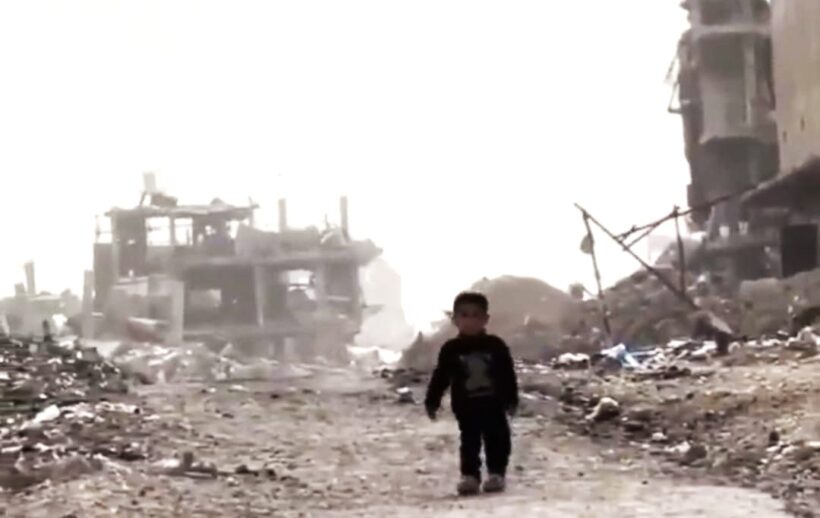
An Israeli air strike on southern Gaza during the night of 5–6 February left at least 24 Palestinians dead. Among them was a Palestinian Red Crescent paramedic, killed while evacuating the wounded. The massacre once again places at the centre an essential warning: normalising these crimes is a form of complicity.
During the night of 5–6 February 2026, Israeli aircraft bombed areas in the south of the Gaza Strip, mainly around Khan Younis. According to official Palestinian sources, the attacks struck residential sectors and areas where displaced people were sheltering, killing at least 24 Palestinians, most of them civilians.
The Gaza Ministry of Health confirmed that the fatalities included men, women and children, as well as emergency personnel who had gone to assist the wounded after the initial strikes. Palestinian authorities denounced that the bombings occurred in a context of a formally declared ceasefire and described the attack as a serious violation of international humanitarian law.
Among the dead was Hussein Hassan Hussein Al Samiri, a paramedic with the Palestinian Red Crescent Society. Al Samiri was hit while transporting wounded civilians to a field hospital. He was wearing his medical uniform, travelling in a clearly marked emergency vehicle, and performing humanitarian duties protected under the Geneva Conventions. He died doing what he had been trained to do: saving lives amid chaos.
The Palestinian Red Crescent Society officially confirmed his death and stated that the strike occurred while medical teams were responding to multiple emergency calls. The organisation stressed that its workers operate under extreme conditions and reiterated that medical personnel cannot be turned into military targets without such acts constituting war crimes.
Alongside Al Samiri, 23 other people were killed. They were not combatants on a battlefield. They were families, displaced civilians, people trapped in a strip subjected to recurrent bombardment. Their names, as so often happens, risk being dissolved into statistics unless they are remembered for what they were: concrete human lives, extinguished in a single night.
From Gaza, health authorities reported that hospitals and emergency posts received the bodies and numerous wounded under conditions of extreme precariousness, with limited resources and under the constant fear of further attacks. The death of civilians and medical personnel in the same operation reinforces, according to Palestinian officials, the accusation of a disproportionate use of force in densely populated areas.
Humanitarian organisations have warned that the repetition of such attacks is eroding one of the last ethical limits of war: the protection of those who do not fight and of those dedicated to alleviating suffering. When a paramedic dies alongside the people he was trying to rescue, the message is devastating: no one is safe, not even those who embody humanitarian neutrality.
The story of Hussein Hassan Hussein Al Samiri cannot be separated from that of the other 23 victims of that night. Together they form a stark portrait of life in Gaza, where death has become so frequent that it threatens to lose its capacity to shock. That is, perhaps, the greatest danger.
We must never become accustomed to this. Not to the death of civilians. Not to the killing of medical personnel. Not to twenty-four lives extinguished in one night becoming just another item in the news flow. Naming them, counting them and demanding accountability is not a rhetorical gesture: it is a moral obligation in the face of crimes that, if normalised, ultimately empty the very idea of humanity of its meaning.



