

While media attention focuses on international conflicts and geopolitical realignments, the most profound crisis facing the United States today is internal. It is not only economic or political, but existential: the unraveling of a system built on material expansion that no longer provides orientation, coherence, or meaning to those living within it.
The United States is no stranger to crisis—economic, political, or violent—but the current rupture is of a different nature and scale. News coverage emphasizes international tensions involving the U.S.—from Iran, Venezuela, and Greenland to Russia, Ukraine, and the United Nations—often framed as signs of the end of the international order. What is far less examined is the internal collapse unfolding beneath these events, one that may prove even more consequential.
To understand the depth of this shift, it is enough to look back a few years. Before COVID, major technology corporations—Google, Facebook, Twitter—symbolized a new social model: free meals, luxurious campuses, time allocated for personal projects, childcare, gyms, and benefits that suggested a reconciliation between work and life. Today, many of these same employees have been laid off or are treated like second-class citizens at work. Most of these corporations now openly align themselves with those in power and with authoritarian tendencies. Something fundamental has changed.
Journalists were rarely targeted directly by the federal government, apart from a few emblematic cases. That restraint has weakened. Police forces have been militarized for years, and military troops are now visible in subway stations, in schools, and patrolling neighborhoods. The line separating civilian life from military presence is eroding.
The justice system once functioned with a degree of independence from political power. That independence is now in question. Social organizations—long supported by local, state, and federal funding—provided essential services: food assistance, counseling, after-school programs, training, housing support, and community care. This social infrastructure is steadily collapsing.
In recent years, prestigious universities and their students have been directly targeted by the federal government: funding has been blocked, campuses pressured, and institutions dragged into courts. At the same time, efforts are underway to centralize and nationalize what was historically a decentralized, state-controlled electoral system. Abortion rights are under attack, clinics are closing, and LGBTQ+ and trans rights are being rolled back.
Washington, D.C. itself has been dismantled piece by piece. The Department of Education is on the verge of closure. Environmental protections, water safety regulations, and product controls are being eliminated. This is not a cyclical downturn or a market correction—it is a structural rupture. It resembles termites attacking the beams of a house: the damage is gradual, often invisible, and discovered only when collapse is already underway.
The materialist cycle that defined the industrial and post-industrial eras is exhausted. Corporations treat employees as disposable. The social and political fabric has become fragile, producing chronic insecurity. Every day brings new anxieties about social security, pensions, and retirement. People are disoriented—caught between what they were promised and what they now experience.
The system in which many once felt secure is broken. Even the engine of competition is stalling; few genuinely believe in competing with China on purely economic or technological terms. Young people see no clear path forward—only meaningless jobs, entertainment as anesthesia, and drugs as escape. Relationships suffer: more divorces, more isolation, more adults living alone or returning to their parents’ homes.
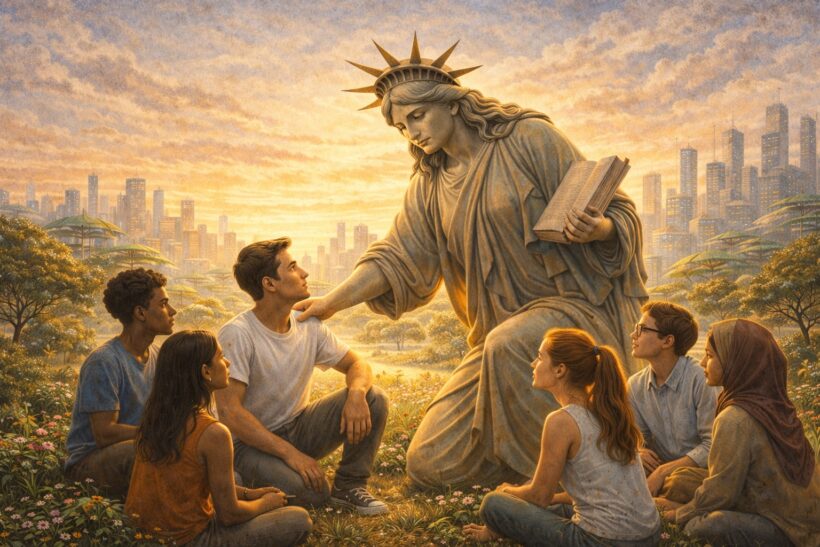
What we are witnessing now is an existential crisis, unprecedented in U.S. history. The question is not how to restore the old system, but how to change direction.
The shift required is deceptively simple: to place greater value on our own existence and intentionality, and to reduce our dependence on external markers such as money, prestige, and material accumulation. This is not a rejection of material needs, but a movement beyond their dominance—a form of post-material humanism, in which human development, meaning, and internal coherence become the true measures of progress.
We already know that the number of cars one owns does not define happiness, coherence, or fulfillment. Peace, strength, and joy do not come from what we possess, but from the direction we give to our lives.
Let this be the ground for the next revolution—not an external revolution of flags, boycotts, and spectacles, but a different kind of transformation: an internal one. A revolution that begins when individuals choose a different road, invest in their inner qualities, and orient their lives toward meaning rather than accumulation.
We are in a position to voice this new direction, to share it, and to build a different future together. The influence of the United States has reshaped the world before. It can do so again—but only if it first rediscovers the meaning of its own existence.



