

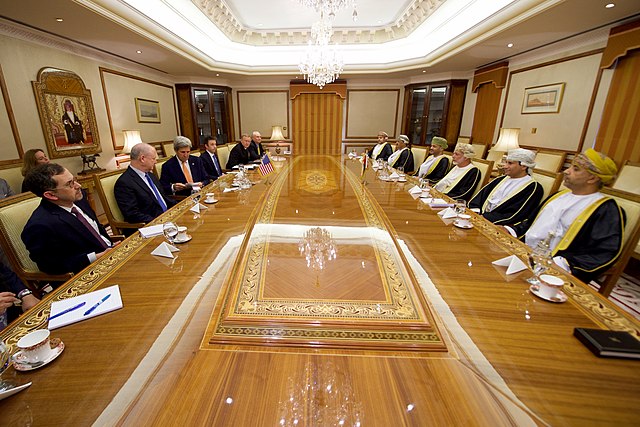
The talks that the United States and Iran will begin this Friday in Oman are not negotiations in the full sense of the term, but an exercise in containment. They are fragile, exploratory and politically unstable. That is precisely their greatest risk: they are not designed to resolve the conflict, but to prevent it from spiraling out of control, in a regional context where the margin for error has narrowed to a minimum.
The mere fact that the meeting is taking place in Muscat, under Omani mediation and away from formal multilateral forums, reveals the precariousness of the moment. There is no agreed framework, no consensus on the agenda, and no clear roadmap. Iran arrives insisting that the dialogue be strictly limited to its nuclear program and sanctions relief; the United States, by contrast, views the meeting as a gateway to a broader strategic discussion. This asymmetry is not a technical detail: it is a structural flaw from the outset.
The fragility is also explained by the immediate context. Following the regional military escalation of 2025, the increase in Iran’s uranium enrichment levels, and explicit threats of military action, the parties are not negotiating from a position of trust but from fear of direct confrontation. There is no political capital for deep concessions, nor a real willingness to absorb domestic costs. What exists instead is a shared awareness that a total collapse of dialogue could push the region toward a point of no return.
The exploratory nature of these talks, far from being a virtue, exposes their weakness. Without verifiable commitments, without clear incentives, and with sanctions firmly in place, the process risks becoming a rhetorical exercise aimed at buying time. Each round without substantive progress erodes the credibility of the diplomatic channel and strengthens those who argue that military deterrence is the only viable option.
Oman is not the stage for a historic agreement, but the last remaining space to prevent a broader escalation. The danger lies not only in the possibility that the talks fail, but in the extreme fragility that allows any external incident, regional provocation, or internal political calculation to make them implode. In that sense, the risk is not the slowness of dialogue, but its volatility. In an increasingly strained international system, talking without solid foundations can be almost as dangerous as not talking at all.