

China has not waited for robotaxis to massively displace drivers before asking what to do with them. The expansion of autonomous driving in cities such as Wuhan, Shenzhen, or Beijing is not presented as an isolated experiment, but as an industrial policy backed by the state. In that framework, the labor question does not appear as collateral damage, but as a variable to be managed within economic planning.
The transition of taxi drivers is not contained in a single specific decree. It unfolds through an architecture of measures that combine industrial policy, active labor policy, and adjustments to the social protection system. What is decisive is that the automation of the steering wheel is not conceived solely as substitution, but as occupational reconfiguration.
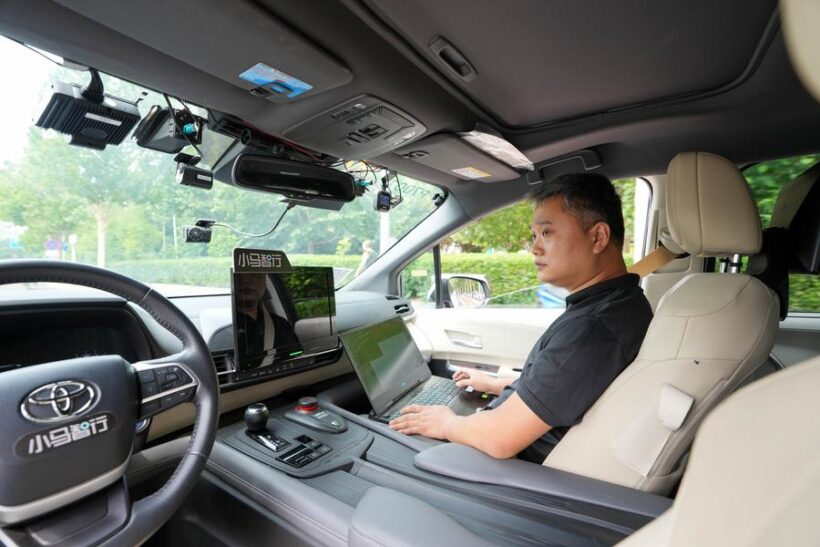
At the most immediate level, robotaxi companies themselves are generating jobs in the operational perimeter of the technology. The vehicles no longer require a driver, but the system still requires human supervision. Positions have emerged such as ground safety supervisors, responsible for moving within authorized operating zones to intervene in incidents, coordinate with local authorities, or verify anomalous behavior. Tester roles have also been created, tasked with conducting controlled routes, documenting failures, and validating software performance under real-world conditions. Other positions are linked to remote monitoring and fleet coordination.
A relevant point is that, according to information disseminated by Chinese official media, many of these vacancies prioritize former taxi drivers, bus drivers, or ride-hailing platform workers. The accumulated experience in urban traffic, passenger interaction, and territorial knowledge is not considered obsolete, but transferable. Automation displaces the steering wheel, but it does not eliminate the need for human operational judgment.
However, the volume of these new positions is unlikely on its own to absorb all potentially affected drivers. For this reason, the transition is embedded within a broader program: the National Vocational Training Initiative 2025–2027. This policy provides large-scale subsidized training, with quantified annual targets and explicit alignment with strategic sectors. The goal is not only to update skills, but to redirect the labor force toward areas where the state identifies structural deficits.
Within this framework, drivers may be relocated to logistics, fleet coordination, charging station operations, or basic technical support—areas where experience in circulation and route management is relevant. Channels also open toward expanding formal service sectors. For example, the plan to strengthen the domestic and care services sector contemplates 1.5 million annual training participations between 2025 and 2027, indicating that labor absorption is conceived in terms of sectoral redistribution rather than exclusively technological redeployment.
The macro dimension of the response is formalized through the announcement by the Ministry of Human Resources and Social Security that in 2026 it will publish a specific document addressing the impact of artificial intelligence on employment. This institutional step explicitly recognizes the substitution effect associated with technologies such as autonomous driving. The labor transition is not left to corporate dynamics alone; it is incorporated into the central agenda of social stability.
In parallel, measures have been advanced to expand social security coverage for flexible workers, a category that includes a significant portion of platform drivers. Automation does not only transform occupations; it also places pressure on social protection schemes. Extending coverage mechanisms during periods of retraining reduces the risk of abrupt income loss and mitigates the political cost of technological adjustment.
There is therefore no program titled “taxi driver reconversion.” What exists is a staged design. First, partial absorption within the robotaxi ecosystem. Second, retraining financed under a national 2025–2027 policy oriented toward strategic sectors. Third, institutionalization of the issue through a specific regulatory framework on AI and employment. Fourth, gradual expansion of safety nets for workers in the platform economy.
The model does not eliminate structural risk. In the long term, it is likely that the number of jobs generated within the autonomous driving value chain will be lower than the labor mass displaced. Yet the Chinese strategy seeks to distribute the impact over time, cushion it through sectoral reallocation, and prevent automation from translating into abrupt social instability.
The transition from taxi driver to “intelligent mobility worker” is not presented as an individual leap, but as a planned movement within an economy that conceives technological innovation and labor cohesion as variables that must evolve in parallel. In that balance—between industrial momentum and employment management—this process will shed light on the organic capacity to manage unstoppable technological developments and the corresponding structural transformations in the market, such as autonomous driving in China.



