

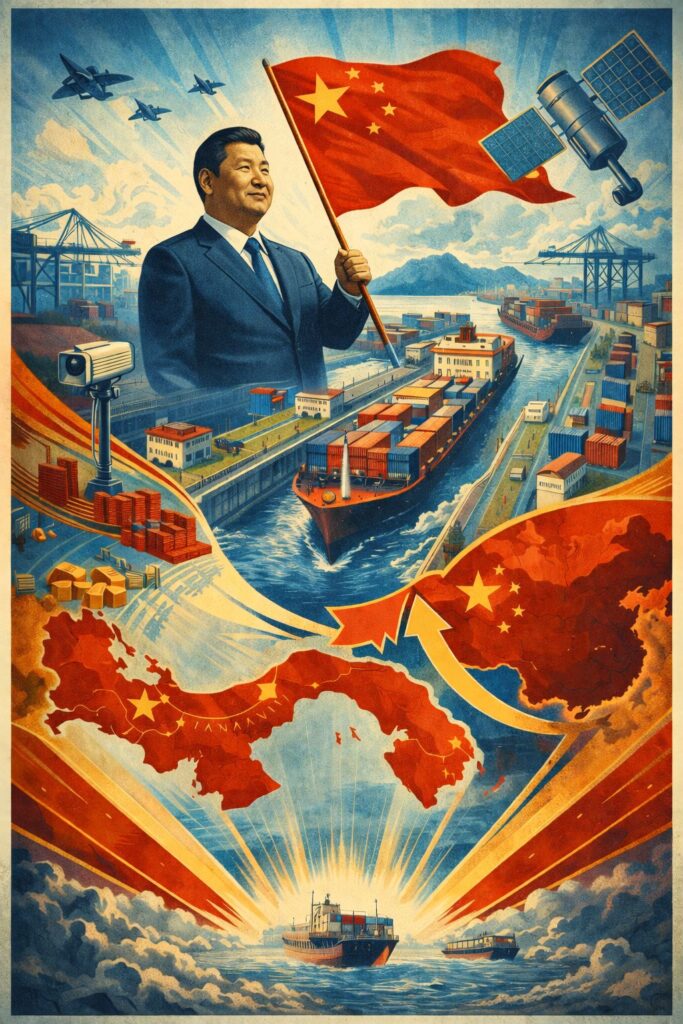
China’s reaction to the judicial annulment of the port concession contract held by CK Hutchison in Panama must be read through a lens different from that dominating Western headlines. From Beijing’s perspective, this is neither an impulsive threat nor an imperial warning, but a carefully calibrated political signal in defense of principles China considers fundamental: the stability of international trade, legal certainty for investments, and the depoliticization of strategic infrastructure.
From the Chinese point of view, the decision by a Panamanian court to annul a valid contract affecting the operation of key ports at the entrances to the Panama Canal introduces systemic uncertainty into one of the most sensitive nodes of global commerce. The Canal is not merely a Panamanian asset; it is a critical artery of world trade, through which a significant share of Asia–Americas commerce flows. Any abrupt disruption to its port ecosystem has consequences that go far beyond bilateral relations.
China approaches the case from a basic premise: infrastructure contracts, particularly those linked to international supply chains, must be shielded from political fluctuations and judicial reinterpretations driven by external pressure. In this sense, Beijing’s concern extends beyond the specific situation of CK Hutchison to the precedent it sets for Chinese investments throughout Latin America and the Global South.
For China, the issue is not Panama’s sovereignty nor the state’s right to review its legal frameworks. The problem lies in the growing tendency to use domestic legal instruments as indirect tools of geopolitical alignment. In Beijing’s reading, the annulment does not occur in a vacuum, but within a regional context marked by intensified pressure from the United States to limit China’s presence in critical infrastructure across the Western Hemisphere, particularly in transport, energy and telecommunications.
From Beijing’s perspective, this dynamic represents a deliberate politicization of the economy. China has consistently argued that trade and investment should be governed by mutual benefit, predictability and non-interference. When judicial or administrative decisions create the perception that Chinese companies are treated as extensions of the Chinese state — and therefore as strategic threats — the foundation of trust is undermined.
In the case of the Panama Canal, the sensitivity is even greater. For China, which depends on stable maritime routes to sustain its external trade, the Canal is an essential passage point. Although China neither controls the Canal nor seeks to do so, it considers it legitimate for its companies to participate on equal terms in the operation of associated port services. The gradual exclusion of Chinese firms from these spaces is perceived as a form of covert strategic discrimination.
The warning about a “high price” should therefore be understood, from this perspective, as a reference to systemic consequences rather than immediate retaliation. Beijing is pointing to potential effects on the investment climate, commercial cooperation and Panama’s long-term credibility as a reliable partner. China rarely responds abruptly; instead, it emphasizes that erosion of legal certainty carries cumulative costs, particularly for small, open economies.
There is also a matter of principle. China has repeatedly argued in international forums that development in the Global South should not be conditioned on externally imposed geopolitical alignments. In its narrative, Latin America should be able to diversify its economic relations without being forced to choose between major powers. When internal decisions appear driven more by external strategic calculations than by technical assessments, Beijing interprets this as a weakening of regional strategic autonomy.
From the Chinese point of view, the real risk for Panama is not China’s reaction, but the loss of room for maneuver. Turning strategic infrastructure into arenas of great-power rivalry reduces states’ ability to negotiate according to their own interests. China has warned on multiple occasions that the geopolitical instrumentalization of ports, railways and logistics corridors ultimately harms host countries by raising costs, limiting options and increasing dependence on a single bloc.
In this context, China presents its position not as a corporate defense, but as a defense of global trade stability. Beijing maintains that global economic growth depends on clear rules and on maintaining a separation between economic competition and strategic confrontation. The erosion of that separation, it warns, leads to a more fragmented, less predictable world, increasingly prone to crises.
The dispute surrounding CK Hutchison in Panama is, from this perspective, a symptom of a broader problem: the growing difficulty of preserving spaces for economic cooperation in an international environment marked by structural rivalry. China does not question Panama’s right to govern its territory, but it does challenge the international community to reflect on the risks of transforming sovereign decisions into instruments of geopolitical containment.
For Beijing, the Panama Canal see should remain a symbol of global connectivity, not another front in great-power competition. China’s message is clear: when trade is subordinated to the logic of strategic confrontation, all actors — including host countries — ultimately bear the cost.