

by Asif Showkat Kallol (Dhaka Bureau)
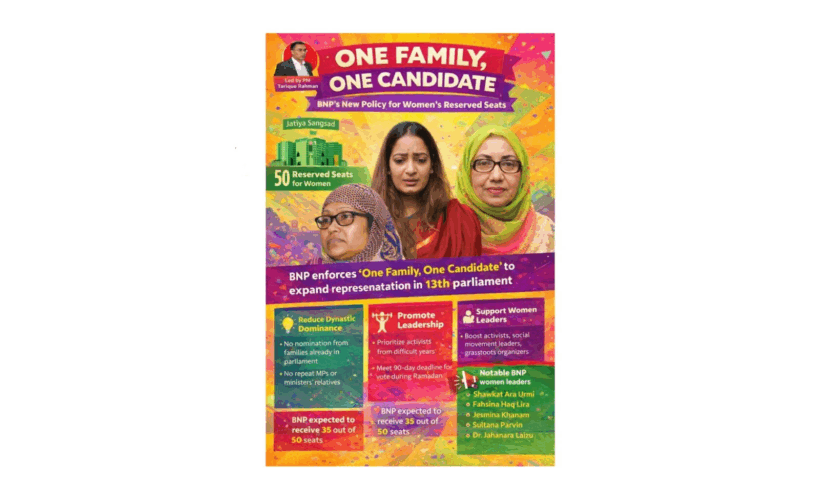
Bangladesh’s ruling Bangladesh Nationalist Party (BNP) has decided to enforce a ‘one family, one candidate’ policy in the allocation of women’s reserved seats in the country’s 13th parliament, a move party leaders say is aimed at widening representation and reducing dynastic dominance.
The decision comes weeks after the BNP’s sweeping victory in the 12 February general election and the formation of a new government led by party chair Tarique Rahman, who was sworn in as prime minister on 17 February. With the cabinet in place, attention has now turned to the distribution of the 50 constitutionally mandated reserved seats for women in the Jatiya Sangsad.
Senior BNP figures say the leadership has taken a principled decision not to nominate women from families that already have members serving as MPs or ministers. ‘This is about leadership development,’ one senior leader said. ‘If the same families occupy both general and reserved seats, the party risks shutting the door on capable activists who carried the movement during difficult years.’
Under the constitution and the Representation of the People Order, women’s reserved seats are allocated proportionally based on the number of general seats won by each party. Having secured 212 seats outright, the BNP is expected to receive 35 of the 50 reserved seats. Party sources say that figure could rise to around 37 if several victorious independents- many of whom were expelled from the BNP before the election—are readmitted.
The scale of interest has been intense. Party insiders estimate that more than 100 aspirants have already begun lobbying senior leaders, including veteran street organisers, professionals and younger activists seeking national exposure. While the new policy is likely to sideline several familiar names with close family links to influential figures, supporters argue that it opens space for long-overdue renewal.
The Election Commission has indicated that the election to the reserved seats is likely to be held during Ramadan, with the entire process completed before Eid. By law, the vote must take place within 90 days of the publication of the general election gazette, a deadline that adds urgency to internal party deliberations.
Within the BNP, the debate over reserved seats has also revived criticism of the party’s women’s wing. Some leaders privately acknowledge that it was less visible and less strategically organised during the election campaign than comparable organisations linked to rival parties. ‘Half of the electorate is female, yet we failed to mobilise women voters in a systematic way,’ said one party strategist. ‘This allocation process is a chance to correct that.’
Others argue that the reserved seats should not be treated merely as consolation prizes for those denied general seats. Instead, they say, the party should prioritise women with proven records in social movements, professional bodies and local government, thereby strengthening the BNP’s presence beyond its traditional political base.
According to a member of the party’s election management committee, the selection process will begin with a broad list of names drawn from across the country. That list will then be gradually narrowed based on political track record, grassroots acceptability, and contribution during the years of opposition. Final approval will rest with the party’s parliamentary board.
‘The message from the top leadership is clear,’ the committee member said. ‘This time, recommendations and family connections will not be enough. Those who stayed on the streets when leaders were jailed or forced underground will be prioritised.’ Several senior BNP leaders say the party will strictly enforce the ‘one family, one candidate’ policy to promote leadership development. As a result, many familiar faces may be left out. If the policy is fully implemented, several influential women leaders from the families of standing committee members and ministers will remain outside the reserved seats. However, there are plans to recognise women active in movements and struggles- including professional women such as singers Baby Naznin, Rizia Parvin, and Kanak Chapa- by considering them for positions in the upper house.
In addition, former Chhatra Dal leaders Shawkat Ara Urmi and Shahinur Sagar, former Chattogram City Corporation councillor Jesmina Khanam, Sultana Parvin- the wife of disappeared BNP leader Shahidul Alam Siraj of Fatikchhari- and Fahsina Haq Lira, a leader of the Mymensingh district women’s wing, are also being discussed. Professor Dr Jahanara Laizu, daughter of former Barishal-3 MP Mosharraf Hossain Mongu, is likewise seeking a position. She says she was active from the mass uprising of the 1990s to the anti-fascist movement and expects recognition for staying on the streets during the party’s most difficult days.
For many within the BNP, the handling of the women’s reserved seats has become an early test of the party’s promises of reform following its return to power after years in opposition. Whether the ‘one family, one candidate’ rule is applied consistently- or diluted under pressure- will signal how serious the leadership is about reshaping its parliamentary ranks.
As the countdown to the reserved seat elections begins, the outcome is being closely watched not only by aspiring candidates but also by observers who see women’s representation as a measure of how far Bangladesh’s new political era is willing to break with old habits.
##########
The Author:
 Asif Showkat Kallol: Works for a German-based online outlet, The Mirror Asia, as Head of News. Contributor, Pressenza- Dhaka Bureau.


