

by Dimitra Staikou
The 2026 national elections in Bangladesh were not merely a parliamentary realignment. They evolved into a social referendum on gender, authority, and the limits of ideological revival within a rapidly transforming Muslim-majority democracy. While the Bangladesh Nationalist Party (BNP) secured a commanding majority, the most symbolically charged development was the unprecedented rise of Jamaat-e-Islami, which captured 77 seats and roughly 31 percent of the vote—its strongest electoral performance in decades. A party long associated with the traumas of 1971 has now been politically rehabilitated. Yet despite its momentum and rhetorical confidence, Jamaat failed to convert electoral growth into executive dominance. The explanation may lie not primarily in elite bargaining or coalition arithmetic, but in the structural and electoral resistance of Bangladesh’s women.
For years, Jamaat-e-Islami lingered at the margins of parliamentary politics, rarely crossing double-digit representation. Its dramatic surge in 2026 reflects both institutional opportunity—created by political realignment after 2024—and a deliberate strategy of narrative recalibration. During the final phase of the campaign, party leaders projected certainty that they would form the government. Sympathetic commentators amplified this narrative across television studios and digital platforms, gradually normalizing a force historically associated with ideological rigidity and collaborationist shadows.
The rehabilitation, however, was political rather than historical. The memory of 1971—when elements aligned with Jamaat cooperated with Pakistani forces during the Liberation War—remains embedded in Bangladesh’s collective consciousness. Political rehabilitation without historical accountability risks converting collective trauma into electoral amnesia. The party’s rise therefore raises broader questions about democratic memory, generational turnover, and the capacity of political systems to absorb actors without resolving their past.
Central to Jamaat’s 2026 campaign was a familiar but strategically deployed message: the protection of “mothers and sisters.” The party’s Amir, Shafiqur Rahman, publicly declared his willingness to sacrifice his life to defend women’s honor. In the same breath, he argued that however successful women may become in education, they can never surpass men and must walk behind them. The language was not theological abstraction—it was electoral framing.
Scholarly literature on political Islam has long observed that gender often functions as a symbolic frontier in moments of ideological mobilization. Appeals to moral guardianship and social purity serve not only as doctrinal positions but as tools of electoral consolidation. Jamaat’s rhetoric fits squarely within this pattern: by defining women primarily as dependents requiring male protection, the party sought to mobilize conservative constituencies while presenting itself as the custodian of social order.
Even more revealing was the proposal to reduce women’s working hours to five per day, ostensibly to allow more time for domestic responsibilities and child-rearing. Presented as benevolent reform, the measure was widely interpreted as an attempt to re-domesticate women’s labor. In a country where women constitute a substantial share of the ready-made garment workforce—the backbone of Bangladesh’s export-driven economy—the proposal was not a neutral social policy. It signaled an ideological preference for containment over autonomy.
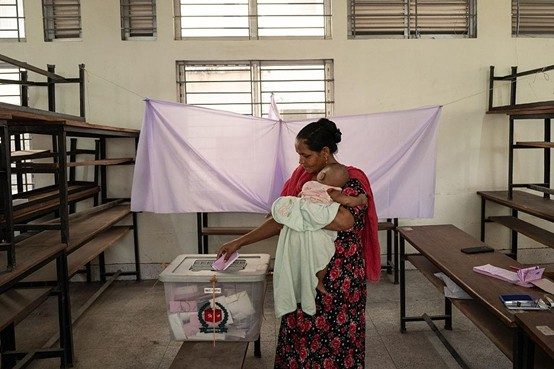
Bangladesh’s women voters did not respond as Jamaat anticipated. Reports from across the country showed women arriving at polling stations with their children, determined to exercise a right many felt had been constrained in previous electoral cycles. For some, the act of voting itself symbolized political re-entry. They were not merely casting ballots; they were asserting citizenship.
Consider the testimony of a domestic worker in Dhaka who insisted on returning to her village to vote. Her husband drives a rickshaw; her daughter works in a garment factory. Her concern was direct: if Jamaat consolidated executive authority, women like her daughter might face restrictions on working outside the home. This anxiety was not an ideological abstraction—it was economic calculation. In households dependent on female income, gender regression translates into material insecurity.
Bangladesh’s workforce is profoundly shaped by female participation. Women power the garment industry, sustain rural and urban households, and increasingly pursue higher education and professional careers. Over the past two decades, female labor force participation has risen alongside urbanization and digital connectivity. These shifts have produced not merely economic change but sociopolitical transformation. Women are no longer peripheral actors in public life; they are embedded within the country’s development trajectory.
Jamaat’s electoral strategy appears to have underestimated the degree to which socio-economic transformation has recalibrated gender expectations. Female labor participation, migration, and exposure to digital political discourse have generated a constituency less receptive to paternalistic political framing. The electorate includes a generation that has grown up witnessing female prime ministers, female justices, and women occupying visible roles in public administration. The symbolic order that once sustained unchallenged patriarchal authority has been structurally diluted.
Jamaat’s electoral success remains undeniable. Securing 31 percent of the vote represents substantial ideological resonance. Yet its inability to secure executive control signals a structural limit. Political Islam in Bangladesh may mobilize identity and moral discourse, but it cannot easily reverse decades of economic integration and social adaptation.
The party’s rhetoric collided with lived experience. Women who contribute significantly to household income, who aspire to education and mobility, are unlikely to endorse policies that confine them to domestic invisibility. Even within conservative cultural frameworks, economic interdependence has altered gender hierarchies. Ideological revival must therefore compete with material reality—and in 2026, material reality proved more resilient.
Bangladesh’s economic transformation over the past two decades has been inseparable from female labor participation. Women constitute a substantial share of the country’s ready-made garment workforce, a sector that generates the overwhelming majority of export earnings. Any political project seeking to reduce women’s visibility in the workforce risks colliding not only with evolving social expectations but with the structural logic of Bangladesh’s development model itself. Export-oriented industrialization, integration into global supply chains, and reliance on female wage labor create systemic constraints on projects of gender re-domestication. Ideological conservatism does not operate in isolation; it must contend with macroeconomic dependence on women’s public participation.
Beyond economics, gender autonomy in Bangladesh has increasingly become intertwined with questions of democratic legitimacy. Comparative research on transitional political systems demonstrates that the inclusion—or exclusion—of women from full public participation often functions as a barometer of institutional maturity. Bangladesh’s electoral history, marked by alternation, contestation, and periodic crisis, has nonetheless normalized women as central political actors. Attempts to reframe them primarily as dependents under male guardianship risk undermining this gradual institutional evolution. The 2026 election, therefore, was not merely a contest over policy preferences; it became a test of whether democratic consolidation would incorporate gender pluralism or regress toward moralized hierarchy.
The geopolitical implications remain significant. Had Jamaat translated its surge into executive authority, concerns in India would have intensified. India already navigates strategic pressure along its western frontier; an ideologically hardened Bangladesh could have introduced additional anxieties in the geopolitically sensitive northeastern corridor. Yet the 2026 outcome suggests complexity rather than linear radicalization. Bangladesh did not reject conservative politics—but neither did it surrender to ideological absolutism.
The electorate imposed boundaries. The 2026 elections were not solely about parliamentary arithmetic. They were about whether a society shaped by female labor participation, digital exposure, and generational turnover would accept a political project rooted in containment and hierarchy. Jamaat-e-Islami achieved rehabilitation, but it encountered resistance where it least expected it: among the women it claimed to defend.
Political Islam tested its mobilizational capacity. Women asserted their structural centrality. The result was not ideological defeat—but it was constraint. And in a region where ideological tides often transcend borders, the establishment of such boundaries may prove more consequential than outright victory.
About the Author:
DIMITRA STAIKOU is a Greek freelance journalist and professional writer who writes about India, Pakistan, Bangladesh, China, and the Middle East in the Greek and the International Press.



