

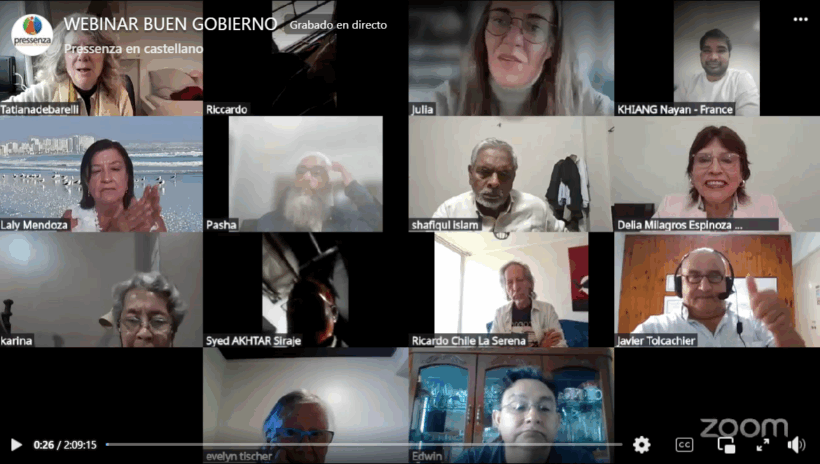
This past Sunday, January 18, the “Good Governance” webinar, organized by the international news agency Pressenza, took place, featuring various representatives from civil society across different countries. In a spirit of camaraderie, attendees analyzed the challenges the world faces in exercising our right to good governance, which guarantees the development of all peoples.
The event featured prominent figures in the fight against corruption, promoting good governance, and advocating for nonviolent journalism.
Thus, the first speaker was Dr. Delia Espinoza, a former Attorney General in Peru who was disbarred for investigating corrupt individuals. She spoke about good governance, its mechanisms, and the importance of a public policy that trains new generations of leaders.
Proposal 1: Leaders with values and citizen consensus
“I know it’s a long-term project, but if we work with children and adolescents, we have the opportunity to provide future leaders with values and leave an indelible mark on their spirit. That’s why civic education is so important. If we instill that indelible mark, the adults who grow up with those values will not tolerate corruption. Currently, we have very good laws, but they are not enough, because the issue isn’t the laws, but the people,” she stated.
Prosecutor Espinoza also highlighted the Historic Citizen Agreement (AHC), which proposes measures for the Peruvian context, such as: restoring constitutional order, reparations for victims of repression, and reforms in university, basic, and regular education for industrialization and national development.
Proposal 2: Transparent Government and Respect for Human Rights
For her part, Khiang Nayan (France), a social activist for the rights of migrants and youth, highlighted transparency, the accountability of leaders, the active participation of the population in public decisions, and respect for human rights as strategies for good governance.
Khiang Nayan emphasized that good governance includes “free access to information and clarity in decision-making; accountability of elected officials; active citizen participation in decision-making; optimal use of human and financial resources; and strict adherence to the law.”
Proposal 3: Rule of law, freedom of expression, and corruption-free administration
In a third presentation, Mohammad Mejanur Rahman Talukder Pasha (Bangladesh), a human rights activist with the Dhaka Bureau, emphasized that “good governance is not an abstract concept; it rests on pillars such as the rule of law, freedom of expression, accountability, and an administration free from corruption.”
“Good governance is not a privilege granted by those in power; it is a fundamental right of all citizens. When institutions are accountable, laws are applied fairly, and voices can be expressed freely without fear, a nation prospers. Bangladesh’s history demonstrates that development cannot be sustained without justice, transparency, and public participation. Therefore, ensuring good governance is not only a responsibility of the state but also a demand and a right of the people. Only when this right is respected can true progress and dignity be achieved,” Pasha stated.
Proposal 4: Working Together for Development
Finally, Javier Tolcachier, an Argentine researcher, writer, and humanist activist, urged a humanist approach to good governance. This “must be evaluated in light of the increased opportunities for human development that it generates for society as a whole. By human development, we mean the improvement of conditions so that human intentionality can be freely expressed. In this way, popular participation grows and gives new meaning to what is now a declining ‘democracy.’”
The design of good governance involves “placing responsibility on every person in the community, without whose participation this model would also be empty. Working together, both in external and internal conditions, allows us to liberate ourselves and move forward with our sights set on a more compassionate and non-violent human being,” he added.
The two-hour event brought together humanists and members of the public from around the world, concerned with social issues, who concluded that “Good governance is a fundamental right that we must demand from our leaders, but we as a society must also cultivate it, actively participate in it, and instill civic values in our new generations… A great task lies ahead!”.
Don’t miss these and other interesting proposals for good governance.
To attend the webinar, you can access the following links:
Facebook Pressenza Castellano: https://www.facebook.com/share/v/1CUyG16PDG/



