

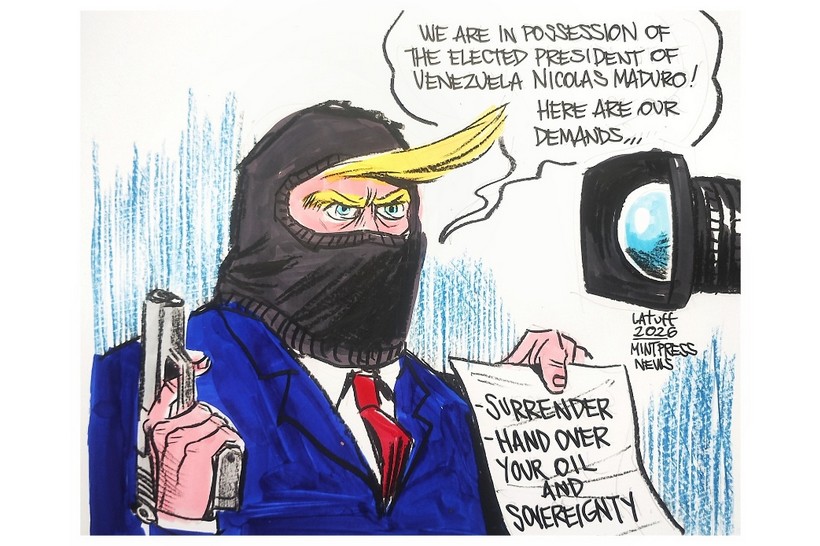
The year 2026 begins with a hangover: US imperialism reminds the world of its ugly past. A head of state is kidnapped, whisked away to the kidnapping country, put on display, subjected to a sham trial, and his country declared “run ” by the kidnapping nation (a protectorate). He is treated as a hostage in the hands of his captors. The image of the Roman Empire displaying captured enemies comes to mind. Jugurtha was Maduro’s predecessor. Toussaint Louverture and Abdelkader experienced captivity and French prisons. Their fate bodes ill for Maduro.
That the United States attacks, overthrows governments, occupies, or seizes raw materials abroad is nothing new; it has been common practice for decades. Imperialism breeds these vices like a stagnant swamp releases nauseating miasmas. Nevertheless, the kidnapping of heads of state by other states is a new and dangerous method for the world. It represents a broadening of the range of means used to attack and subjugate recalcitrant peoples and countries. There was, of course, the arrest of Manuel Noriega in 1989, also accused of drug trafficking, but his abduction was part of a full-fledged invasion. The novelty now lies in limitation to kidnapping, nothing more, with the additional objective of transforming the country into a protectorate.
Traditional and new methods
We know the classic methods: military aggression, invasion, occupation, and the installation of puppet regimes. The United States has made frequent use of them. In recent years, they have also experienced the failure of these methods in Indochina, Iraq, Libya (without occupation), and Afghanistan. Conquering is easy against weaker countries; consolidating one’s authority and governing them is not. The worst drawback for the occupier is that it suffers losses of soldiers, which creates political unrest at home. So, lately, the preference has been given to destabilization, proxy wars, and taking control through coups d’état.
The procedure has been codified as “color revolutions,” that is, uprisings fomented by the CIA, the NED, and the NGOs they fund to provoke unrest, behind which a power grab is carried out by organized groups supported by the United States. There have been numerous such revolutions, especially since 1990. The Maidan events in Kiev in 2014 provides a prime example. The method has the advantage of achieving control over a country and its passing into the US camp without military occupation. Not deploying American troops (boots on the ground) avoids the deaths of soldiers and public discontent in the United States. While ready to defend their country, the population refuses to die in wars of aggression. Thus, the imperialist power’s rear is secured, and protests can be confined to activists and politically aware citizens.
State-sponsored kidnapping represents a further step towards a takeover that exposes the dominant power to as little resistance as possible from the violated country. Abducting a leader raises hopes for the collapse of the targeted state’s institutions or the co-opting of their successors by the imperialist power. The shift from the method of “color revolutions” to that of kidnapping as a prerequisite for the overthrow of elites was tested in Venezuela on the night of January 2-3, 2026. After the capture and exfiltration of the head of state, the structure of the state was maintained, the regime’s figures retained their positions, the bureaucracy remained in place, the army was not dissolved, but the overall direction is to be determined from the outside by the imperialist power. The resemblance to 19th-century European protectorates is striking: administration by local elites under the orders of a European “resident” or “governor.” In this case, it will be Marco Rubio acting from Washington. This throwback to the past says a lot about the current state of imperialism.
The attack against Venezuela
The events in Venezuela came as a partial surprise. It was understood that the armada assembled on the Venezuelan coast was not a prelude to a land invasion. American forces were insufficient, and the risk of casualties in a protracted war was high. A “color revolution” aimed at regime change was more likely: aerial bombardment, street demonstrations orchestrated and prepared in advance by long-established US agents, and a coup to replace the existing regime.
In the end, there was no “revolution” and no regime change. The regime remained in place. The United States intends to govern through the ruling party, not the opposition. It is limiting itself to the kidnapping of Maduro. Why? Because support for a “color revolution” is lacking. The opposition is too weak to seize power; its defeat in 2019 has not been forgotten. It would require an American military occupation to support it, which is out of the question for the United States and, in particular, for Trump, who owes his rise to power to his rejection of distant and endless wars. As for Machado, the opposition spokesperson who received a Nobel Prize as a boost to her rise to the presidency, she does not have sufficient support, and Trump acknowledged this by dismissing her out of hand during his press conference. Lacking enough rioters for a pseudo-revolution, the United States opted for the president’s abduction and assurances to the elites surrounding him that they would not face reprisals. This does not preclude a “color revolution” for regime change at a later date.
Many aspects of this operation remain unclear. Why didn’t the Venezuelan armed forces retaliate? Why didn’t the air defenses function? Were they disabled? Were there orders not to fire? It is implausible that foreign attackers would venture into a city of 3 million inhabitants and escape unharmed, without prior assurances of their safety. One death or one downed helicopter would have been politically costly for Trump in the United States. The scenario is too easily executed. We cannot rule out the possibility of directing funds where they can influence decision-makers. General Javier Marcano Tábata , the head of presidential security, was dismissed without explanation. Was it for treason?
The protectorate
It also remains to be seen whether the protectorate formula can be implemented. That the United States had accomplices is beyond doubt. The elites, or segments of the elite, seem to have gambled on collaborating with the foreign “protector,” and they maintain their positions. What will they do when US demands clash with Venezuelan interests? The government is stuck between a rock and a hard place: between a distant master issuing threats to gain obedience and a population that is not fooled by the subjugation of its country. The Bolivarians remain the dominant force. Can this government last?
The United States wants its oil companies (ExxonMobil, ConocoPhillips, Chevron) to return to Venezuela. It wants to export Venezuelan oil to keep its refineries running, refineries built specifically for this type of oil and currently underutilized due to Venezuela’s isolation. Trump announced that he also intends to appropriate the revenues from these exports (for the good of Americans and Venezuelans…). However, Maduro had already offered the US companies the opportunity to return. Why did Trump kidnap him, if not to stage a show meant to impress the world and claim a “success” he desperately needs? New electronic technologies allow those who possess them to boast, and Trump certainly didn’t hold back. About thirty years ago, an official bragged on television about having a guided missile capable of assassinating someone by entering through their window. To each his pleasure.
This act of international gangsterism had some comical consequences. The fervent apologists for US globalist imperialism of the Clinton-Obama-Biden type (“liberal and democratic world order”), who populate Western governments and the mainstream media, became ardent anti-imperialists overnight. They even began using the taboo word “imperialism.” Their instant conversion is entirely due to Trump’s voracious appetite; he has them on his menu. When raw materials are at stake, he makes no distinction between “allies” and enemies. His frankness leaves no escape, even for those most accommodating to US imperialism. Others express their regret at the disregard for international law, as if it were something new. The primacy of force over law in international relations did not begin on January 3, 2026. What has changed is that violations of law are no longer disguised by the demagogic rhetoric of democracy, human rights, “morality,” or “our values.” We are witnessing predation without concealment or hypocrisy.
While this episode represents a return to the past of protectorate regimes, it is above all an innovation and a variation on the methods of control currently in place. It continues the trend of downplaying the military factor and large-scale combat. They are too politically dangerous and have a low success rate. Faced with the impossibility of triggering a “color revolution,” the United States improvised another formula: kidnapping and regime maintenance. Attacks against leaders (Israeli assassinations, now American kidnappings) are replacing ineffective traditional methods (military aggression, occupations) and their increasingly exhausted substitutes (“color revolution,” destabilization). It is likely that, unable to achieve its objectives, the United States will increasingly target foreign leaders to intimidate or blackmail them. The recent attack on Putin’s residence bore the hallmarks of the CIA.
Decapitation has been in vogue for some time (https://www.pressenza.com/fr/2025/09/lassassinat-detat-un-camouflage-pour-linsucces-politique-et-militaire/). The Iranians Qassem Soleimani (January 3, 2020), Mohammad Bagheri (June 13, 2025), and Hossein Salami (June 13, 2025) fell victims. Hezbollah Secretary General Hassan Nasrallah was also killed (September 27, 2024). Israel has developed this “expertise” and regularly targets Hamas leaders. It has often been successful: Marwan Issa (March 10, 2024), Mohammed Deif (July 13, 2024), Ismail Haniyeh (July 31, 2024), and Yahya Sinwar (October 16, 2024), but sometimes not: Khaled Meshaal (September 25, 1997), Mahmoud al- Zahar (September 10, 2003), and the Hamas negotiators in Doha (September 9, 2025). New technologies allow for relatively precise targeting. What was new on January 3, 2026, was decapitation by kidnapping.
For the peoples of the world, the method of decapitation through kidnapping and the manipulation of elites opens a new chapter in the history of imperialism. Rather than a mob for “color” riots, it involves the co-opting of members of high strata of targeted societies to make them partners of the imperial power in the takeover itself. It will necessitate close surveillance of the personalities and circles surrounding government, the primary targets of bribery efforts from abroad. It can only exacerbate class divisions between a collaborating minority within a framework of foreign domination and a marginalized majority.