

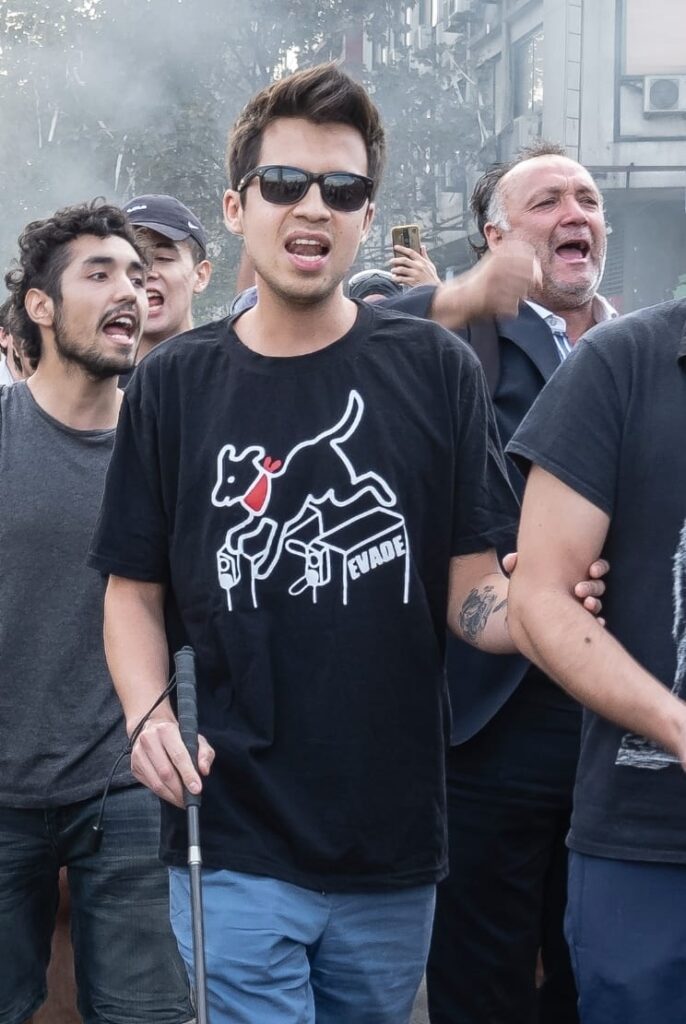
An open wound in Chile’s –de facto– fragile democracy
The recent acquittal of former Carabineros officer Claudio Crespo, responsible for the shot that left Gustavo Gatica blind on November 8, 2019 during the social uprising, is not an isolated event. Santiago’s Fourth Oral Criminal Court retroactively applied Law 21.560 —known as the Naín-Retamal Law— acknowledging that Crespo fired the projectile, but declaring him “not punishable” under the presumption of privileged self-defense. This ruling, issued on January 13, 2026, reopened a national wound and triggered a rupture within the Chilean governing coalition, with the Socialist Party (PS) freezing its participation in the coalition following criticism of the law by the PC and the FA.
For victims like me —a journalist and political refugee in Canada, granted asylum after being tortured by Carabineros during the uprising, with physical and psychological injuries certified under the Istanbul Protocol— this law represents institutionalized revictimization. It not only perpetuates the impunity of those responsible for human rights violations during the social uprising and the repression in the Wallmapu, but also enshrines a Pinochet-era legacy within Carabineros and the Armed Forces: a structure that has historically operated under privileged criminal treatment, extremely difficult to dismantle.
The context of the uprising and the Wallmapu: Violence and systematic abuses
The social uprising of October 2019 left a toll of 464 severe ocular traumas, thousands of arbitrary detentions, acts of torture, and at least 10,796 complaints of institutional violence by 2021. In parallel, the Wallmapu (Mapuche Indigenous territory) has endured decades of militarization, with prolonged states of emergency and the disproportionate use of lethal force against communities engaged in resistance and territorial claims.
Carabineros, direct heirs of the repressive apparatus of the Pinochet dictatorship (1973–1990), maintain a deeply rooted culture of impunity. During the dictatorship, torturers were amnestied or recycled; after the transition, subsequent superficial reforms did not alter the doctrine of the “internal enemy.” The Naín-Retamal law updates this framework: it presumes police self-defense in the face of protests, requires proof of “regulatory non-compliance” for illegitimate coercion, and protects salaries during investigations.
Revictimization: From torture to legal silence
Revictimization occurs when the criminal justice system reproduces the initial trauma through omissions or inadequate treatment. The law aggravates this:
- Privileged presumption:
Carabineros/Armed Forces are presumed to be acting in self-defense when using force to establish “public order,” shifting the burden of proof onto victims —requiring them to demonstrate serious aggression despite contrary evidence, as in the case of Gustavo Gatica (peaceful protest in most cases, and self-defense in the most complex situations to delimit, given that peaceful protest was possible only thanks to the resistance belt of the so-called “front line” of demonstrators who contained the arbitrary aggressions of Carabineros, as demonstrated in various reports by human rights observers).
- Coercion reform:
It removes the aggravating factor of “under state custody” and requires proof of “regulatory non-compliance” (something very vague), reducing sentences or leading to acquittals, as in cases of sexual abuse of incarcerated women (a retroactive review reduced sentences from 3 years to 818 days).
- Retroactivity:
Applied to the uprising/Wallmapu, it acquitted Crespo despite ballistic evidence; this benefits 130 carabineros formally charged since 2019.
For victims of torture (like me, with a positive Istanbul Protocol), this means impossible justice: the law shields torturers, reviving the trauma of the events and of exile.
The governing coalition rupture: A political wound
Crespo’s acquittal in the Gatica case triggered the crisis: the Communist Party (PC) and the Broad Front (FA) criticize this law as “impunity,” in response to which the PS froze the governing alliance, accusing “disloyalty.” This rupture exposes the fracture within the left between those committed to human rights guarantees and those centered on public security at any cost and under any circumstances. The government of Gabriel Boric, which processed the law, now faces a mea culpa among governing parties, while the FA in particular downplays the issue as a “tantrum” by the PS, overlooking the human dimension that impacts citizens.
Pinochet-era legacy: Eternal impunity
Carabineros preserves a Pinochet-era counterinsurgency doctrine: the supposed “internal enemy” would justify lethal force (uprising/Wallmapu). The Naín-Retamal Law (named after two Carabineros officers killed in the line of duty), together with some 70 similar regulations (laws on states of emergency, laws on critical infrastructure, etc.), collectively militarize territories in practice, normalizing gunfire against unarmed civilians as “defense.”
In Chile, Pinochetism lives on: military pacts of silence and implicit amnesties still exist and prosper. The Naín-Retamal Law constitutes a setback in human rights, a political response to a delicate issue of responsibility regarding public order and social conflicts, and represents a difficult social rupture by prioritizing “unrestricted support” for the actions of Carabineros and the Armed Forces over truth and justice.
Gustavo Gatica: A revictimized symbol
In the case of Gustavo Gatica, the Fourth Oral Court explicitly invoked the Naín-Retamal Law to acquit Claudio Crespo, despite confirming that his riot shotgun fired the projectile that blinded him (although Crespo always denied it, since lying is another very common practice within Carabineros). The judicial reasoning revolved around the principle of in dubio pro reo —in case of doubt, in favor of the accused— but biased toward the police officer due to the automatic presumption of self-defense: the court interpreted Gatica’s participation in the protest as an “aggression” justifying the shot, and held that the “non-compliance with internal regulations” required by the reform on illegitimate coercion had not been proven. Amnesty International and the INDH (National Institute of Human Rights) have stated that, without this privileged presumption and the new evidentiary requirements imposed by the law, the ballistic evidence and the context of a predominantly peaceful demonstration would have allowed for a punitive conclusion for illegitimate coercion or serious bodily harm.
Breaking the cycle: Towards truth, reparation and non-repetition
The Naín-Retamal Law is not a mere regulatory adjustment, but a structural mechanism of revictimization that silences victims of the social uprising and the repression in the Wallmapu, while perpetuating the Pinochet-era legacy of impunity within Carabineros and the Armed Forces. By enshrining a privileged presumption of self-defense and hardening the evidentiary burden against victims, the law transforms individual pain into a collective defeat, making justice for torture, ocular trauma and disproportionate lethality almost impossible. The rupture within the governing coalition —with the PS freezing its alliance in response to criticism from the PC and the FA— is not a minor political clash, but the symptom of a profound crisis within the Chilean left: the unresolved tension between the public security agenda and the human rights imperative, inherited from the uprising and an unfinished democratic transition.
As a journalist and political refugee in Canada, granted asylum after being tortured by Carabineros during the social uprising —with physical and psychological injuries certified under the Istanbul Protocol— my exile is living proof of this perverse dynamic. I left Chile with irrefutable documentation, but Crespo’s acquittal in the Gatica case and laws like this condemn me to an impossible return, where impunity not only denies justice, but threatens repetition. I demand full truth regarding systematic violations; effective reparation for silenced victims; and guarantees of non-repetition through the dismantling of the counterinsurgency doctrine of Carabineros. Chile will not be a full democracy as long as its repressive apparatus remains shielded by inheritances and repetitions of the past.



