

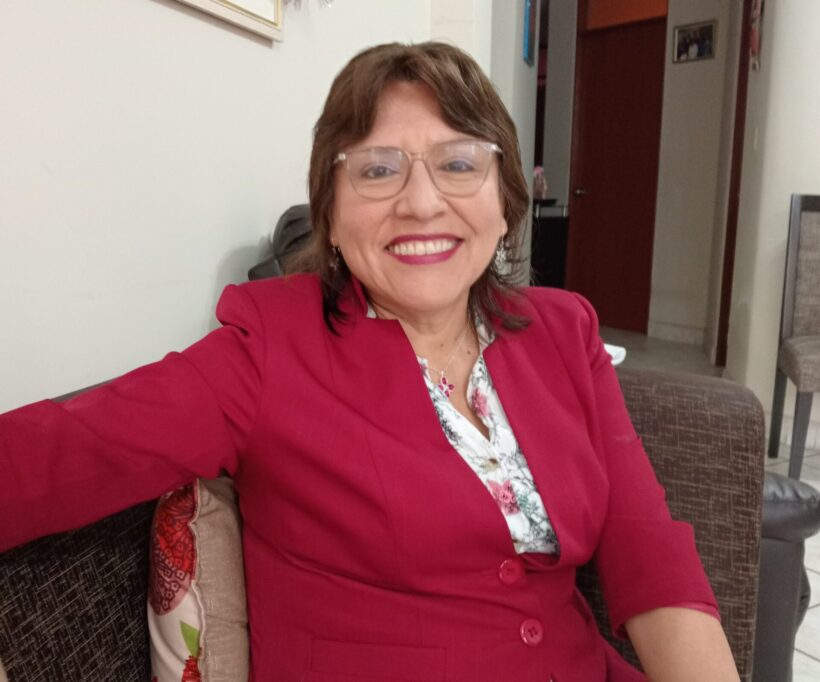
“I’m used to dealing with and confronting criminals, delinquents. And they don’t scare me,” says Delia Espinoza Valenzuela, the Attorney General who was disbarred by those she was investigating, and an emblematic figure in the fight against corruption in Peru.
In an exclusive interview with Pressenza, Dr. Espinoza reveals the inner workings of a world riddled with vengeance and abuse of power, which attacks those who confront the mafia networks entrenched in the political structure.
Is good governance possible amidst corruption? Her case answers this question, highlighting an unexpected social actor: the people.
Pressenza: Dr. Delia Espinoza, you were suspended, denied reinstatement as Attorney General, and then barred from holding any public office for 10 years… why so much animosity in your case?
Delia Espinoza: My suspension as Attorney General, and subsequently the disqualification imposed on me by the Congress of the Republic, are both a response to the impeccable work I have been doing as Attorney General, prosecuting crime at the highest levels, against the most representative authorities: the President of the Republic, ministers, members of Congress, members of the Constitutional Court, the National Board of Justice, the Ombudsman, the Comptroller General, Supreme Court justices, and prosecutors; all of these individuals are under investigation. When there is an alleged crime, the Attorney General can and must investigate it. In that sense, my work has not been well received, despite being legal, constitutional, and conducted with respect for the fundamental rights of those under investigation.
When I took over as Attorney General last year, people started feeling uneasy with me because they don’t want any investigations or constitutional complaints before the elections. That’s the crux of the matter, the breaking point for them. It’s not in their best interest to have an Attorney General prosecuting crime during election season. I have to investigate because most of the complaints are filed by citizens. I have to fulfill my duty to prosecute crime. I have a career of over 29 years, uninterrupted and impeccable, without any administrative sanctions for irregularities in my duties. And I have never been criminally prosecuted for serious crimes of corruption or organized crime. My record is completely clean.
Pressenza: Doesn’t your disqualification have anything to do, for example, with the fact that you didn’t allow Patricia Benavides to resume her position as Attorney General?
D.E.: Yes, it’s directly related. I mean, they’re using politics for revenge. The members of the National Board of Justice (JNJ), who are supposed to discipline judges and prosecutors who have committed irregularities or serious misconduct in office, are using that procedure against me for supposedly not having obeyed the order to reinstate Patricia Benavides as Attorney General. But, Judith, the public needs to know this. I couldn’t commit a constitutional violation. According to Article 158 of the Constitution of Peru, only the Supreme Prosecutors, sitting as a board, can choose who the Attorney General is. I can’t just hand it over directly; it’s like they’re telling you, “You have to hand over the Attorney General’s office to the Nation.” I can’t do that. It’s not legal, it’s not constitutional. And they forced me into an unconstitutional act. And that’s why they’re now prosecuting me, and they’re going to remove me from office soon, I know it. What they want is to disguise and validate the unconstitutionality they committed by trying to force me to hand over the Attorney General’s office to Patricia Benavides.
Pressenza: Which instances of the justice system did you appeal to in order to obtain justice?
D.E.: They are both judge and jury. That’s why I went before the constitutional judge who granted me my precautionary measure, but now they are acting in concert. The Constitutional Court has already detained me, already blocked my precautionary measure because the National Board of Justice requested it. The last one they filed for amparo (constitutional protection), right? Yes, that one, the amparo action that was under precautionary measure, the Constitutional Court has suspended it. And on December 3, the Congress of the Republic disqualified me. In other words, they have been working on several fronts to block my return as Attorney General.
And they are allowing an interim Attorney General, facing serious investigations for “White Collars” and influence peddling, to have his case dismissed in Congress. Another alleged white-collar criminal, Mr. Carlos Arce, also returned very quickly; his investigations in Congress were also dismissed, one of them for illicit enrichment of 13 million soles, with expert reports and evidence. Ms. Benavides is well-positioned, and it will soon be decided among them who will succeed me as Attorney General.
They should be upholding my appointment, and they know that the National Board of Justice is committing arbitrary acts, abuse of authority, prevarication, and a series of other crimes against me, in addition to Congress, but I have already filed my appeal for protection and so far everything has been refuted with rigged appeals.
Pressenza: How confident are you that this new injunction will be carried out? Will this legal recourse be effective, or will you have to go to a supranational body?
D.E.: Well, that’s a big question, and all I can say is that I have to exhaust all domestic remedies. As for confidence, I couldn’t say whether I have it or not.
I’m truly uncertain, because of the way Judge Torres Tazo has behaved. After granting me the injunction and then delaying it for a month and a half, even though the injunction is supposed to be enforced immediately (it’s protective, meant to prevent further violations of fundamental rights), he took a month and a half to issue notifications.
What he should have done was enforce it himself, with police support (as was done in Patricia Benavides’ case).
Pressenza: Looking at another aspect, how do you currently perceive our political class, our authorities? Because fundamental rights are being violated, pro-crime laws are being passed, institutions are being taken over, the separation of powers is being lost, immunity is being confused with impunity… And this has been gradually worsening.
D.E.: That’s right, precisely. And since they are aware that nobody trusts them anymore… If not, just look at the polls, it’s undeniable. As we know, more than 90 percent don’t want them. It’s because they haven’t done things right.
And I would add one more thing to that list you mentioned: They have been benefiting particularly, personally. For example, one, the law that allows their relatives to contract with the State. And two, as a bonus… The investment of 90 million soles to contract insurance for them and their relatives. When those 90 million soles could easily go to schools, to buy medicine for public health. Vulnerable people are not being cared for. Their social programs are being reduced. Scholarship 18 has been a blow… I would say, a slap in the face to the children, the young people who want to build a future and who don’t have resources, who deserve that support from the State… instead of diverting budgets, like fixing the facade of Congress, which are superfluous, trivial expenses, irrelevant. For all these reasons, what trust can there be? And now, I join the “#NotForThem” campaign.
Pressenza: How will you contribute?
D.E.: I will contribute by saying that the parties and parliamentary groups in government, especially in Congress and the Executive branch, have demonstrated not only their inability to provide genuine service to the population—for which they are paid salaries, which come from our taxes, right?—but also their failure to demonstrate that capacity, good faith, willingness, and selflessness, their failure to uphold their oath of office. So, can we possibly renew our confidence in them? No.
Furthermore, they disregarded a 2018 referendum in which the population clearly told them “No reelection,” and they have also repeatedly said “No to bicameralism.” But they blocked the referendum. Why not consult them again? It’s because they were afraid the population would say no again. They know they will say no, given everyone’s awareness of Congress’s inefficiency and bad faith, its focus solely on its own interests and its disregard for the public good. If they had done a proper job, the story would be very different.
Pressenza: Besides the pro-crime laws…
D.E.: There’s a very clear feeling that they’re even benefiting from the pro-crime law. There are studies that have concluded that many political organizations are linked through illicit financing or economies. But there hasn’t been any investigation, has there? Or perhaps there is an investigation, and now that’s being shut down.
For example, they’ve currently limited the capacity of the Lava Jato team. That’s why they want to dismantle or render ineffective the investigative teams, even though these teams are characterized by investigating highly complex cases—enormous webs involving many people, many witnesses, ringleaders, members, associates, and funding flowing back and forth through various types of illegal economic activities. That’s why a team is necessary. Because it coordinates, communicates, articulates, interrelates, and analyzes all the cases linked to all the agents or those under investigation.
That’s why when you dismantle or nullify something, as the interim director wants to do, there simply won’t be any more teams. The files, the investigations, are sent to their prosecutors, and that’s it. Everything is isolated. It’s broken up, and information is no longer shared. Evidence, information, or elements that could help one case or another are no longer shared. And the lack of communication or unity is completely detrimental. What’s the immediate consequence? They’ll be shelved, or shelved one by one.
Pressenza: The investigation into the enormous web of corruption is falling apart…
D.E.: And also because he’s personalizing it, right? The interim Attorney General has already been speaking inappropriately, hasn’t he? Against the prosecutors, but anyway, that’s beside the point. What matters here is that the team, like the Lava Jato team, has had achievements, convictions. How many presidents, how many investigated? Some say one of them killed himself. That’s why the special teams, EFICABIP, the one focused on social protests, now he says he’s going to end it. He’s going to send the investigations back to their respective jurisdictions, right? And that’s where it all ends again. It’s a total setback for EFICOP, the prosecutors against corruption in power. The interim Attorney General offered and even apologized. He said he wasn’t going to be excessive like I had been, well… And that’s why he’s going to dismantle the teams.
The problem is that at EFICOP, she has directly clashed with the former president’s brother, his lawyers, and various other people, including those involved in the Valkiria case—the case that has implicated former Attorney General Patricia Benavides and Jaime Villanueva. She is deeply involved in these matters, which has allowed for investigations against her. There are very strong cases against her, constitutional complaints filed in Congress, but they haven’t been touched since last year. What trust can this current administration ask of the public, given what they are demonstrating?
They persecute those who investigate them. They try to smear me and make an example of me, showing that “anyone who dares to challenge my power” will have their career, their reputation, and even their image destroyed… because they’re using every kind of insult against me. But as I always say, I’m used to dealing with and confronting criminals. And they don’t scare me. I’m prepared for this and much more.
I simply ask that people be aware of who they vote for.
Pressenza: Do you think there will be fraud? Because with all this background, for many people, this is a sign that fraud is being planned. Because, putting out 30-odd lists is to disperse the vote, first point; second point, the ballot with such little information, I mean, that could lead to errors…
D.E.: Yes, there are two interpretations regarding how this electoral process is being carried out.
The first interpretation, let’s say the most sensible one, is that they’re playing on people’s mistakes, hoping that out of boredom or confusion, they’ll mark the well-known parties, and we all know which ones they are. That’s one aspect, and then there’s the misinformation, the sheer number of candidates, so many people, and not all of them are prepared—that’s a danger. With such a large ballot, with small print or tiny boxes, imagine what it could be like in jungle areas, in rural communities, in the high Andes, in the most remote places—there could even be manipulation. That’s one aspect.
The other interpretation, as you mentioned, is that of a supposed or probable fraud. Yes, I’m also leaning towards that view, because with so much public rejection, with so much animosity they’ve earned from the people, through sheer force of will, nobody believes them anymore. The #PorEstosNo campaign is strong and is increasingly reaching the population.
It’s very likely they don’t want to risk failing to meet the electoral threshold and not having any senators or representatives in Congress. That’s where the National Elections Board (JNE), the electoral bodies, and the ONPE itself will come into play. Given what the National Elections Board (JNE) has been demonstrating recently—I don’t know if you’re aware, for example—my vote was taken away, along with other ineligible voters, which is against the Constitution.
And it can’t be taken away because the Constitution, Article 33, clearly states that the right to vote is only lost by judicial resolution, by court rulings, nothing more. And court rulings imply a whole legal process. But active suffrage is your right to cast your vote. How can they take it away from us? This is a universal right. Inalienable. I’m going to file a complaint and report these gentlemen because they have committed a flagrant abuse of power. What’s happening is that this is part of the pressure they’re putting on me to show the public what happens, what will happen to anyone who dares to speak out.
Pressenza: Is this a message to the public, during election season, to discourage political participation?
D.E.: We’re so tired of so many people who have wanted to do things and are doing things in Peru. Let me tell you something. There’s a misconception about political participation. We can participate in politics every day. People get confused when they say, “Oh, no, that politician stuff doesn’t apply to me. I have to work, I have to get ahead.” No. That’s false. Politics is in what we eat every day. Politics is in our salaries, in our public health services, in transportation, in security, in the cost of living, in the quality of our housing and neighborhoods, in public sanitation, in environmental protection. So, people have to understand that what happens in politics will directly influence “what I have in my life.” Whether I have a dignified life or an undignified one.
For now, we have a life we don’t deserve. Look at the state of public safety, the state of the healthcare system—how is it possible that our children with cancer or other illnesses are dying because corrupt officials aren’t providing the necessary services, medicines, treatments, or medical equipment so they can receive proper care? Corruption kills, Judith. Corruption kills every day. And that corruption is present in politics right now. And I’ve been fighting against it at the highest levels. And they won’t forgive me for that.
Pressenza: What is your current situation?
D.E.: I’ve already been disqualified for the second time by the standing committee, and they’re going to call me to the plenary session. I don’t know if it will be in February or March, so that it will be the final stage of this second disqualification. I hope they understand and dismiss it because this case, the issue of double salaries… What these people have done is propose a law that would allow retired military and police officers, who have their pensions and can return to public service, to do so with an unlimited salary, but only for retired military and police officers. Unlimited, but it doesn’t end there. They also want to exclude those who have been elected, only them. Those who have been elected, members of Congress, presidents. Popularly elected, but who have to come from a background of military or police pensions. No one else. If you look at the number of people who would benefit, it’s only them. That’s called a law with a specific target. And that’s called the crime of abuse of power. The name says it all.
They never wanted to meet with me because I had a plan to help them structure police operational intelligence plans. First, to bring together all the honest police officers capable of working with us to track down the real ringleaders using infiltrators, undercover agents, and informants.
Why do I say “real”? Because those they’re supposedly dismantling right now are just lower-level, mid-level people. They’re the ones who shoot, the ones who ride the motorcycles, the ones who extort money. They’re just the foot soldiers. But the ringleaders, the ones who are organizing, structuring, and planning everything in their hideouts, in their secret locations—they’re not being caught. Why do you think the killings and extortions continue? The assassinations. Why? Precisely because they’re not reaching the real ringleaders. Who are they? They haven’t found them yet; they have no leads.
That was my idea, to also push for the restructuring of the police. There are many police officers involved with criminal gangs, many. And it’s not just my opinion; the arrests are there. There’s also corruption in the prosecutor’s office, of course, otherwise there wouldn’t be White Collars, or Valkyrie, or the Prosecutor’s Office and the Power Elite, of which there are plenty of elements, cooperating witnesses, and other informants. In other words, the conditions are there to be able to investigate and get to those levels, so to speak.
Finally, you have been invited by Pressenza to participate in the international webinar “Good Governance is a Right.” We want to give people back their decision-making power, so they know that good governance is a fundamental right. How do we make citizens understand that they have this right?
By spreading the word. Because for people who aren’t necessarily law-abiding, it needs to be explained. That’s why I’ve decided, through media outlets like yours, and others that are contacting me, and through my appearances in alternative and regional press, to spread the word.
I call it education. Explaining things like in a small school, because not everyone knows about the law, and that’s not exactly surprising. Many Peruvians have lived their entire lives without knowing their rights, until now… The right to good food, to a good education, your right to protest, your right to hold your authorities accountable.
Why? Because the power is yours, it’s yours, mine, it belongs to all 34 million Peruvians, it belongs to everyone, the power is one.
The thing is, we entrust certain authorities with our confidence, with our vote. The nation—that is, all Peruvians—gives us that confidence to work for you, for everyone. And many people think that, for example, members of Congress are untouchable, that no one can denounce them, no one can prosecute them. That’s false.
It’s also about understanding—people think that once they vote, others will take care of the rest, and that’s it. No, the people must also participate. They need to demand transparency and accountability, which go hand in hand. Every month, ministers should hold press conferences to explain and say, “We’ve been doing this,” but with evidence, not just empty words. They need to listen to the people, but truly listen. That’s what it means to know your rights.
The official is there to meet with you. If you voted for Congressman X, you have every right, just like in other countries, to request an appointment and be seen as soon as possible. Greater civic engagement. That’s what we need to keep promoting. That’s why I believe that for something to become known, it has to be explained and communicated. And I’m committed to that.
Pressenza: Thank you very much, Dra. Delia Espinoza.
D.E.: Thank you.



