

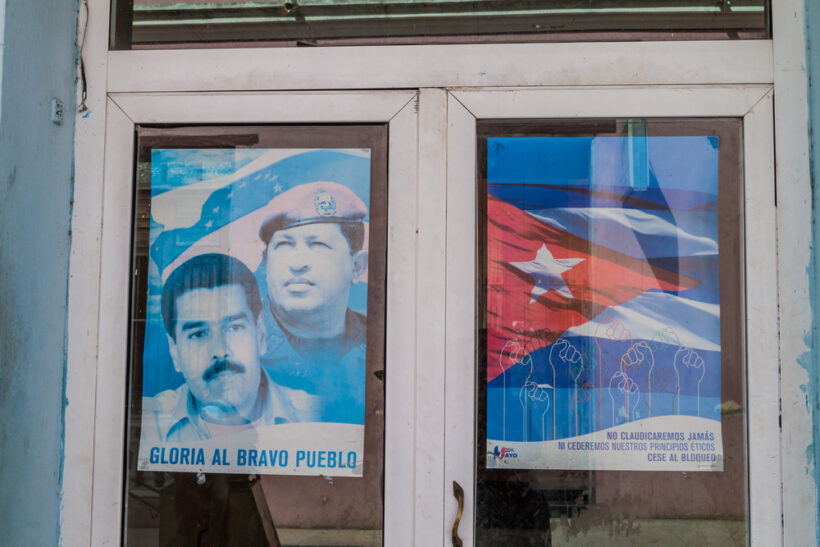
This war on Venezuela has been two decades in the making
By Nuvpreet Kalra
On January 3rd, the United States invaded and bombed Venezuela and abducted President Maduro and First Lady Flores. This violent act of imperialist aggression by the Trump regime is a continuation of over two decades of hybrid warfare aimed at suppressing the Bolivarian Revolution. Over the past months, the US has been escalating aggression against Venezuela, but this abduction is the culmination of over two decades of imperialist war. In fact, it was predicted 20 years ago this year by Hugo Chávez, the first president of the Bolivarian Republic of Venezuela, at an address to the UN General Assembly.
In 2006, in what became one of his most iconic speeches, Hugo Chávez said:
“The government of the United States doesn’t want peace. It wants to exploit its system of exploitation, of pillage, of hegemony through war. It wants peace. But what’s happening in Iraq? What happened in Lebanon? In Palestine? What’s happening? What’s happened over the last 100 years in Latin America and in the world? And now threatening Venezuela — new threats against Venezuela, against Iran?”
Chávez could have made this exact speech today, last year, or really any time in the past two decades. His words are so apt for today because US foreign policy has not changed. It is the same violent maintenance and exertion of its hegemony and deadly system of exploitation and hegemony, no matter if orchestrated in blue or red. This is what we have been seeing with Israel’s genocide in Gaza, attacks on Lebanon and Yemen, regime change in Syria, threats and attacks on Iran, suffocation of Cuba, provocations and war preparation against China, proxy war in Ukraine, and continued regime change attempts against Venezuela. Chávez’s words will remain timeless as long as US imperialism remains intact and the smell of sulfur remains.
Since 1998, with the election of the revolutionary leader Hugo Chávez and the Bolivarian Revolution, the United States has been hellbent on overthrowing the government of Venezuela. Before Chávez, American companies ran wild in Venezuela, extracting and exploiting natural resources and labor. In the 1980s, Venezuela adopted US-backed neoliberal reforms, which emphasized an open oil market, deregulation, and privatization, which accumulated huge profits for US companies at the expense of the Venezuelan people. This is the Venezuela that the United States wants; in fact, this is the US’s modus operandi across Latin America.
Today, the media class is doubling down on its line of Venezuela’s fall from grace as the richest country in Latin America. This regime change propaganda has been plastered across media platforms, like CBS’s 60 Minutes, to manufacture consent for US regime change operations, impending invasion, and for continued US war crimes against small boats in the Caribbean.
Coincidentally erased from these media narratives are the impacts of suffocation with US-led sanctions, which have slashed Venezuela’s oil revenues by 213% between January 2017 and December 2024. This amounts to $77 million in losses every single day. These unilateral coercive measures are a form of warfare aimed at impoverishing the Venezuelan people, blaming the Bolivarian Revolution for hardships, and triggering regime change from utter suffering.
It is shameful, though unsurprising given these are the same media outlets justifying US-Israeli genocide, to peddle this lie, which purposefully erases the true history of neoliberal Venezuela. In this era, romanticized by these imperialist mouthpieces as a haven to which they want Venezuela to return, just 20% of the Venezuelan population was benefiting from oil wealth, while the other 80% suffered from poverty. Also erased from these narratives are the horrors of IMF austerity, which overnight locked out millions of people from basic necessities and essential services, leading to Caracazo, an uprising of hundreds of thousands of Venezuelans opposing these neoliberal reforms. It is convenient for 60 Minutes and others to erase the deaths of over 3,000 people from the military crush of these protests, just as it is to remove all traces of the neoliberal crisis that the US enforced on the country. But despite attempts, they cannot redact how the horrific neoliberalism of the 1980s and 1990s brought about the popular uprising led by Commandante Hugo Chávez, which eventually led to his successful election as president in 1998.
While Chávez’s victory did not immediately alert Washington, and the Clinton administration adopted a “wait and see” policy, in the years following, alarms certainly began to ring. Chávez’s openly anti-imperialist politik, including selling oil to Cuba and supporting anti-imperialist resistance and governments, and the imposition of Venezuela’s sovereignty, quickly made US politicians, oil tycoons, and those with stakes in the US empire tremble.
Sabotage Made in the White House (2001-4)
With the arrival of Bush in the White House in 2001, US policy towards Venezuela became more overtly aggressive, with Chávez as the target fresh from re-election victory. This shift was deepened in response to Chávez’s opposition to Bush’s so-called “war on terror” and refusal to join the “coalition of the willing, as well as Venezuela’s escalating assertion of its oil sovereignty. As the US escalated attacks across Afghanistan and Iraq, Chávez criticized and called out the terror and violence the US imposed across the world and domestically. Chávez’s bold opposition to US terror was a substantial threat to the imperialist coalition that sought to impose its violent will on the peoples of West Asia. In response, the US accelerated its hybrid warfare from a campaign of pressure and isolation to regime change.
This came to a head in 2002, when the US backed and coordinated right-wing elites to kidnap Chávez in an attempted coup where they tried to dissolve the constitution of the Bolivarian Republic. In quick succession, the US recognized the short-lived 47-hour coup , which embarrassingly failed as popular forces rallied in tandem with the military to brush off the coup. Rather than demoralize the Venezuelan people, this coup galvanized the socialist project with oil revenues now reinvested in education, healthcare, and housing rather than the pockets of US tycoons. The government built 3,000 new schools and, by 2005, eradicated illiteracy with the support of Cuba; set up 6,000 community health clinics as 15,000 Cuban doctors provided healthcare for millions of Venezuelans; and by 2009, infant mortality was cut by 40%, and the free healthcare system was caring for millions of Venezuelans.
In the face of overwhelming support for the revolution, the US changed course and used economic and technological warfare to try to strangle the revenue the government was relying on to fund its sweeping reforms. 8 months after the failed coup, the US-backed opposition groups sabotaged the nationalized oil company, PDVSA, through INTESA (majority owned by US weapons company SAIC) , a company working in PDVSA. At the same time, US-funded opposition groups provoked a “strike” at PDVSA. The strike and lockout cost the country $20 billion, which could have been used to fund the healthcare system, to build a million homes, or continue to better the lives of Venezuelan people. In 2004, US-trained thugs violently attacked and killed people in Caracas in another attempt to oust Chávez. This was quickly followed by a NED- and USAID-funded campaign, led by US puppet Maria Corina Machado, for a referendum to recall President Chávez. This was yet another attempt to impose regime change that was crushed repeatedly by the streets.
Despite relentless attempts to overthrow Chávez, the revolutionary government pushed ahead with anti-imperialist worldbuilding in forming the Bolivarian Alliance for the Peoples of Our America, or ALBA, as an anti-hegemonic alternative to the US ‘Free Trade Area of the Americas’ (FTAA) which prioritized social programme and solidarity over neoliberal, extractive “trade”; leadership of OPEC to facilitate development and constitute the progressive bloc across Latin America; and challenged US imperialist violence, with powerful statements like:
‘From Latin America, from Venezuela, we send out our heart to our brothers the Iraqi people, and the Arab peoples … who are fighting the battle against the imperialist aggressor” (Hugo Chávez, April 2004)
Second Offensive (2005-08)
As Venezuela continued using oil incomes to develop Venezuela in the interests of the people, the US imperialist aggression continued in full force. This pushed the United States into formulating a multi-pronged approach aimed at overthrowing the Bolivarian revolution. In 2005, the Bush administration imposed formal sanctions on Venezuela and funnelled millions of dollars into opposition figures to cause chaos and suffering. This approach has been tried and tested by the US empire across the world, most notably in Cuba, where a decades-long total blockade has sought to produce immense suffering amongst the Cuban people, that they support the overthrow of their own government via US-backed figures.
Between 2005 and 2012, the US used the National Endowment for Democracy to funnel $30 million into opposition parties, non-governmental organizations, and other opposition groups in Venezuela. This spiked ahead of the December 2006 presidential election with the aim of propelling figures to undermine the democratic process and provide domestic calls for US invasion. One of the key figures to emerge from this money was Maria Corina Machado, the 2025 winner of the Nobel “Peace” Prize and vocal supporter of the US imperialist invasion of Venezuela. After the Trump regime killed over 110 Venezuelans and abducted their President, totally undermining the sovereignty of a country, Machado stated the US had fulfilled its promise to enforce the law. Such figures, despite being snubbed by their puppet master, Trump, are paraded to give the sense that imperialist invasion has a domestic face.
In 2005, the US officially labelled Venezuela a “non-cooperative” country and banned the sale of all weapons, parts, and software, including maintenance of F-16 fighter jets and any regional defense cooperation. Under the guise of “terror, the Bush administration effectively imposed an embargo on the country as an attempt to suppress its international solidarity, bold policy, and socialist construction. Over the following years, the Bush administration continued imperialist attacks, including propaganda of “authoritarianism” and human rights abuses, lawfare imperialism via companies like Exxon, as well as escalating targeted sanctions, including on the financial sector, the first OFAC designations for senior Venezuelan officials, as well as other individuals and businesses at whim.
All the while, Venezuela was providing free heating oil to Americans across 25 states. The CITGO-Venezuela Heating Oil Program began in 2005 and provided over 2 million Americans with free and discounted heating services, including for homeless shelters and Native American communities. While the US was investing millions of dollars into attacking Venezuela and bringing about regime change, the Chávez government was providing aid to the American people.
This material international solidarity provided to exploited Americans was part of a wider and sweeping investment in public services in Venezuela itself. By 2008, Venezuela’s GDP grew by almost 5%, driven by the oil boom, which facilitated the massive investments in public spending. In this period, 25% of oil revenue went directly into the government’s Fonden national fund for direct investment into public projects for food sovereignty, housing, education, healthcare, transportation, cooperatives, sanitation, and socialist construction. Between 1998 and 2008, 17 large hospitals were built, primary-care physicians increased twelve-fold, infant mortality fell by more than a third, death from malnutrition cut by half, higher education enrolment more than doubled, foreign debt fell by more than half, five million people were brought into formal sanitation systems, major new transportation networkers were built, and 6,200 new cooperatives received funding. The Venezuelan people’s material conditions were vastly improved by this ambitious and socialist government, using oil revenue in the interests of the people. This, of course, motivated the United States’ coercive measures.
Coercion and control (2009-13)
The Obama regime’s first moves marked an escalation in direct attacks on revolutionary leaders in government in Venezuela. Between 2010 and 2013, Obama sanctioned 19 Venezuelan officials, froze their assets, and denied them travel, all based on lies over “drugs.” Such a turn marked a move to designate individuals as enemies of the United States and provide propaganda points for further actions. Years before, Chávez predicted this labelling of “narco-trafficking” as justification for invasion and regime change. The same formula was also imposed on Diosdado Cabello and then Maduro. In an interview in 2005, Chávez said:
“Years ago, someone told me: ‘They’re going to end up accusing you of being a drug trafficker—you personally—you, Chávez. Not just that the government supports it, or permits it—no, no, no. They’re going to try to apply the Noriega formula to you.”
In 2013, Hugo Chávez passed away, leaving behind a legacy inspiring Venezuelans and all those across the world who moved to build societies based on peace and justice. The Presidential election of 2013 set out the same playbook the US was to use in all preceding elections. The vote was won by Nicolás Maduro, who contested a NED-funded candidate, Henrique Capriles, who refused to accept his defeat and claimed it was a rigged election. The Obama regime used this opportunity to give grounds for regime change by denouncing the election results and labeling Maduro the illegitimate leader. Thus arose the newest villain in Venezuela, deemed an authoritarian human rights-abusing dictator, or whichever combination of words the US ruling class selected that day.
US-funded groups instigated violent riots across Venezuela, providing the ideal conditions for the “imperialism of peace” waged by the US on the country. The “Venezuela Defense of Human Rights and Civil Society Act” passed in 2014 provided further basis for widespread sanctions, using so-called “human rights” as the rationale for interference and punitive measures. The most prominent propaganda lines the US used to peddle during this time were over “human rights”, “corruption”, and “drugs”, all to demonize Venezuela and justify all coercive measures, just as the lies of the “terror” threat were the rationalization for the US to kill over 4.5 million people.
Lethal Actions (2015-2019)
On March 9, 2015, the Obama regime labelled Venezuela an “extraordinary threat to US national security, invoking the Emergency Economic Powers Act to do so. This Executive Order froze the assets of seven senior Venezuelan officials and banned them from the US, as well as critically providing the legal scaffolding for all further unilateral coercive measures imposed on Venezuela by subsequent administrations. Obama seamlessly set up the scaffolding that enabled Trump’s more abrasive, lethal attacks on Venezuela.
Between 2015-17, the US Treasury pressured financial institutions to cease operations in Venezuela and to close the accounts of their clients. In quick succession, this economic strangulation had deadly effects: Citibank rejected Venezuela’s payment for 300,000 doses of insulin, UBS Swiss Bank delayed a purchase of vaccines for months, Pfizer, Abbot, and Baster refused to issue certificates for cancer drugs, and a $9 million payment for dialysis supplies was blocked. The US deliberately disrupted the free healthcare the government was providing to Venezuelans.
In 2017, during Trump’s first presidency, the US imposed a more robust financial blockade on Venezuela, seeking to cut Venezuela off from financial markets. The US imposed bans on financial engagement between US and Venezuelan individuals and companies, and issued warnings of penalties for foreign banks if they did so. In an attempt to circumvent these attacks and fund public services, the Maduro government introduced the Petro, a cryptocurrency based on oil reserves. Immediately, the US sanctioned that too as it continued to stack lethal sanctions, blocks, and bans intended to destabilize, attack, and destroy the country’s ability to function on its own.
In 2019, the Trump regime escalated its terrorist maximum pressure campaign on Venezuela. They imposed a total oil embargo and de facto economic embargo, seized Venezuelan company CITGO, sanctioned the Central Bank of Venezuela, and continued to add officials to the sanctions list. While these coercive measures sought to economically strangle the country, the US continued to push opposition figures. In January, Juan Guaidó declared himself president of Venezuela. With US pressure, at least 60 governments across the world were pushed into recognizing this illegitimate statement. In order to push him to challenge Maduro’s legitimate government, the US handed Guaidó control of foreign frozen Venezuelan assets, including CITGO, as well as Venezuelan embassies. Despite being handed all of the concessions needed, Guaido failed to garner any popular support as people in Venezuela and across the world saw this as an open and weak attempt at regime change.
Between 2015 and 2019, food imports fell by 73%, which caused chronic hunger to skyrocket by 214%; 180,000 surgeries were halted due to a lack of antibiotics and anesthetics; 2.6 million children could not access vaccines; and over 60% of HIV/AIDS patients were forced to suspend their treatment. These all-out sanctions forced public services to cut their capacity by half as shortages of fuel, spare parts, and imports reduced their ability to function, according to UN Special Rapporteur Alena Douhan. US sanctions killed 40,000 people in one year, between 2017 and 2018. The true cost of US measures is in its hundreds of thousands, all victims of the US empire, hellbent on imposing its interests and will on a sovereign nation.
Suffocation (2020-2024)
In response to the Maduro government’s resilience and popular support, the US set a $15 million bounty for the capture of Maduro and four other officials, as well as imposing ridiculous charges over “narco-terrorism” and corruption against Maduro and 14 other officials. US sanctions, mercenary-backed coup attempts, and Guaido’s meddling continued to harm Venezuelan people as medicine shortages leaped, the US blocked aircraft and bullied foreign insurers to drop their coverage of oil tankers.
The sanctions regime caused a quarter of Venezuelans to leave the country, many to the United States, where they were told they would find safety. Migration has been weaponized, just like with Cuba, in order to build domestic pressure for those outside of Venezuela propagandized to believe the suffering in Venezuela is at the hands of the government, not US warfare.
Biden’s government, purporting to be interested in “democracy” in Venezuela, made a big show of easing some sanctions in the run-up to the 2024 elections. This was set up in order to feign concern, attempt to hide US hybrid warfare, and to justify the propaganda push denouncing the elections. In quick succession, the US sanctioned more officials and seized Maduro’s presidential plane.
Invasion (2025-26)
As power changed hands from Biden to Trump, the outgoing government imposed further fresh sanctions on Venezuelan officials, including Maduro, paving the way for further moves by the incoming Trump government.
The Trump regime designated US-created “drug cartels” as “foreign terrorist organizations. In August, the US raised the bounty on Maduro to $50 million and began a renewed propaganda campaign on the grounds of “narco-terrorism” and “cartels. This all provided the justification for the escalated aggression against Venezuela, with repeated war crimes as the US bombed small boats in the Caribbean and Pacific, which killed over 117 people.
Despite negotiations and diplomacy on the part of the Maduro government, including when Trump deported thousands of Venezuelans, the US only ramped up its aggression. All the while, the US has been continuing its funding and promotion of opposition candidates in elections, pushing propaganda in domestic and international media, and attempting to wrangle control of Venezuela’s oil.
In the past month, this aggression showed to the world just how the US operates without any consequence or accountability. On December 10, the US hijacked and stole 1.8 million barrels of Venezuelan oil and a tanker set for Cuba. A few weeks later, they hijacked and stole another oil tanker in international waters and tried and failed to hijack another. From December 21 until January 7, the US was chasing an empty oil tanker, which was put under Russian protection. Despite this, on January 7, the US hijacked and stole this tanker in the North Atlantic as well as another tanker in the Caribbean. These continued attacks, while the US and Israel threaten to bomb Iran, continue a slower, quieter genocide in Gaza, and threaten to attack Cuba, Nicaragua, Mexico, and Colombia, are part of the US empire’s monstrous operation. They seek to suffocate any challenge to its maintenance of an international system of plunder and exploitation.
Right now, the Venezuelan President Nicolás Maduro and First Lady Cilia Flores are captured in chains in New York, facing sham charges that are more for the spectacle than any justice. The US is continuing to steal Venezuela’s oil, broadcasting videos and cheering about hijacking another tanker. They are throwing around threats and gloating about deadly bombings that have killed over 110 people. It can feel hopeless, just as over two years of US-Israeli genocide go on without any justice for those who carry it out, who justify it, and who protect it.
All over the world, people are rising up against the US empire. Chants of “Yankee go home” have rung out across the Americas, Europe, Asia, and Africa. Venezuelans have been taking to the streets every day, chanting “Maduro, aguanta, que el pueblo se levanta / Maduro, hold on, the people are rising up”. When we take a look back at the past 20 years of US violence against Venezuela, we know that the biggest fear for the imperialists is a popular uprising. That is why they make the people suffer, that is why they fund figures to pretend to speak for them, that is why they spend billions of dollars on propaganda.
20 years ago this year, when Chávez took to the floor in the United Nations, he was not only speaking to the people of 2006 nor to Bush, but to us today as we rise up: “What is happening is that the world is waking up and people everywhere are rising up. I tell the world dictator: I have a feeling that the rest of your days will be a living nightmare, because everywhere you will see us rising up against American imperialism, demanding freedom, equality of peoples, and respect for the sovereignty of nations. Yes, we may be described as extremists, but we are rising against the empire, against the model of domination.”
Nuvpreet Kalra is CODEPINK’s digital content producer. She completed a Bachelor’s in politics and sociology at the University of Cambridge, and an MA in Internet Equalities at the University of the Arts London. As a student, she was part of movements to divest and decolonize, as well as anti-racist and anti-imperialist groups. Nuvpreet joined CODEPINK as an intern in 2023, and now produces digital and social media content. In England, she organizes with groups for Palestinian liberation, abolition, and anti-imperialism.



