

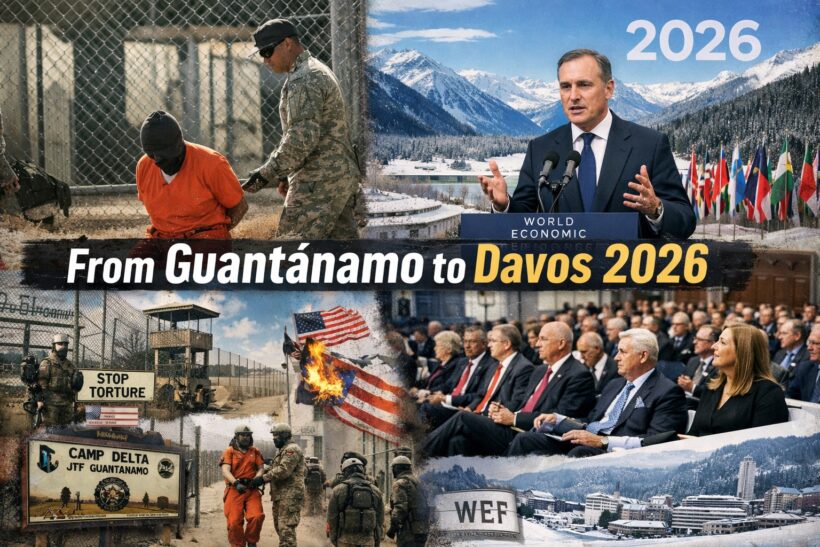
The last twenty-five years trace the slow collapse of a global order built on legal exceptionalism, unchecked power, and the illusion that force could replace cooperation.
Trumpism began long before Donald Trump took office. It emerged through the expansion of authoritarian executive power, justified by a permanent state of emergency. To understand this trajectory, we must rewind to September 18, 2001, when the U.S. Congress passed the Authorization for Use of Military Force (AUMF), granting the president sweeping powers to detain individuals indefinitely in the name of the “war on terror.”
Under the George W. Bush–Dick Cheney administration, the establishment of the Guantánamo Bay Detention Camp exposed a systematic regime of illegal incarceration without due process. Detainees were held indefinitely, often without charge or trial, in clear violation of international law, including the Geneva Conventions and the Convention Against Torture. The use of torture and so-called “enhanced interrogation techniques” constituted war crimes under international law, regardless of the legal justifications later advanced by U.S. officials. Guantánamo institutionalized a permanent state of exception, normalizing indefinite detention and the suspension of fundamental rights.
Internationally, Guantánamo provoked widespread and sustained condemnation. The United Nations, its special rapporteurs, and treaty bodies repeatedly concluded that the camp violated international law and called for its closure. Human rights organizations such as Amnesty International and Human Rights Watch documented arbitrary detention and torture, while the International Committee of the Red Cross issued rare and unusually strong criticisms of U.S. practices. Although U.S. Supreme Court rulings later curtailed some executive power and affirmed detainees’ rights, no senior civilian or military officials were ever held criminally responsible. The result was a lasting legacy of impunity that damaged U.S. credibility, strained relations with allies, fueled anti-American sentiment, and continues to undermine both international law and U.S. democracy.
What once appeared as a temporary “war on terror” exception has now become a generalized condition of global politics—acknowledged even by those who once claimed to manage and defend the system.
Almost twenty-five years later, Canadian Prime Minister Mark Carney openly declared the end of the so-called rules-based international system. In a hard-hitting speech delivered on January 20, 2026, at the World Economic Forum, Carney called on states to build strategic partnerships at multiple levels in order to counter intimidation and bullying by “hegemonic powers,” while protecting smaller countries.
Carney is not a progressive, nor does he fundamentally question capitalism, state power, or militarization. Yet his intervention reflects a significant shift: an acknowledgment, even within elite circles, that interdependence and the limits of domination now define the global landscape.
Many observers agreed that this speech could mark the beginning of a more complex international order—one built on multiple layers of relationships involving economics, energy, research, security, and access to raw materials. This represents a shift away from hierarchical political power toward more pragmatic cooperation based on need, development, and stability. It is an implicit recognition that humanity’s future development will depend on cooperation, mutual dependence, and the understanding that every society has something to contribute to the world now taking shape.



