

Nepal prepares for the national election, which was necessitated following the collapse of KP Sharma Oli’s government in the height of Gen-Z rebellion (youth uprising) in September 2025, which is scheduled for 5 March. The Himalayan nation conducted the last general election in 2022 (next national polls were due in 2027). But due to the dissolution of Nepal’s lower house of Parliament last year by President Ram Chandra Poudel, the electoral process began under the patronage of an interim government, installed under the leadership of retired Supreme Court judge Sushila Karki on 12 September. The Hindu majority nation of over 29 million people will witness over 3,400 (including 390 women) electoral candidates representing 68 political parties as well as independents vying for 165 seats in the 275-member House of Representatives.
At least four former Prime Ministers remain in the fray, where three mayors are also expected to try their luck in the electoral battles. Deposed premier Oli, 74, who leads Communist Party of Nepal (Unified Marxist–Leninist) will face electoral challenges from Balendra Shah (who recently resigned as Kathmandu metropolitan city mayor and joined Rastriya Swatantra Party) in Jhapa-5 Parliamentary constituency of eastern Nepal. Balendra, 35, an engineer turned rapper turned politician, who was one of the protagonists in the anti-government protest demonstrations last year, is anticipated by local political observers as a tough contestant against the four-time premier of Nepal.
Oli, who resigned as Prime Minister on 9 September, recently claimed that some foreign hands instigated the people to overthrow his government in Kathmandu. He suspected that the last uprising that resulted in the killing of 77 nationals and damaging of government and private property worth NPR 84 billion (Rs 52 billion) was unusual, and it was orchestrated after meticulous planning. Oli even mentioned that after Sri Lanka and Bangladesh, Nepal was targeted by those elements to destroy the democracy in the South Asian nation. On various occasions, he also made anti-India comments and remained critical of New Delhi’s foreign policies towards Nepal, which also borders Tibet (now under China).
The other three former premiers, who are contesting in the Nepal election, include Pushpakamal Dahal (alias Prachanda, 71) of the Communist Party of Nepal (Maoist Centre), Baburam Bhattarai, 71, of the Pragatisheel Loktantrik Party, and Madhav Kumar Nepal, 72, of the Nepali Communist Party. Two former premiers, namely Sher Bahadur Deuba (Nepali Congress) and Jhala Nath Khanal (NCP), however, opted not to contest in the polls. Deuba was actually compelled to avoid the contest by the division of his party under the mentorship of Gagan Thapa, now recognized as the chief of Nepali Congress. Besides Balendra, two other candidates from mayoral positions, including Harka Sampang (Dharan sub-metropolitan city) and Renu Dahal (Bharatpur metropolitan city), remain in the fray.
It may be mentioned that Ms. Renu is the daughter of Prachanda, who led the decade-long Maoist movement in Nepal. In reality, the hardliner communist leader was instrumental in abolishing the Nepalese Hindu monarchy in 2008. Nepal’s last king, Gyanendra Shah, who lives a common citizen’s life, but with visible support bases across the country, recently made a public comment criticizing the Nepali political leaders for adopting an increasingly imbalanced foreign policy and conduct against national interests. Addressing the nation on the occasion of the 304th birth anniversary of Prithvi Narayan Shah (his forefather) and National Unity Day, the former monarch slammed the political leadership for bringing the country under persistent crises in the last two decades.
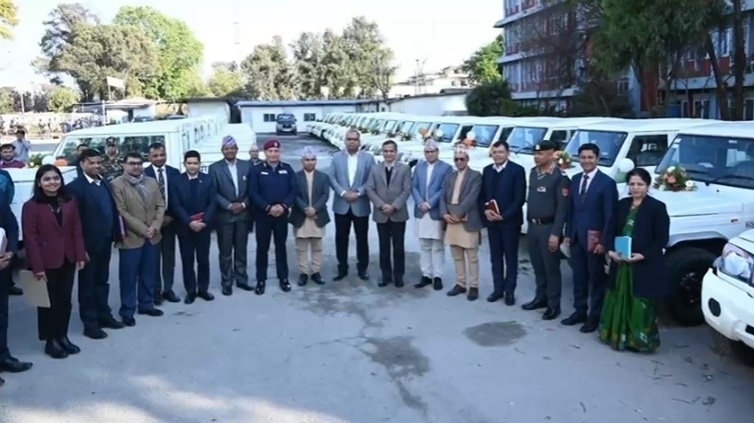
India, responding to the requests from the government and different political parties, continues extending logistical support to Nepal. Recently, the largest democracy on Earth handed over more than 60 double-cab pickup vehicles along with other supplies to support Kathmandu’s preparation for the forthcoming polls. They were formally received by Nepal’s home minister Om Prakash Aryal from Indian diplomat Rakesh Pandey. Thanking New Delhi for the support, Minister Aryal stated that the assistance reflects the depth of trust and friendship between the two neighbours, reported The Kathmandu Post, a leading daily newspaper of the Himalayan nation. Mentionable is that, since 2008, New Delhi has been offering election-related assistance to Nepal, where this time, over 600 vehicles are expected to be delivered to its northern neighbour.
The Communist China also expressed its commitment to provide every possible support for the successful conduct of Nepal’s general elections. During a recent interaction with a group of editors and journalists, a Chinese diplomat in Kathmandu, Chen Song, commented that Beijing was working in close coordination with the interim government as it places a high priority on Nepal’s political stability, development, and prosperity. Amid the electoral fever, hardcore supporters of the deposed king are demanding restoration of the monarchy, arguing that selfish politicians had failed the citizens, precisely the young generation, and the return of King Gyanendra emerges as the only alternative to save Nepal and its nationals.



