

by Asif Showkat Kallol (Dhaka Bureau)
If the Bangladeshi government’s decision to suspend the broadcast of the Indian Premier League (IPL) is dismissed as an emotional outburst or a reaction born of cricketing disappointment, then the deeper language of South Asian power politics has been entirely missed. This was neither a spontaneous move nor a momentary display of anger. It was, rather, a restrained, polite, yet pointed act of resistance against a cricketing superpower- the Board of Control for Cricket in India (BCCI). No slogans were raised, no diplomatic barbs exchanged. Instead, symbolism was deployed. And in politics, symbolism often speaks louder than confrontation.
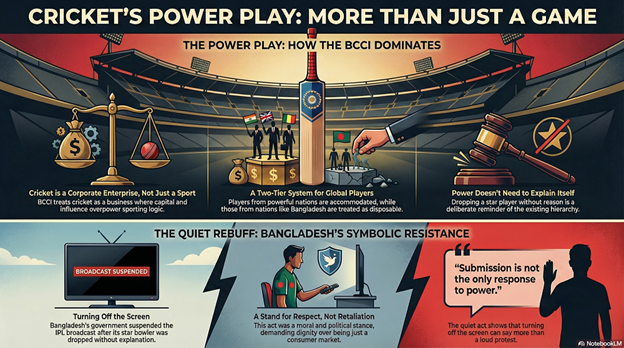
The Ministry of Information and Broadcasting justified the decision in straightforward terms: Bangladesh’s star fast bowler, Mustafizur Rahman, was dropped from the Kolkata Knight Riders squad without any explanation. On the surface, this may seem like a routine franchise decision. But the absence of explanation is precisely the issue. In modern cricket, a refusal to explain is not merely about omitting a player- it is about disregarding a country’s cricketing dignity. It is a reminder of hierarchy.
The BCCI has long made it clear that cricket, to them, is no longer just a sport. It is a multi-billion-dollar corporate enterprise, where bats and balls are decorative accessories, and real decisions are made in boardrooms shaped by capital, influence, and political alignment. Cricketing logic is secondary. Performance is negotiable. Power is not.
The IPL is marketed as the world’s premier T20 league, a meritocracy where talent triumphs above all else. In reality, it resembles a gated community- open to many, owned by a few. You may play, you may entertain, you may generate revenue, but you may not ask questions. If you seek clarity, you are told: ‘These are the rules.’ Who makes the rules, and for whom, remains off-limits.
For Bangladeshi cricketers, this reality is especially unforgiving. Their presence in the IPL is never treated as a right- it is framed as a favour. A privilege that can be granted today and withdrawn tomorrow, without explanation. To ask why is to invite discomfort. Meanwhile, when Australian or English players face scheduling conflicts or security concerns, calendars are rearranged, justifications soften, and negotiations take place at the highest levels. Global cricket suddenly becomes flexible.
Is this what ‘global cricket leadership’ looks like? In the BCCI’s lexicon, leadership means imposition. Cooperation means compliance. And the so-called cricketing family exists only as long as everyone knows their place.
Mustafizur Rahman is no anonymous cricketer. His cutters, variations, and composure under pressure have earned him international recognition. He is not new to the IPL. His credentials are well established. Yet neither the BCCI nor the franchise felt compelled to offer an explanation for his exclusion. Because power does not explain itself. It announces decisions and expects acceptance.
This is where the mask of the ‘global cricket family’ slips. When BCCI interests are protected, unity is celebrated. But when smaller nations ask for parity or respect, they become inconvenient relatives- best ignored.
At this point, cricket bleeds seamlessly into politics. The IPL does not exist in isolation from the broader contours of India–Bangladesh relations, which have long been marked by asymmetry- whether in trade, water-sharing, border killings, visa regimes, or diplomatic leverage. Cricket simply offers a more palatable theatre in which dominance can be exercised under the banner of sport.
Bangladesh’s decision to halt the IPL broadcast is therefore not economic retaliation. It is a moral and political stance. No one seriously believes this will dent the IPL’s revenue or dull its spectacle. The league is too vast, too entrenched, too profitable for that.
But in politics and culture, symbolism is not measured in balance sheets. Suspending the broadcast sends a clear message: Bangladesh is not merely a consumer market. It is a cricket-loving nation that demands respect. Passion can be monetized- but humiliation is remembered.
In India’s political ecosystem, cricket has long functioned as soft power. The BCCI operates almost as an unofficial extension of Indian foreign policy, where diplomacy is conducted through fixtures, exclusions, and selective ‘security concerns.’ Who plays, who does not, who is deemed safe, and who is dispensable- these decisions are rarely apolitical.
Bangladesh’s quiet rebuff raises an uncomfortable question: is cricket still a global game? Or has it become a stage where the largest shareholder decides who plays, who watches, and who silently absorbs indignity?
The BCCI will likely ignore the gesture. The IPL will go on. Cameras will roll, stadiums will fill, and the ‘festival of cricket’ will resume. But outside the celebration, some will stand apart- remembering that this festival is not equal for all.
If cricket continues down this path- where power eclipses merit- the future is clear. The game will cease to be global. It will become a franchised entertainment system, where players are interchangeable assets and rules are beyond challenge.
In that version of cricket, the ‘Man of the Match’ will no longer be decided by bat or ball. It will belong to the institutions that write the rules, rewrite them when convenient, and never feel obliged to explain themselves.
Bangladesh’s restraint serves as a reminder: submission is not the only response to power. Sometimes silence itself is resistance- and sometimes, turning off the screen says more than any protest ever could.
About the Author:
 Asif Showkat Kallol: Head of News, The Mirror Asia (Germany) & Contributor, Pressenza- Dhaka, Bureau.



