

By Genevieve B. Kupang and Jennifer Longchasen
FLAIR-UPLIFT Part I & II: Building the Foundation: Rankings, Quality, and Sustainability
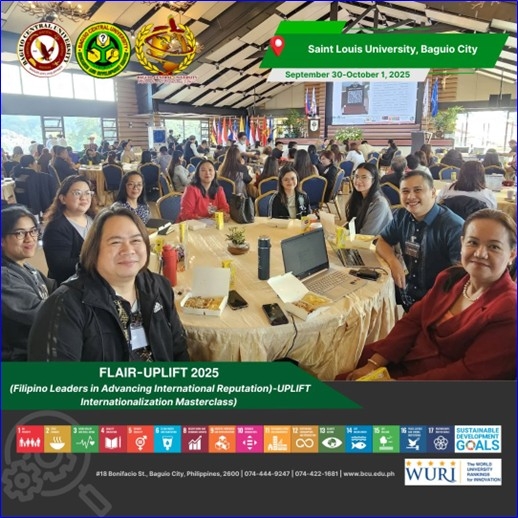
Baguio Central University (BCU) took a step toward strengthening its internationalization agenda by participating in the UPLIFT-FLAIR Masterclass 2025, a flagship initiative of the Commission on Higher Education – Cordillera Administrative Region (CHED-CAR). Held on September 30 to October 1, 2025, at the Verbist Hall, Medical Arts Parking Building, St. Louis University, Sacred Heart Medical Center, the two-day intensive training brought together higher education leaders, international relations officers, and key administrators from institutions across the Cordillera region.
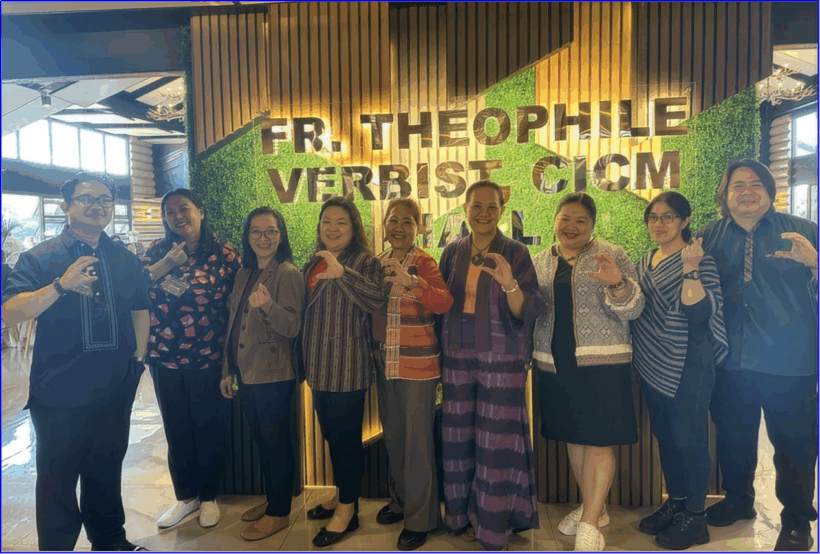
BCU and UC delegates share a souvenir moment while co-learning with fellow CAR-HEIs representatives at the masterclass.
Co-organized by St. Louis University and the Cordillera Association of International Relations Officers, the masterclass centered on UPLIFT-FLAIR 2025, an acronym representing “Upscaling Programs and Projects, Leveraging Internationalization and Futures Thinking.” The event represented a crucial convergence of educational leaders and international relations officers dedicated to enhancing the quality and global competitiveness of higher education institutions across the Cordillera Administrative Region and Northern Philippines, while strategically positioning these institutions on the international stage.
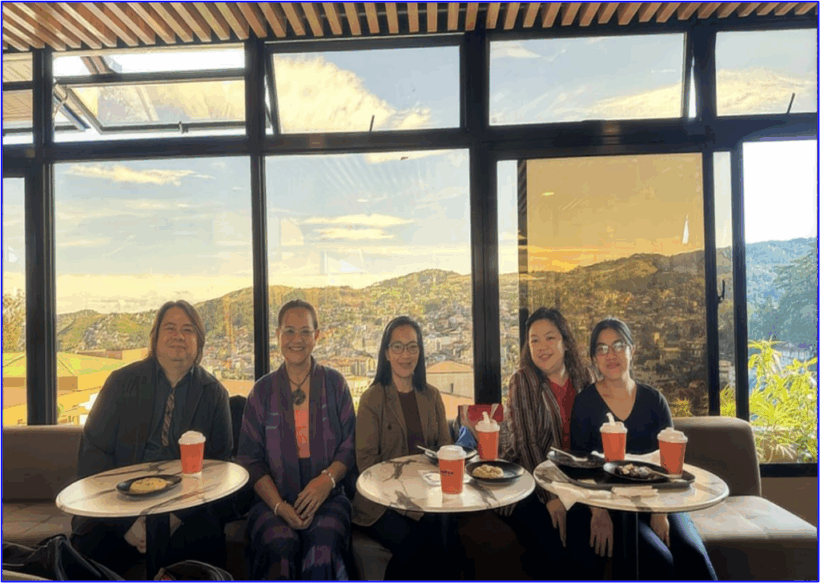
A coffee-fueled morning: Team BCU awaits the start of Day 2 FLAIR-UPLIFT.
Building Strong Foundations for Global Impact
Dr. Joselito C. Gutierrez, Executive Assistant to the President, opened the masterclass with remarks on behalf of Rev. Fr. Gilbert B. Sales, CICM, President of St. Louis University. He emphasized the imperative to enhance institutional systems and elevate Philippine higher education through strategic internationalization. He underscored the critical need to strengthen institutional capacities while anchoring organizational visions to sustainability—a theme that would resonate powerfully throughout the masterclass.
Dr. Godfrey G. Mendoza laid out the compelling rationale for FLAIR UPLIFT, explaining how the initiative has evolved since its launch in 2022. What began as the Filipino Leaders in Advancing International Reputation (FLAIR) has transformed into the premier platform for internationalization capacity-building in the region. The masterclass represents more than a workshop series; it is a movement dedicated to bringing Cordillera institutions to the world stage.
CHED-CAR Director Dr. Jimmy G. Catanes highlighted the region’s vision of becoming a research center, building on foundations established between 2012 and 2017. He emphasized the shift from isolated initiatives to cross-cutting, quality assurance networks that would enable institutions to compete globally while maintaining their unique cultural identities.
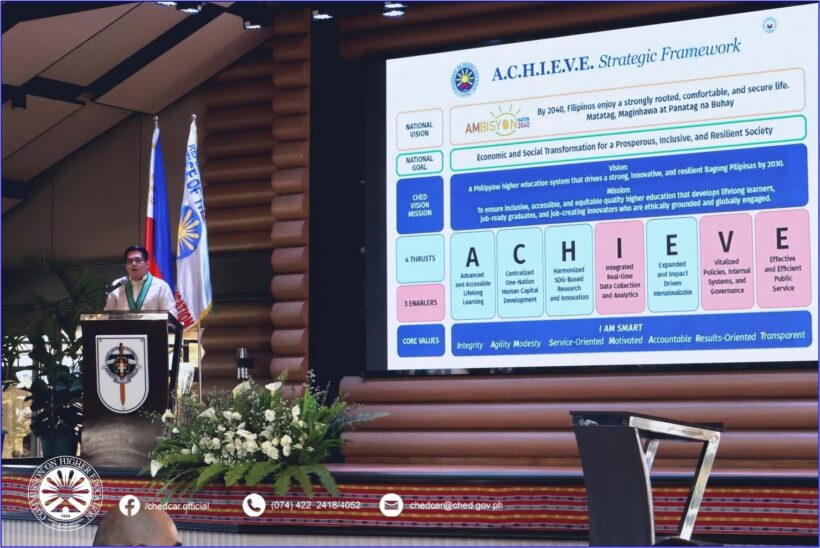
Dr. Jimmy G. Catanes presents the ACHIEVE framework during the FLAIR-UPLIFT 2025 masterclass. Photo credit: CHED-CAR.
Strategic Internationalization: Learning from Regional Pioneers
Day One featured an illuminating session on crafting Strategic Internationalization Plans (SIP), with Dr. Rex John G. Bawang, Director of the International Relations Office at Benguet State University, sharing BSU’s comprehensive 2021-2025 strategic framework. He emphasized the importance of involving representatives from different offices and deans in the planning process, ensuring institutional buy-in and coordinated implementation. He also discussed the IRO Manual of Operations, which undergoes peer review by CHED-CAR to ensure quality assurance standards are met. The session underscored a challenge facing many regional institutions: the absence of plantilla positions for International Relations Offices, highlighting the need for structural support to sustain internationalization efforts.
Data, Storytelling, and Cultural Identity
Dr. Eva Codamon-Dugyon, President of Ifugao State University, delivered a powerful session on data and storytelling in impact rankings and visibility tools. She articulated a profound insight: institutions in the Cordillera don’t need to reinvent their distinct brand—it already exists in their culture. The Ifugao Rice Terraces, for instance, serve as both niche and global significance, a UNESCO-recognized heritage with outstanding universal value.
“With or without ranking, we continue to carry our mission,” Dr. Codamon-Dugyon emphasized. She reframed rankings not as measures of prestige but as mirrors and megaphones—tools that reflect institutional strengths while amplifying voices to the world. Rankings serve as a compass, holding institutions accountable while showcasing indigenous knowledge and heritage to global audiences.
This visibility and credibility open doors to research collaborations, global networks, and partnerships with larger consortia. IFSU’s membership in the ASEAN consortium and the Globally Important Agricultural Heritage Systems exemplifies these opportunities. Enhanced mobility, internationalization, scholarships, and joint research opportunities naturally follow, alongside capacity building that ensures regional institutions aren’t left behind in the global conversation.
Dr. Codamon-Dugyon stressed that data alone isn’t enough—narrative matters. Institutions must frame data with context and meaning, coupling statistics with compelling visuals and stories that help the world understand not just what they do, but why it matters.
Building Cross-Border Partnerships and Quality Assurance
Ms. Jesusa Rocel S. Estanislao, SEPS from CHED-IAS, conducted an online session on building and sustaining cross-border partnerships. She discussed CMO 55 series 2016, which provides guidance on crafting international agreements and strengthening institutional readiness for accepting international students. The session emphasized identifying centers of excellence and fostering cooperation between Philippine institutions and the rest of the world.
Participants learned about the UMAK membership opportunity, which offers accreditation pathways, global visibility, and networking benefits for an annual fee of 5,000 pesos. The presentation highlighted the importance of diversifying internationalization activities beyond student mobility to include research collaboration, industry partnerships, and faculty development.
Dr. Mildred M. Libot, CEPS from CHED-QIQAG, addressed global standards and local impact through quality assurance initiatives. She presented sobering findings from EDCOM II, including the reality that 90% of 10-year-olds in the Philippines cannot read and comprehend simple text, system fragmentation between basic and higher education, and significant quality disparities between urban and rural areas.
Dr. Libot outlined CHED’s internationalization support mechanisms, including policy development, quality standards, recognition systems, and capacity building. She introduced the concept of virtual global classrooms for collaborative final projects with international partners, emphasizing the importance of documenting global learning experiences through research portfolios.
FLAIR-UPLIFT Part II: Strategic Positioning and Institutional Showcases Leadership, Policy, and the SDG Corner
Day Two featured Major John Eric A. Tadeo, PMA Professor and Fulbright Fellow, who brought fresh perspectives on leadership and policy in higher education. Using interactive tools like Mentimeter, he engaged participants in discussions about structural barriers affecting internationalization, policy priorities for Cordillera HEIs, and the competencies Filipino faculty need to thrive in global contexts.
Major Tadeo emphasized that leadership is artistry and choice, encouraging institutions to identify their unique strengths and cultural stories worth sharing with international partners. He discussed the importance of moving beyond structural requirements—like establishing dedicated internationalization offices—to cultivating genuine institutional commitment and sustainable impact.
The masterclass concluded with a session on establishing SDG Corners to make institutional impact visible. Discussions centered on Baguio City’s tourism sector (1.2 million visitors annually), circular economy education, and the Baguio Youth Innovation Hub. The concept of “Sirib ken Siglat”—an interface between local government and academic solutions—was presented as a model for testing innovative approaches toward adaptive governance.
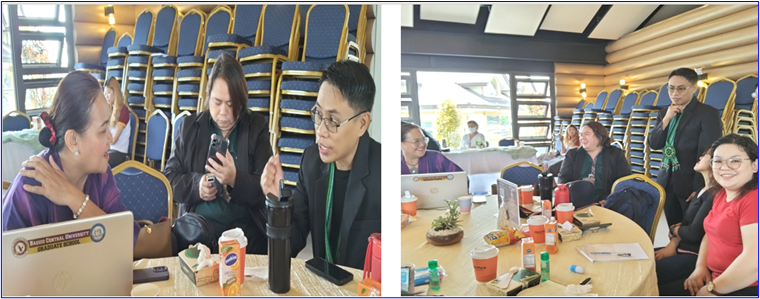
BCU representatives Dr. Genevieve Kupang, Dr. Lyha Fias-ilon, Dr. Jennifer Longchasen, and Dr. Michael De Roxas engage with Major John Eric A. Tadeo following his presentation.
FLAIR UPLIFT PART III: Cultivating Innovation: Key Takeaways from Speakers of CAR Winning Universities
Leading universities shared their most creative and significant projects at the seminar, demonstrating their dedication to advancing society and education. Aiming to address actual issues and enhance lives, accomplishments included everything from innovative teaching strategies to community initiatives and scientific discoveries. The significance of creating a robust, cooperative academic community where staff, instructors, and students can collaborate, try new things, and adjust to changes was one of the event’s main takeaways.
The universities also discussed issues such as finding sufficient resources, involving everyone, keeping pace with societal demands, and connecting theory to practical application. They emphasized the importance of creativity and resilience to overcome these obstacles.
The most important lesson I learned is that innovation should benefit people. The key to success in WURI is striking a balance between real-world impact (Hands), meaningful programs for people (Heart), and competence and skills (Mind). Universities genuinely make an impact when they are combined.
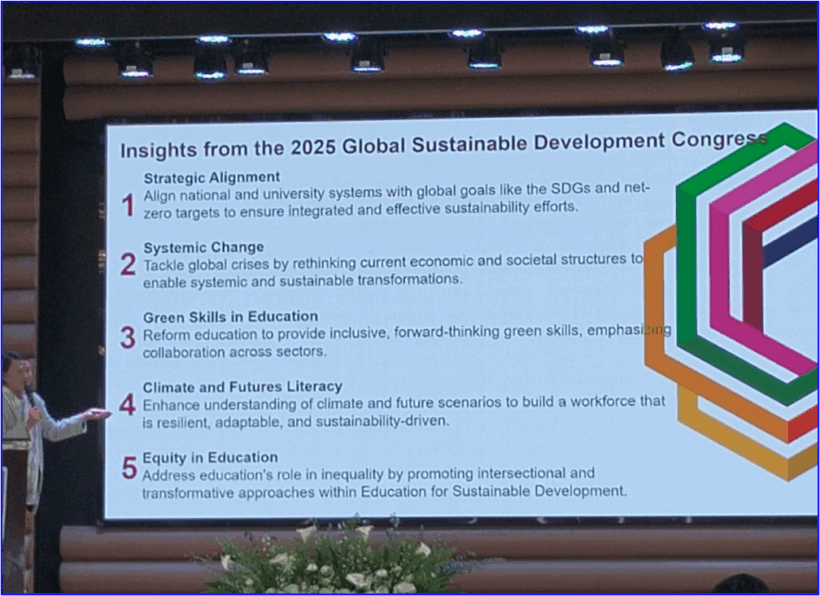
Ifugao State University shares insights from the 2025 Global Sustainable Development Congress.
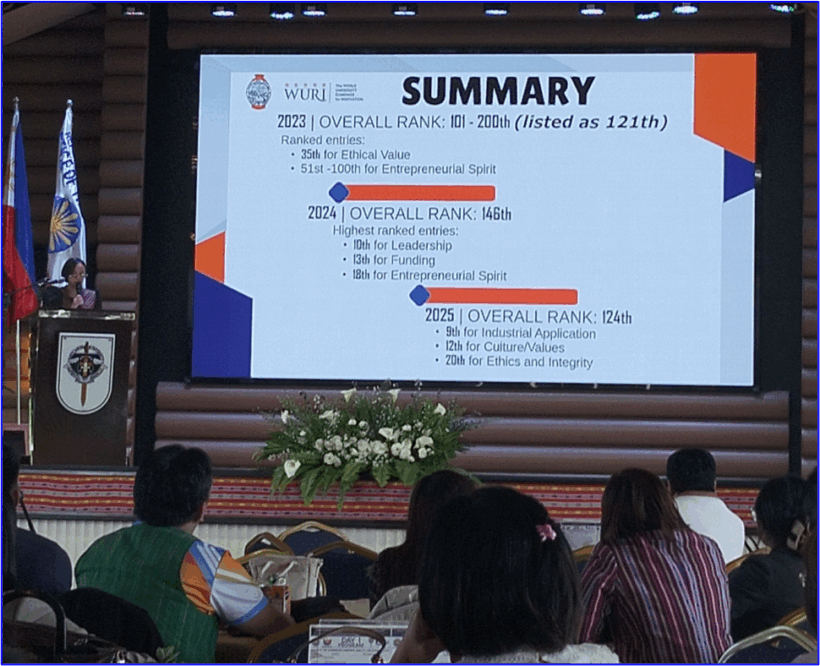
BCU co-learns best practices from other CAR HEIs like CDC’s young president, Dr. Sherry Junette Malaya-Tagle, who showcases their institution’s journey climbing the WURI Ladder, 2023–2025.
Moving Forward with Purpose
As BCU returns from this intensive learning experience, the institution carries valuable insights and renewed commitment to advancing its internationalization agenda. The masterclass reinforced that internationalization isn’t about chasing prestige but about staying true to institutional vision and mission while engaging meaningfully with the global community. With clear frameworks, strategic partnerships, and authentic storytelling, BCU is well-positioned to contribute to the Cordillera region’s emergence as a center of educational excellence in Northern Philippines.
The journey toward global engagement requires political will, dedicated resources, and collective effort. As one presenter aptly noted, “Walang magbubuhat ng bangko ninyo kundi kayo”—no one will lift your bench but yourselves. BCU’s participation in UPLIFT-FLAIR 2025 marks another important step in that journey.
For the FLAIR-UPLIFT Part III CHED-CAR’s Gawad Parangal sa Pandaigdigan Kahusayan, please check this link: https://www.bcu.edu.ph/ched-car-recognizes-bcu-for-excellence-in-internationalization-during-the-flair-uplift-masterclass-2025/.
#BCUsoarshigher
#CHED-CAR&CAIROCollaborates
#UPLIFT-FLAIRMasterclass2025
#Charting the Path Toward Global Excellence



