

by Asif Showkat Kallol
In the bustling constituencies of Dhaka, Bangladesh’s capital, a new political drama is unfolding as top opposition figures break with tradition to contest seats in the urban heartland for the 13th national parliamentary elections. Amid festive campaigning across the country, these party chiefs are mounting vigorous bids, viewing victory not just as a seat but as a symbol of their parties’ strength- though analysts warn it could prove a fiery test of their popularity.
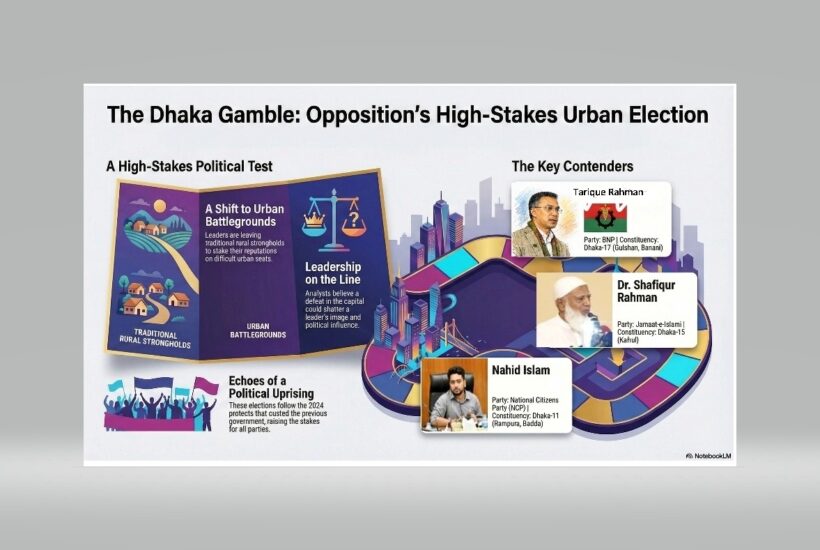
Typically, party leaders opt for safe home turfs, but this cycle sees a shift: BNP Chairperson Tarique Rahman in Dhaka-17 (covering affluent Gulshan, Banani and Bhashantek), Jamaat-e-Islami amir Dr Shafiqur Rahman in Dhaka-15 (Kafrul), National Citizens Party (NCP) convener Nahid Islam in Dhaka-11 (Rampura, Badda and Bhatara), and Bangladesh Khelafat Majlis amir Maulana Mamunul Haq in Dhaka-13 (Mohammadpur and Adabor). Their candidacies have drawn intense scrutiny, with Dhaka’s results seen as a barometer of opposition momentum.
The stakes are high. ‘A defeat for a party leader in the capital could create an image crisis,’ said one political analyst, speaking on condition of anonymity. ‘Leaders usually choose ‘safe zones’ to avoid that risk, but this election’s equations are different- it’s all to play for.’
In Dhaka-17, Tarique Rahman, son of former prime minister Khaleda Zia and a polarising figure in Bangladeshi politics, announced his bid on 27 December, triggering a surge in BNP grassroots activity. He has held meetings with local cadres, emphasising democratic restoration. Previously, the seat was eyed by Bangladesh Jatiya Party (BJP) chair Barrister Andaleeve Rahman Partho, who shifted to Bhola-1 after Rahman’s entry. Rahman’s main rival is Jamaat’s Dr Khaliduzzaman, a long-time campaigner in the area.
Abdus Salam, head coordinator of BNP’s election committee, told press agency Pressenza, ‘The people will decide the government’s future through their votes. We believe in restoring democracy and voting rights- that’s why they’ll choose the paddy sheaf symbol.’ Tarique Rahman himself, addressing a rally in Narayanganj, decried the past 15 years of alleged electoral suppression: ‘People want real change and a secure state where everyone can live, work and move freely.’
Dr Shafiqur Rahman, Jamaat’s leader, is contesting Dhaka-15, where he has campaigned steadily since last year’s mass uprising. In 2018, running under the BNP alliance’s paddy sheaf symbol, he lost to Awami League’s Kamal Ahmed Majumder. This time, his chief opponent is BNP central leader Shafiqul Islam Milton. At a public meeting in Dinajpur, Rahman pledged comprehensive development if elected: ‘We want no one left behind. We’ll empower every youth and citizen to build the nation.’
Nahid Islam of the NCP is in Dhaka-11, backed by Jamaat’s organisational muscle after the party joined a 10-party alliance on 28 June. Jamaat’s initial candidate, Advocate Atiqur Rahman, withdrew in his favour. Facing BNP’s Dr M A Quayum, Islam has accused rivals of fostering fear: ‘Seeing the tide of public support, one side is trying to intimidate. But attempts to seize polling centres or scare voters will fail- the people will guard them and elect their true representative.’ Residents of several Dhaka constituencies describe a complex and often contradictory electoral landscape, where public rallies do not necessarily reflect silent voter sentiment.
Mohammad Musaddak, a resident of Dhaka-11, said large crowds were visible at rallies and meetings organised by Nahid Islam. However, he claimed that many local residents quietly support the BNP candidate, Dr. M. A. Quayum, despite allegations that have followed him for the past 17 years. ‘Public presence and private support are not always the same,’ he noted.
In Dhaka-15, Nurul Islam, another local resident, alleged that supporters of Jamaat-e-Islami had been brought into the Kafrul area in large numbers to influence the outcome of the national election. He said there were widespread allegations against Jamaat’s amir, Dr Shafiqur Rahman, particularly regarding attempts to mobilise external voters rather than relying on local support.
Rabual Islam, speaking about Dhaka-17, observed that while BNP chairperson Tarique Rahman’s programme in Bhashantek drew a significant crowd, Jamaat’s presence in the constituency was barely noticeable. ‘In areas like Gulshan, Banani and Bhashantek- traditionally seen as politically aware and affluent- there is little visible activity by Jamaat candidates,’ he said.
Political analyst & scientist Professor Dr Dilara Chowdhury emphasised that Dhaka’s election carries symbolic importance for the entire country. ‘The capital must be recognised as a model constituency- free from violence, intimidation, and politically motivated cases,’ she said. ‘Only then can other constituencies follow Dhaka’s example and move towards elections that are fair, neutral, and publicly credible.’
In Dhaka-13, Maulana Mamunul Haq represents the 10-party alliance, with Jamaat’s Mobarak Hossain and an Islamic Andolan candidate stepping aside. His opponent is NDM Chairman Bobby Hajjaj, running on BNP’s symbol after resigning from his party. Haq told: ‘If victorious, I’ll implement promises with my life. We’ll honour the families of 1971 freedom fighters, 2013 Shapla Square martyrs and 2024 uprising victims. Dhaka-13 is united- Almighty Allah willing, divisive politics ends here.’
Historical precedents add caution. In 1991, Awami League president Sheikh Hasina lost both Dhaka seats she contested: Dhaka-10 to BNP’s Abdul Mannan and Dhaka-7 to Sadeque Hossain Khoka. Conversely, Jatiya Party Chairman Hussain Muhammad Ershad won Dhaka-17 in 2008 with over 123,000 votes. Jamaat’s Leader Shafiqur Rahman lost Dhaka-15 in 2018 under the Awami banner.
Fears of rigging persist, with some candidates voicing concerns over centre captures or intimidation. Yet leaders remain defiant, framing the contests as battles for dignity. As Dhaka’s voters prepare for 12 February’s polls, these races could redefine opposition trajectories- or expose vulnerabilities in a polarised landscape.
————————————————
The Author:
 Asif Showkat Kallol: Head of News, The Mirror Asia and Contributor, Pressenza- Dhaka Bureau.


