

The intervention of the United States in Venezuela marks a political turning point that goes far beyond the Venezuelan case itself. It is not merely a concrete operation, but an operational precedent: the decision to act de facto outside the constraints of international law and to openly assume the political cost of doing so. From that moment on, the board changes. Not because everything will happen immediately, but because what once seemed unthinkable now enters the realm of the plausible.
Donald Trump’s return to the White House accelerates this shift. Not because of his rhetorical style, but because he embodies a logic of power that no longer strives to justify its actions within the framework of international norms. The signal is clear: when hegemony perceives that it is losing structural ground —economic, technological, commercial— it may choose to impose de facto rules, even at the cost of blowing up the discourse it sustained for decades.
From this breaking point, at least six plausible scenarios open up that deserve close attention.
Scenario 1: extraterritorial political persecution and punishment of inconvenient figures
After Venezuela, the criminalization of foreign political actors ceases to be exceptional. The use of U.S. domestic law to pursue, sanction or block individuals outside its jurisdiction expands. The case of Francesca Albanese, United Nations Special Rapporteur on the occupied Palestinian territories, sanctioned and politically harassed for her work, is an alarming precedent. The line separating diplomatic criticism from personal persecution becomes blurred.
In this scenario, presidents, former heads of state, international judges, human rights rapporteurs and political leaders critical of Washington become legitimate targets of smear campaigns, financial sanctions or judicial threats. The objective is not necessarily imprisonment, but discipline and deterrence.
Scenario 2: indirect intervention and pressure on non-aligned governments in Latin America
Governments that maintain autonomous or uncomfortable positions enter a risk zone. Colombian President Gustavo Petro, critical of U.S. anti-drug policy and supportive of structural reforms, is an example of a figure under constant pressure. Colombia, despite being a historic ally of the United States and hosting several U.S. military bases, is not immune to friction if its government strays from the expected script.
Pressure does not necessarily take the form of a classic coup. It may manifest through economic blackmail, suspension of cooperation, media operations, indirect military pressure or the encouragement of internal fractures. Latin American experience shows that these mechanisms are well known.
Scenario 3: the use of the “war on drugs” as a cover for intervention
Bolivia appears here as a particularly sensitive case. A lithium-producing country without sovereign access to the sea, Bolivia is vulnerable to narratives of “failed state,” “narco-state” or “regional threat.” Under the logic of the fight against drug trafficking, a direct or indirect intervention could be easily justified before international public opinion, even if the real objective were control over strategic resources and logistics corridors.
This scenario is not new, but the Venezuelan precedent lowers the political threshold for its execution. A regional consensus or a solid multilateral mandate would no longer be necessary.
Scenario 4: seizure or control of strategic infrastructure and trade routes
Panama and its canal once again occupy a central place. In a context of global competition over trade routes, effective control —formal or informal— of strategic passages becomes a tool of pressure. The same applies to the increase in traffic through the Strait of Magellan, where naval and logistical projection gains renewed importance.
In South America, the emergence of the port of Chancay in Peru, with strong Chinese participation, and the development of bioceanic corridors connecting Brazil to the Pacific introduce additional tensions. The United States does not need to block these infrastructures; it is enough to condition their operation, pressure governments, or install military presence or “security cooperation” at key points.
Scenario 5: pressure on allies and internal fractures in northern countries
Even traditional allies are not left off the board. Canada faces internal tensions, particularly in Alberta, where the weight of oil, fiscal disputes and secessionist narratives can be instrumentalized. The idea, provocatively expressed by sectors close to Trump, of a possible annexation or political subordination, however absurd it may seem today, serves a function: destabilizing the framework of certainties.
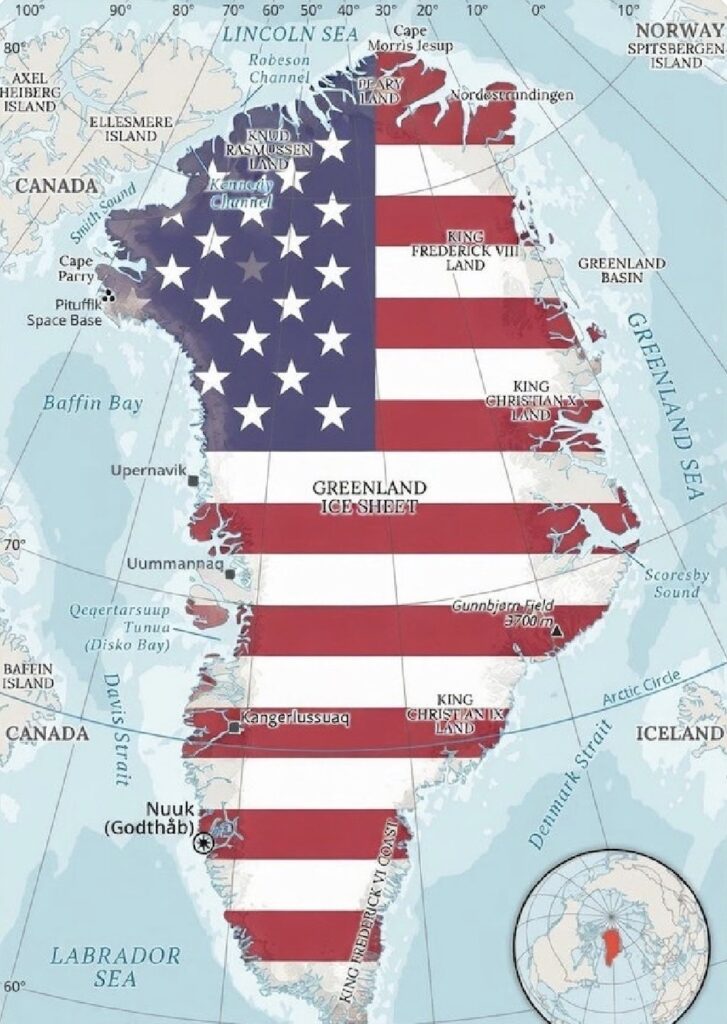
Greenland, for its part, continues to be an object of strategic interest due to control over Arctic routes, resources and military projection. Here too, international law becomes flexible when major interests collide.
Scenario 6: coercive projection in Africa and punishment of emerging powers
The African continent, particularly the Sahel, appears as a space for indirect intervention under the discourse of the fight against terrorism and regional security. The withdrawal or weakening of European actors opens space for aggressive repositioning. South Africa, a member of the BRICS group and a relevant political actor, may become a target of sanctions, economic pressure or diplomatic isolation if it deepens its alignment with China and Russia.
Here coercion takes more sophisticated forms: financial punishment, trade blockades, pressure on strategic companies and influence operations.
A board without clear rules
These scenarios are not prophecies or written plans. They are possibilities opened by a change of phase. What happened in Venezuela does not inaugurate a new era of alternative legality; it inaugurates a stage in which legality ceases to be a reliable limit. The message is that power is willing to act first and discuss later.
For Latin America and the Global South, the lesson is uncomfortable but clear. Neutrality no longer guarantees protection. Diversification of alliances, institutional resilience and sovereign control over strategic infrastructure become matters of political survival.
The board has become harsher and the game has changed its rules. And after Venezuela, no one can say they were not warned.



