

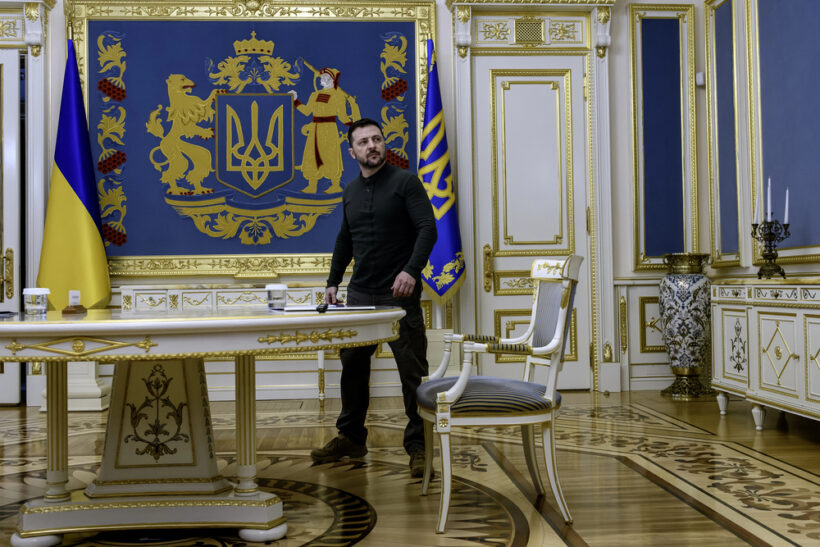
Washington brands Nicolás Maduro a dictator, celebrates Volodymyr Zelenskyy as democratic, and sponsors María Corina Machado to achieve regime change in Venezuela rather than promote genuine democracy.
By Roger D. Harris
Within the narrow spectrum of establishment punditry, “dictator” functions as a term of opprobrium reserved for governments Washington designates as enemies. By this measure, Maduro is cast as the dictator, while Zelenskyy is sanctified as democratic.
Ronald Reagan’s UN ambassador, Jeane Kirkpatrick, wrote about a democracy “double standard” in 1979. A Democrat turned anti-communist neoconservative, she formulated a convenient rhetorical distinction. The so-called Kirkpatrick Doctrine supported “authoritarian” traditional dictatorships and opposed leftist “totalitarian regimes.”
In its modern incarnation, the Brookings Institution argues that US geopolitical interests justify backing “friendly” autocrats while opposing “regimes” critical of Washington.
Thus Ahmed al-Sharaa, former Al Qaeda “terrorist” and now head of Syria after a US-backed coup, was welcomed to the Trump White House. A week later, the “benevolent monarch” from a country that does not even bother to hold national elections – Saudi Crown Prince Mohammed bin Salman – graced the Oval Office.
Ukrainian exceptionalism
What about the leader who banned opposition parties, shuttered critical media, arrested political opponents, closed trade unions, sent security forces into churches, and persecuted speakers of Ukraine’s main second language? When Zelenskyy’s term in office was set to end on May 20, 2024, he declared martial law to suspend elections.
Yet Senate Democrats still deem Zelenskyy to be in “the front lines of democracy.” Forbes praises his “moral velocity.” NPR anoints him an “icon of democracy.”
While Trump and company may have uttered unkind words about the Ukrainian president, follow the money. The US has showered Ukraine with $128–137 billion in aid since Trump took office.
Ukraine is widely recognized as being caught in a war. Yet the deadly hybrid war against Venezuela is rendered invisible – reduced to merely “sanctions” against an errant regime or at most “pressure.” The latest escalation involves what are euphemistically called “kinetic strikes” on small boats, backed by the largest armada in the Caribbean since the 1961 Cuban Missile Crisis. The most recent act of war, the seizure of an oil tanker, has been condemned by the Venezuelans as “international piracy.”
Causalities in the Ukraine war are mourned, but the over 100,000 fatalities by US sanctions in Venezuela are ignored. Both are at war and should be judged by the same standards.
Venezuela – the exception that proves the rule
Since Hugo Chávez’s 1998 victory and the initiation of the Bolivarian Revolution, Venezuela has held over 20 national elections. Washington deemed only the two won by the opposition as legitimate, proving the operative rule that “democracy” is attained when outcomes please the hegemon.
Maduro first ran for president in 2013 after Chávez’s death. The US was the only country not to recognize his win.
In 2018, Washington’s regime-change offensive of sanctions, amounting to illegal collective punishment, and other coercive measures was taking its toll. The US called a boycott of the presidential election, hoping to achieve by extra-parliamentary means what it could not attain by the ballot. Declaring the contest illegitimate six months before the actual vote, Washington even threatened opposition politician Henri Falcón with sanctions for running.
Venezuela did not fall in 2018. Falcón came in second with 21% of the vote after Maduro, who the US again refused to recognize.
The following year, Washington tried a new “democracy promotion” gambit. Juan Guaído, after receiving a call from Trump’s VP Michael Pence, declared himself “interim president” of Venezuela on a Caracas street corner. The 35-year-old had never run for national office. This embarrassment lasted until 2022, when Guaidó’s own opposition found him so toxic that he was given the boot.
The making of Nobel Laureate María Corina Machado
Ahead of the 2024 Venezuelan presidential election, Washington’s regime-change campaign had “failed.” Maduro’s resolute political leadership and the unbroken civilian-military unity had defeated Washington’s illegal measures.
The Biden administration faced a choice: boycott again and hand Maduro an uncontested mandate, or back a candidate and thereby legitimize elections in a government it refused to recognize. Washington’s workaround was to promote a candidate who could not legally assume the presidency.
The audition began with a US House Foreign Affairs Committee “bipartisan roundtable” in February 2024 featuring María Corina Machado as the sole opposition candidate. Machado had been disqualified in 2015 from running for public office due to treasonous activities. But the fanatical Zionist was photogenic, fluent in English, and came from one of Venezuela’s wealthiest families.
Even so, Washington’s favorite was not a consensus candidate among those opposed to the ruling Chavista party. Widely resented, Machado belonged to the extreme insurrectionary wing in a fractious field of competing opposition groupings.
She returned to Venezuela to stage a dubious “opposition primary,” not run by the electoral authority but by her own private NGO, Súmate, which had received NED funding. Machado claimed an implausibly lopsided victory and destroyed the ballots, eliminating any possibility of verification.
Barred from running, Machado hand-picked Edmundo González Urrutia as her surrogate. A minor Foreign Ministry official in the 1980s, he was unknown even in rightwing circles. With Washington and the corporate press running interference, González did not even bother to leave the capital city during the campaign. Which was just a well since his platform of privatization at home and genocide in Palestine was far more popular inside the Beltway than in Venezuela.
Predictably, both Maduro and González claimed victory. The contested election went to the Venezuelan supreme court, which required all candidates to submit their evidence proving they won. Largely underreported in the US press, González refused to submit anything, leaving no legal pathway for him to be declared president, even if he had won. Even Trump, disputing his 2020 defeat, fought it out in the courts.
To this day, the US has not formally recognized González as president of Venezuela. Why bother when the objective of demonizing Maduro was accomplished with a help from the fourth estate.
Propaganda gap
As MAGA mavens might say, exporting democracy exhausted our strategic reserves at home. Masked ICE agents now have license to terrorize US cities.
Trump rationalizes the mission against Venezuela as a war on narco-terrorism. The problem is that few buy the alibi from the world’s largest consumer of narcotics, leading drug money launderer, and top gun runner to the cartels.
Proving the obvious, Trump sprung Juan Orlando Hernández from federal penitentiary, after the former Honduran president was convicted in US courts of aiding in the importation of over 400 tons of cocaine. Sentenced to 45 years for running a “narco-state.” Hernandez was freed in Trump’s undisguised interference in Honduras’s November 30 presidential election.
As Trump’s hypocrisy on narco-trafficking and his weak justification for naked imperial aggression falter – and as US public opinion rejects further escalation – the corporate press has moved in to fill the propaganda gap, justifying “Maduro must go.”
In the end, the “dictator” narrative reveals less about Venezuela or Ukraine than about Washington’s geopolitical imperatives. Media caricatures, selective indignation, and shifting standards of legitimacy validate intervention when convenient and dismiss democratic processes conflicting with US aims. Stripped of moral pretenses, the discourse reduces to a simple calculus: allies are democratic by definition, adversaries authoritarian by decree, The empire’s issue is not democracy, but domination.
Roger D. Harris is a founding member of the Venezuela Solidarity Network and is active with the Task Force on the Americas and the SanctionsKill Campaign



