

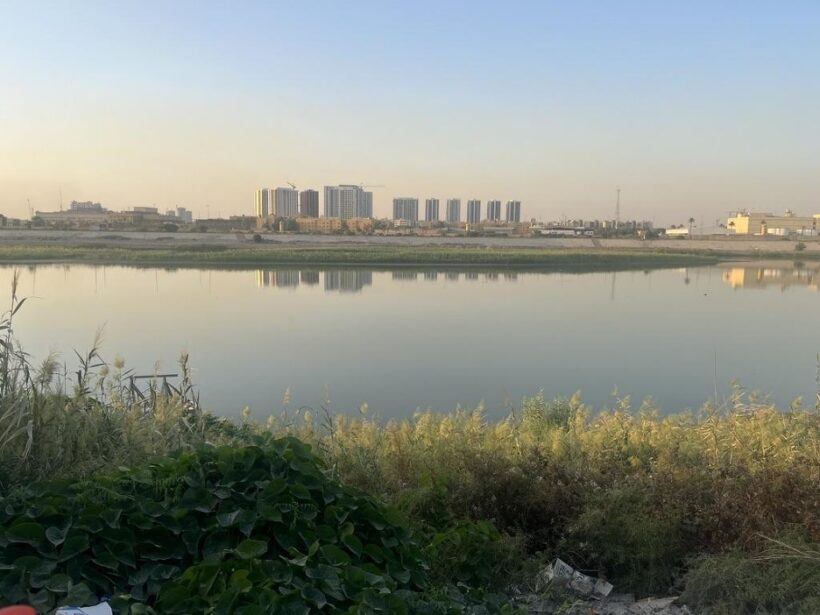
I arrived at the Taj Hotel in Baghdad’s Jadriyah neighborhood at 6 a.m., worn thin by the long flight from Los Angeles. After sleeping until mid-afternoon, I stepped out into the 90-degree heat on a simple mission: find falafel, fries, and a place to exchange money. A local bus picked me up and dropped me right across from a falafel shop—a small act of hospitality. Full and settled, I walked beside the Tigris River, watching construction cranes against the sky. Life was visibly moving forward. Yet the mental newsreel kept playing: bombs falling on these same banks twenty years earlier. I was a tourist now in a country I had once protested my own nation for invading. Needing to escape both the heat and the weight of those memories, I returned to the hotel for Nutella cake and Iraqi tea, yet deeply conscious of the complex layers beneath the surface.
By Nancy Mancias
The next day settled heavily. We started at Tahrir Monument and the roundabout where Saddam’s statue once stood—toppled in 2003 by U.S. Marines in an image seen around the world. Today, no plaque marks the spot. Only election banners fluttered in the wind. From there, we traveled to the Arch of Ctesiphon, a soaring Persian vault from 540 AD. Nearby lay the relics of a different era: a derelict tourist complex and a museum designed by North Koreans, its walls scarred with bullet marks. Al-Mada’in, our guide remarked, had been a final stronghold against the invasion. It’s one thing to read about war and occupation; another to stand where it happened and touch the pockmarked concrete. Just yards away, young boys kicked a soccer ball in the dust, a powerful scene of life insisting on moving forward. That contrast stayed with me: the tourist complex, once a thriving vacation spot with a luxurious pool, is now a place to store garbage. Aside from the enduring Arch, the entire area lies in ruins, destroyed in the war and never rebuilt. Who knows if it ever will be. For some parts of Iraq, rebuilding only began around 2017, over a decade after the invasion. With elections approaching, I wondered about Iraq’s future—and what accountability looks like when destruction runs so deep.
A slower day followed, wandering through Old Baghdad: its bazaar, colonial facades, antique shops, Christian churches, and tea houses thick with the smoke of cigarettes. But I felt an unease seeing Saddam-era memorabilia, like old currency, sold as casual souvenirs. My time in Iraqi Kurdistan, at Amna Suraka and Halabja Memorial, had shown me the human cost of his brutal regime. Later, we passed the haunting cement skeleton of one of Saddam’s grand mosques, frozen mid-construction by the 2003 war. It stood empty, monumental yet abandoned, like a set from Dune—a stark metaphor for interrupted futures.
We traveled to Babylon. Before entering, we paused before one of the last remaining monuments to Saddam. His image is now outlawed; we gazed at the bullet marks and graffiti scoring the stone. Nearby, his palace loomed over the Euphrates—a hollow shell gazing across timeless dust. After roaming Babylon’s ruins, we crossed a low fence onto the palace grounds. Entering the space once occupied by a brutal dictator again filled me with unease. While others explored the looted, spray-painted halls, I was struck by the collision of histories here: ancient civilization, the US invasion, and the regime’s own atrocities against the Kurds.
From there, we journeyed to Karbala and the breathtaking Al-Abbas Holy Shrine. I wore an abaya to enter, humbled by the devotion, chanting, and crying that resonated in the air. The contrast stayed with me: between ransacked palaces of fallen power, land ravaged by war, and this enduring faith. We paused briefly at one of the world’s largest cemeteries in Najaf before visiting the Holy Shrine of Imam Ali. The long drive south to Nasiriyah that followed gave me space to hold all these layers: history, belief, silence, and dust.
A highlight came in the Mesopotamian Marshes. Gliding by water buffalo through vast wetlands, said to be the Garden of Eden, I felt a deep connection to this ancient ecosystem and the Indigenous communities who sustain it. The use of reeds to build entire homes felt like a quiet miracle. Later, we visited the Great Ziggurat of Ur—a stairway to a Sumerian sky. We moved through biblical landscapes that day, though in the distance stood an old American military base, now repurposed by the Iraqis. Someone showed me photos of U.S. soldiers standing on those same Ziggurat steps.
As I leave Baghdad, I carry a sense of Iraq’s resilience, the palpable scars of war, the warmth of its people, the hope for a better future, and the ongoing story of a nation rebuilding itself. Now, as the world’s attention drifts to other conflicts, the weight of history here feels so obvious. The US footprint left in Iraq is deep—and as it threatens Iraq with sanctions, it is the last thing this country needs as it tries to move forward and heal.
Nancy Mancias, a dedicated organizer and educator, pursues her doctorate as an act of feminist decolonial scholarship, transforming anthropology from within the California Institute of Integral Studies. Her over 16 years as a CODEPINK Campaign Organizer demonstrate a profound commitment to grassroots, transnational feminist solidarity and dismantling imperialist frameworks. She intentionally wields her MBA from Dominican University of California to challenge capitalist structures by supporting the administrative and pedagogical foundations of justice-oriented programs. Her writing, such as the contribution to Beautiful Trouble: A Toolbox for Revolution, serves as a tool for liberatory praxis, merging theory with direct action. In her roles across academia, she acts as an administrator and an institutional weaver, creating space for marginalized knowledges and supporting the next generation of scholar-activists.



