

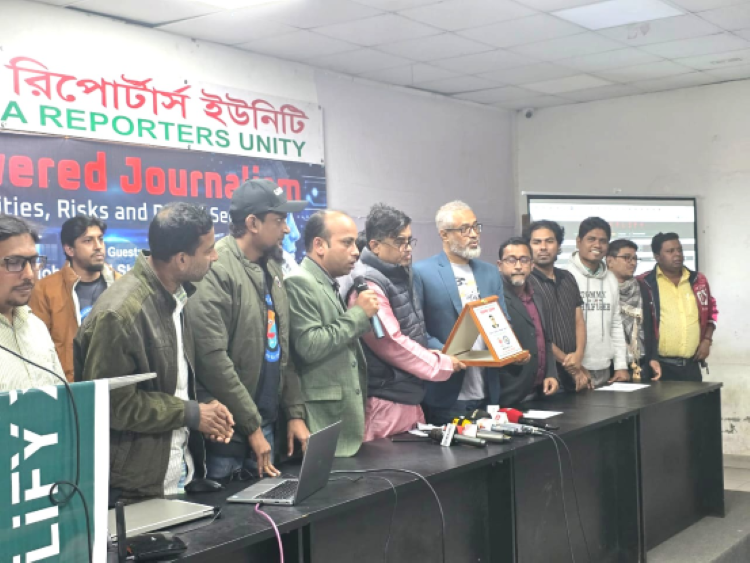
by Zahida Islam Chhanda (Dhaka Bureau)
Shafiqul Alam, Press Secretary to the Chief Adviser of the Interim Government, stated that Artificial Intelligence (AI) is rapidly transforming the traditional landscape of journalism. While the pace of work has increased, so has the risk of misinformation, fake images, and deepfakes. In this context, emphasizing the need to use AI while maintaining the core ethics of journalism, he said that if used correctly, AI can significantly enhance a journalist’s individual capabilities. Previously, where a journalist’s productivity was around 30%, it can now be increased up to 80%.
However, the most dangerous aspect of AI is the misuse of fake images, videos, and photocards. AI can be used to trim and distort long speeches in such a way that it becomes difficult for the general public to understand the original context. He warned that such content creates confusion in society and is becoming a tool to influence public opinion deliberately.
He shared these insights on Saturday (December 27) at the closing ceremony of a two-day training workshop titled ‘AI-Powered Journalism: Opportunity, Risk, and Digital Security.’ The event was organized for members of the Dhaka Reporters Unity (DRU) at the Shafiqul Kabir Auditorium, sponsored by Gameplify.xyz, a tech firm and the world’s first sports-based social media platform.
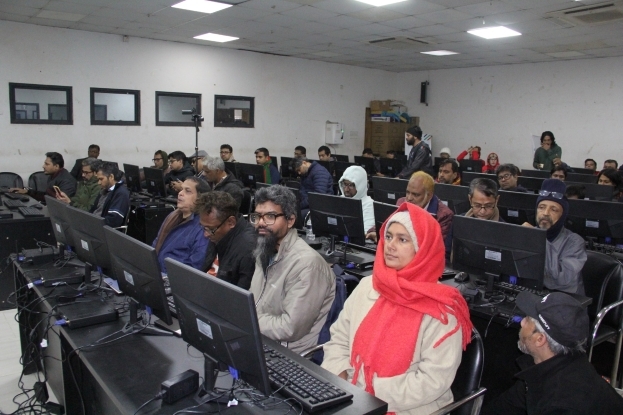
Trainees participating in the training workshop entitled ‘AI-Powered Journalism: Opportunities, Risks and Digital Security’.
Presided over by DRU President Abu Saleh Akon and moderated by General Secretary Mynul Hasan Sohel, the event also featured speeches by Mahfuzur Rahman, CEO of Gameplify.xyz, and DRU ICT and Training Secretary Mahmud Sohel.
As the chief guest, Shafiqul Alam remarked, ‘Whether journalism becomes AI-dependent or not, its ‘Golden Standard’ or fundamental principles will never change. Every piece of information must have a specific source, and every quote must be 100% accurate. There is no room for compromise here.’ He added, ‘Due to deepfakes, we are now facing constant harassment through photocards. I have been a victim myself. My 27-minute speech was stitched together to fit into one minute- it’s unbelievable. Therefore, those who do not know AI should not practice journalism, knowing that AI is now a moral responsibility. As long as we are not technologically self-reliant, journalists must play the role of fact-checkers.’
Shafiqul Alam noted that major digital platforms such as Facebook, Instagram, or X often allow the spread of hate and misinformation under the guise of ‘Freedom of the Press,’ yet these platforms lack effective accountability. He reminded the audience that hate speech spread on social media has endangered minority communities like the Rohingyas, leading to horrific humanitarian disasters. Due to a lack of technological independence, many countries are becoming reliant on these global platforms.
He believes the misuse of AI is also becoming a major threat to democracy. Incidents such as influencing elections, creating social instability, and jeopardizing the security of minority communities are on the rise. Therefore, ethics and effective monitoring in AI usage have become essential.
The Press Secretary added, ‘AI literacy is a mandatory subject. It is impossible to practice journalism today without it. This is not just for career advancement, but to protect democracy and minorities by identifying fake information and deepfakes. AI misuse is being used to obstruct elections and social stability. Therefore, being aware of this is a journalist’s moral duty.’
Shafiqul Alam stated, ‘For those who say they do not know AI, it will be difficult to survive in journalism in current times.’ He urged all media workers, including more than 2,000 members of the DRU, to learn AI- both to improve the quality of their work and to quickly identify dangerous misinformation.
He compared AI to a sharp knife. In his words, ‘The use of AI is like a sharp knife- it can be used to finish work quickly and make life easier, but in the wrong hands or through carelessness, it can cause deep wounds or social chaos. Therefore, mastering the skill or literacy of handling this knife is the path to liberation for journalists.’
In his closing remarks, DRU President Abu Saleh Akon called for utilizing technological knowledge to counter Indian and other foreign hegemonies. DRU General Secretary Mynul Hasan Sohel said, ‘This unique training was organized to prepare journalists to keep pace with rapid technological advancements. The ability to verify which content is AI-generated and which is not has become indispensable for journalists.’
He added that responsible journalism is impossible without knowing how AI works and its limitations. However, AI is not a replacement for journalists but a tool to enhance their strength. He also mentioned that the DRU would continue such workshops throughout the year to keep reporters ahead in information technology.
Joining via Zoom from Seattle, USA, Moshiur Rahman, founder of Gameplify.xyz, emphasized the need to build a healthy environment away from the negative impacts of social media. He noted that media workers must be more cautious in verifying information and expressed hope for future joint ventures.
A quiz competition on the training topics was held at the end of the event, with DRU members Saif Khondoker, Gazi Anowar, and Al Amin Azad receiving prizes.
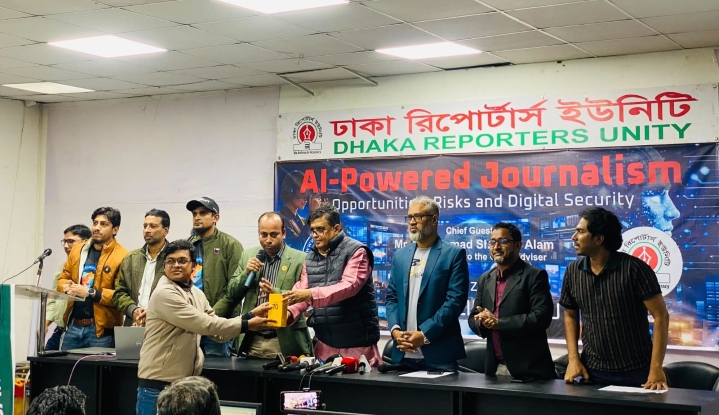
A quiz competition was held among the participants on various topics of the two-day training. DRU member Saif Khandaker was the first to receive the award from the chief guest.
Other attendees included DRU Vice President Mehedi Azad Masum, Joint Secretary Jafar Iqbal, Organizational Secretary M.M Jashim, Women’s Affairs Secretary Jannatul Ferdous Panna, Entertainment Secretary Aminul Haque Bhuiyan, and Executive Members Al Amin Azad, Suman Chowdhury, and Md. Mazaharul Islam.
The Author:

Zahida Islam Chhanda: Contributor, Pressenza- Dhaka Bureau.



