
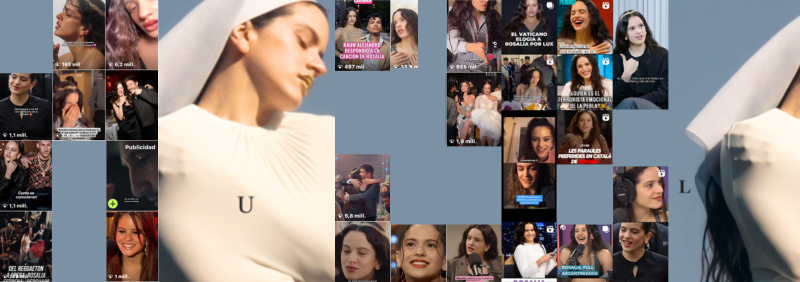
Rosalía has just ascended to the altar of light with her lates album “LUX”, a release that once again places her at the centre of cultural debate. Her new album offers a gaze toward feminine mysticism, casting light on the possibility of rethinking a more critical future. It can be both seen and experienced as an attentiveness to the inner world, and as a space of resistance in a time marked by confusion, digital noise, and disinformation.
Social media was quick to ignite, just as the hearts of the mystics in whom Rosalía seeks refuge, inspiration, answers, meaning, faith, and love were set ablaze… The morning after the premiere, the algorithm spoke only of mystical women. Tickets for her concerts in Spain sold out in a question of minutes. For those who had long been studying Hildegard of Bingen, Saint Teresa of Jesus, or Simone Weil from the margins, the phenomenon sparked surprise—and a certain FOMO—, upon seeing influencers and content creators jumping on the topic as if they had devoted their entire lives to studying them.
The shift is striking: suddenly, the digital ecosystem gathers around historical figures whose contributions have traditionally been relegated to academic or religious spheres; becoming now at the front scenery. An unexpected but promising movement, opening possibilities for thinking about new forms of spirituality, critical thought, and inner search among younger generations.
Despite hasty readings, LUX does not point toward religious fanaticism or a conservative turn. The album, performed in 14 languages, a contemporary Tower of Babel, where cultures, traditions, and sensibilities converge rather than collapse, converge. Rosalía proposes a global approach to mysticism, detached from a single faith and oriented more toward a symbolic and emotional territory. Her lyrics do not resemble mystical prayer: “sin pecado concebida” (means conceived without sin) is ultimately replaced by “I’ll fuck you till you love me”; as an ecstatic and energy-charged closure in her theme “Berghain”; or as she uses contemporary terms to redefine the omnipresence of God, in the song “Dios es un Stalker” (God is a Stalker). We find clear references to the transformation of the Human into the Divine, the search for transcendence, and the annihilation of the ego to achieve union with light.
Historically, feminine mysticism has been a form of reclamation and autonomy in contexts where women had limited access to thought and public speech. From Saint Teresa, who founded 17 convents and organized female support networks, to Hildegard of Bingen (1), who led monasteries and left an interdisciplinary legacy, those figures built communities, structures, and discourses that overflowed their own spiritual circles and far outpaced their epocal mindset. The same is true of “Sun Bu’er” in Taoism (2), “Rabiʿa al-ʿAdawiyya” in Sufism, or Simone Weil in philosophy and social action. Inner strength and meaning guided these women.
In this context, Rosalía’s interest in mysticism raises deeper questions: should we ask why a young generation is delving into questions in an act of inner search? Or rather, what led us to disconnect from that inner search?
Throughout the centuries, several mystical schools have explored inner states of being ina practical way that today resonate with debates about meaning, connection with Nature, and the relationship between body, mind, and community.
From this perspective, LUX can be read less as a stylistic gesture than as a symptom. It points to the possibility of an inner reawakening in contemporary society, particularly among younger generations increasingly detached from inherited forms of meaning. To grasp this, the album must be understood beyond its aesthetic surface.
What these mystical women offered in their own historical moments was not merely doctrine or devotion, but a form of inner strength capable of generating social structures, language, and continuity. Their legacy endures because it addressed a need that remains unresolved. What may appear superficial today can, under certain conditions, be transformed into creative force and cultural renewal within a society showing signs of exhaustion.
Legacies do not return by chance. They are reclaimed when they resonate as answers to contemporary questions—and they require figures with the symbolic capital to reactivate them. In this sense, Rosalía occupies a singular position: not as a mystic, but as a cultural mediator with the capacity to translate, amplify, and reframe these traditions for the present moment. There, Rosalía undoubtedly holds all the cards.
LUX is an album that celebrates meaning and joy for life, with notes of love and heartbreak, where the tension between the spiritual and the carnal, freedom and discipline, mysticism and matter, divine love and human love overlap. The depth and cry of the singer’s voice elevate the senses.
How can the mystical spirit be projected in the contemporary moment? How can we reclaim the profound work that these women carried out with such effort, aiming to shed light on the darkness? What can Rosalía contribute to this entire event? How will this cultural “film” she has set in motion continue?
—
(1) On Saint Teresa of Jesus and Hildegard of Bingen, a study can be found in the book:
LAS MÍSTICAS. OTRO ESTADO DE CONCIENCIA. Ed. León Alado.
(2) In the monograph «El secreto de La flor de Oro», we can find a study on Taoism as well as some of the most representative mystical women.