

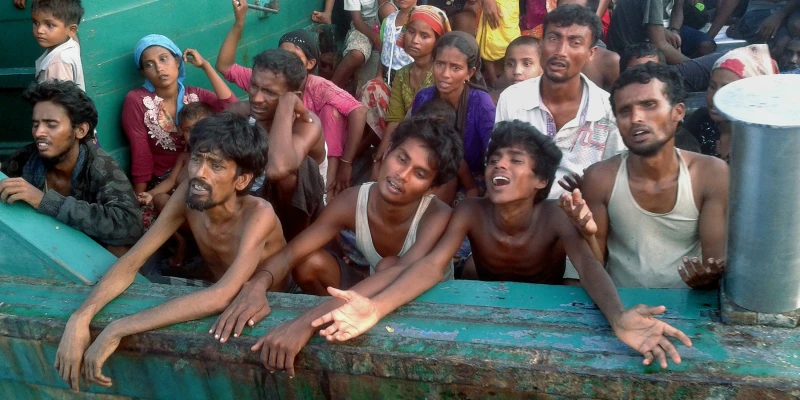
The word Rohingya refugee is about to settle in a dictionary now. Only woes continue for Rohingya refugees and make the atmosphere hostile, dump, nasty, and self-contained interest of some neighboring countries. Above one million Rohingya refugees are now becoming a burden for Bangladesh, which has suffered chronic difficulties not only in getting the way to returning to their homeland, but also in being a burden for Bangladesh. The issue is now getting obsolete not only for the diversion of international communities’ attention but also for changing the internal political environment of Bangladesh. Antonio Guterres, the Secretary General of the United Nations, states, “The Rohingya are the world’s most widely dispersed minority.” But this proves wrong at present.
By Md. Al-Amin
If we go back to the history of the Rohingya refugee crisis, history implies how brutal it is! When the Rohingya community lost their nationality status from Burma (present Myanmar) in the year of 1982, the sorrows continued from then on profoundly. Since the 1982 Citizenship Law, the Rohingya have faced several instances of forced displacement into Bangladesh. The first large-scale expulsion occurred in 1978 under Operation Nagamin, while about 200,000 Rohingya fled. A second major influx followed in 1991–1992 during Operation Pyi Thaya, pushing nearly 2,50000 into Bangladesh. Smaller inflows of 10,000–15,000 occurred after the communal violence in 2012, while the 2016 military crackdown produced another 70,000 refugees. The largest and most rapid exodus occurred after 25 August 2017, when more than 7,40000 Rohingya crossed the border. Even as of late 2025, about 1,50000 Rohingyas have intruded into Bangladesh. These successive waves demonstrate a consistent pattern of systematic expulsion of Rohingya refugees who were forcefully displaced to Bangladesh. About 1.2 million Rohingya refugees keenly await going back to their homes.
The repatriation process for the Rohingya was originally supposed to begin in January 2018, following the November 2017 bilateral agreement between Bangladesh and Myanmar. Under this plan, Myanmar would verify Rohingya identities, prepare reception centers, and start taking back refugees in phases. Bangladesh was responsible for compiling verified lists and arranging the logistics for safe transfer. Later, additional steps were outlined in 2019 and again in 2023, but none of the planned phases were successfully implemented due to security concerns, lack of guarantees, and Myanmar’s failure to create conducive conditions. After the July uprising in Bangladesh, the new Interim government of Bangladesh tries to find a solution to resolve this refugee crisis. Bangladesh appointed Chief Security High Representative Mr. Khalilur Rahman to the United Nations for the Rohingya refugees. Under the direct supervision of Professor Dr. Muhammad Yunus, General Secretary of the United Nations, Mr. Antonio Guterres paid a remarkable visit during the last Ramadan, where “Iftar diplomacy” was applied strategically to create pressure on the stakeholders of this issue. Even through “back channel diplomacy” under the platform of ASEAN, a diplomatic bargaining was negotiated between the Bangladesh and Myanmar sides where a decision was made to return 1,80,000 Rohingyas, but nothing good has happened yet.
Along with 33 camps, the world’s largest refugee camp area in Cox’s Bazar, Bangladesh, is struggling to operate in the face of a 63% deficit in humanitarian aid funding. There has been a series of ration cuts this year. In the immediate aftermath of the USAID cuts, 48 health facilities were forced to close or drastically reduce their services, the International Rescue Committee (IRC) says. About 300 children are seen for malnutrition in those camps every day. Last year, an urgent appeal was launched to secure an extra $85m (£64m) to meet the needs of recent arrivals. But not as much as expected is allotted for them. The United Nations & Bangladesh Government launched the 2025 Joint Response Plan, seeking around USD 935 million to support 1.48 million people, including both refugees and host communities. But reality halts the process. Now the Rohingyas try to amalgamate with locals, which creates sometimes malfunctions in the camp region of Bangladesh.
The pivotal question arises: What Could Happen to the Rohingya now? The conditions in Myanmar are still untenable for the safe, voluntary, and dignified repatriation of this sizable Rohingya population, forcing Bangladesh to host them for an extended period of time. Bangladesh has no immediate choice but to keep offering shelter and basic humanitarian assistance despite its limited resources, dwindling foreign help, and mounting social and environmental challenges in the host towns. The country has been heavily burdened by this ongoing obligation, which has made the Rohingya predicament a protracted and more difficult humanitarian issue.
The most likely scenario is a protracted, unresolved refugee crisis in which the Rohingya continue to live in Bangladesh under growing humanitarian strain and have very little hope of being repatriated or resettled until Myanmar radically alters its citizenship and political policies. Fundamentally, Bangladesh has to be compelled to host this large Rohingya population for an extended period of time. The fate of these Rohingya refugees remains uncertain.
Md. Al-Amin is an educator. He completed his post-graduation from the Department of International Relations at Rajshahi University,Bangladesh. His research interests are Diplomacy, Foreign policy, Border conflicts, and Security issues.