

By G M Forhadul Mozumder (Dhaka Bureau)
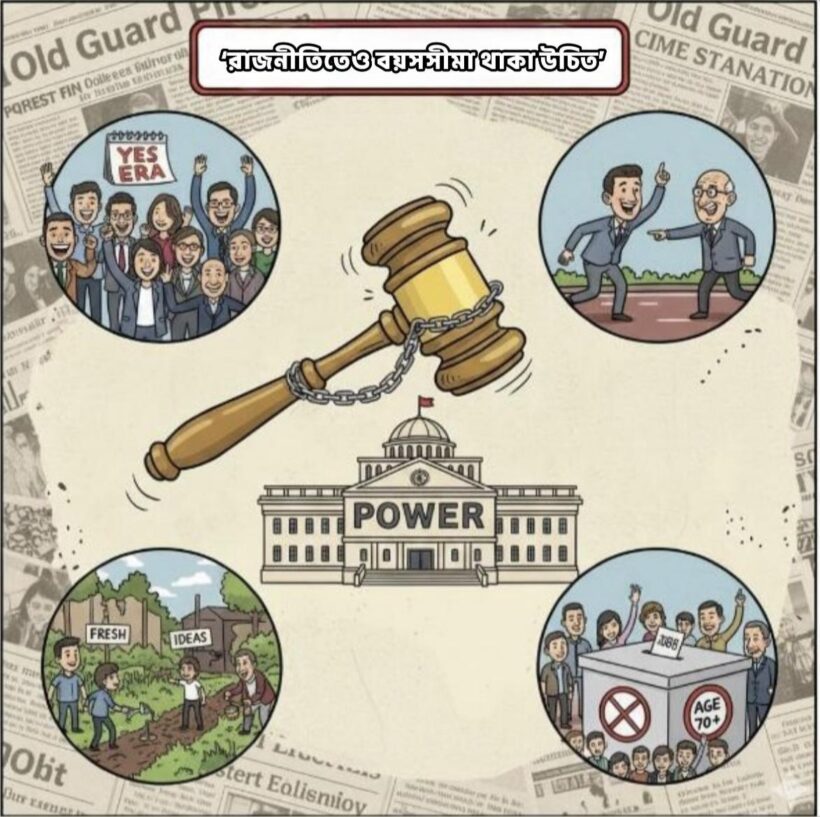
The issue of age limits and retirement in politics is extremely important. In many countries around the world, there are age requirements for taking on political responsibility. This not only maintains the quality of leadership but also opens up opportunities for the new generation, paving the way for innovation and change in politics. In our country, politics often becomes intertwined with the individual’s power. When the same person holds a position for a long period, opportunities for new leadership and the younger generation become limited. Furthermore, as age increases, physical and mental capacity can somewhat decrease, making it difficult to properly carry out stressful duties.
It is imperative to have a minimum age for political life. A minimum age needs to be set to ensure that a citizen is an adult. educated, and socially responsible. The minimum age for taking up responsibility in local elected posts could be 25 years. This will ensure youth participation and create a sense of responsibility towards leadership in society. For national or high-level posts, the minimum age could be 30 years. This will ensure that the person holding the highest responsibility in the country has acquired adequate experience and knowledge.
It is also important to have a maximum age or retirement age in politics. As age increases, the ability to cope with mental stress decreases, and carrying out the same duty for a long time sometimes has a negative impact. A maximum age of 65 years can be set for local posts and 70 years for national or crucial posts. This will ensure that leadership transitions to the new generation and reduces the long-term stagnation of power. If a leader holds the same position for a prolonged period, the path for innovation, new ideas, and change in politics becomes blocked. Having an age limit will allow young leadership to enter politics, and the country will progress with new energy, new thinking, and new plans.
Limiting the tenure of responsibility in politics is indispensable. Long-term responsibility in a single position can sometimes lead to corruption and create political stagnation. When a leader serves multiple terms in the same position, political power becomes centralized. To prevent this, re-election should be limited after two or three terms. If age limits and term limits are enforced simultaneously, opportunities for new leadership will be created in politics, and there will be a fair distribution of power.
Of course, age cannot be the sole criterion. Physical and mental capacity, skill, and leadership qualities must also be considered. Sometimes a person might be physically fit even if they are outside the prescribed age limit. In such cases, special approval can be given through an independent commission. This will ensure that qualified leadership can contribute to politics while the regular policy of age limits and retirement is maintained.
Age limits ensure the participation of the younger generation in politics. The continuous presence of the same individual in politics for a long time prevents the new generation from finding space. New leadership brings innovative ideas, new policies, and programs into politics. They bring new energy and enthusiasm to tackle new societal challenges. This results in a strong generational transition in politics, which plays a crucial role in the country’s development and public welfare.
To implement the policy of age limits and retirement in politics, an independent authority is needed. A central election commission or another neutral body should regularly verify age and ensure compliance. This will make the political system more transparent, stronger, and people-friendly, Regular age verification and accountability will help reduce political corruption, excessive centralization of power, and long-term stagnation.
Having age limits in politics brings many benefits to the country:
1. It ensures the development of new leadership. New-generation leaders bring new ideas, policies, and programs.
2. It ensures the fair distribution of political power. When long-term power is centralized, the participation and opportunities for common people are limited.
3. It ensures that responsibilities are assigned commensurate with physical and mental capacity. As age increases, performing stressful duties can become difficult.
4. It paves the way for innovation and change in politics. New leadership brings new energy, innovative ideas, and the potential for change.
While age limits and retirement policies are important, their implementation requires public awareness and coordination among political parties, Political parties must provide opportunities for new-generation leadership and prevent the long-term centralization of power. The public also needs to be aware that the transition of leadership responsibilities with age is natural and beneficial for the country’s welfare.
The policy of age limits and retirement is a reform in politics. It is not just about the distribution of power, but it also makes the political system more efficient, transparent, and people-friendly, It ensures that the innovative energy of new leadership flows into politics, creating new directions for the country’s development and public welfare. Setting age limits and tenure limits in political life will ensure a strong generational transition, transparency, and opportunities for new innovation in politics.
In conclusion, the policy of age limits and retirement in politics is not just a rule- it is a ong-term developmental step for the country. It gives the new generation a chance at leadership, ensures the fair distribution of political power, and creates innovative and strong leadership in the interest of the country. The change of responsibility with age is natural, and it will make the country’s politics stronger, more transparent, and people-friendly. If this policy is implemented, new energy, innovation, and generational transition will be ensured in politics, which will contribute significantly to the country’s sovereignty, development, and the welfare of its people.
The Author:
 G M Forhadul Mozumder, Contributor of Pressenza- Dhaka Bureau.



