

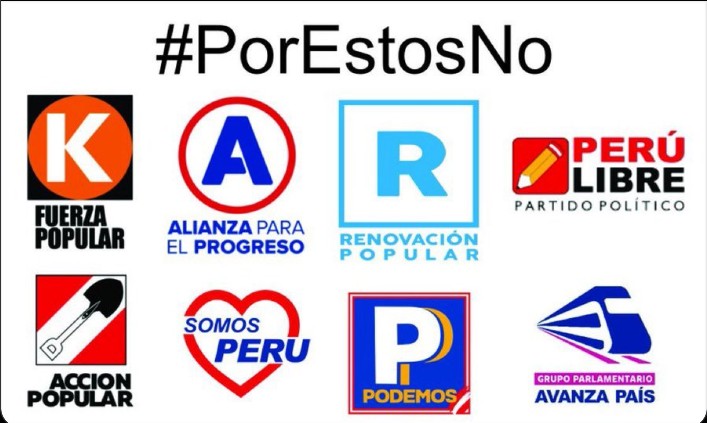
On the eve of the 2026 General Elections, a hashtag has taken over social media and moved from the digital realm to the streets: #NotForThesePeople.
By Melissa Rubio
The slogan originated as a wake-up call from commentators and digital collectives: first, a public column that gave a name to the outrage, and then countless posts on social media tagging parties and congressmen accused of protecting impunity and plundering public funds. This media seed, identifiable in Rosa María Palacios’s column, was the catalyst for gathering political memory, examples, and lists of “not to vote” candidates that are now circulating widely.
In just a few weeks, the hashtag gained traction: it wasn’t confined to Twitter or Instagram, but rather spawned stickers, posters, and public events that all echo the same message and aim to prevent the reelection or the arrival of those whom activists call “the pact.” Public figures and regional groups joined in, and the campaign gained national visibility, especially given the perception that the current Congress has made unpopular or illegitimate decisions.
#NotThesePeople
The nation has decided to use this hashtag as a form of protest against the abysmal performance of those currently in power, who have legislated behind the country’s back, enacting pro-crime laws (protecting organized crime), transforming immunity into impunity, capturing state institutions, using national funds for the benefit of this political class, shielding former president Dina Boluarte and themselves from investigations, and misusing state coffers, among other reforms that have driven the population to its breaking point.
Given this context, the population has decided to use the hashtag #NotThesePeople as a rallying cry to guide the vote, which in these elections has been divided and dispersed among more than 30 candidates.
The blacklist is headed by Fuerza Popular (Keiko Fujimori’s party, who acts as a shadow leader defining party alliances for the different reforms), Alianza para el Progreso (APP), Renovación Popular, Avanza País, Somos Perú, Acción Popular (excluded due to irregularities in internal elections), Perú Libre, APRA, PPC, Juntos por el Perú and Podemos.
Digital Protest That Escalated to the Streets
The digital protest escalated into a peaceful demonstration in Plaza San Martín, which ended with police intervention. This turned the campaign into news and revealed two things: the capacity for citizen mobilization and the risk of a disproportionate institutional response. This episode is revealing: online communication is no longer just noise; it is a driving force behind the public agenda and social conflict.
The dangerous aspect, and here the humanist perspective is unwavering, is the ambivalence: the legitimate campaign against corruption risks becoming a gateway for disinformation or polarization that fragments public debate. Furthermore, in a context where projects that would curtail freedoms—or that seek to excessively regulate expression on social media—are being discussed, all citizen action must be wary of legislation that ends up criminalizing protest and criticism.
Today, the population faces an even more arduous task: evaluating new candidates who will assume leadership of the country in the upcoming elections, ensuring they are free from any signs of corruption.
And for #PorEstosNo to become more than just headline news and a driving force for good governance, we need—in addition to civic courage—a clear plan: electoral education, verified lists based on public records, advocacy channels that demand real transparency, and, above all, a commitment to human rights and non-violence. If the slogan remains a simple “no” without any solutions, the hashtag will serve to highlight discontent, but not to govern. We demand that outrage be transformed into proposals that protect people and the common good.