

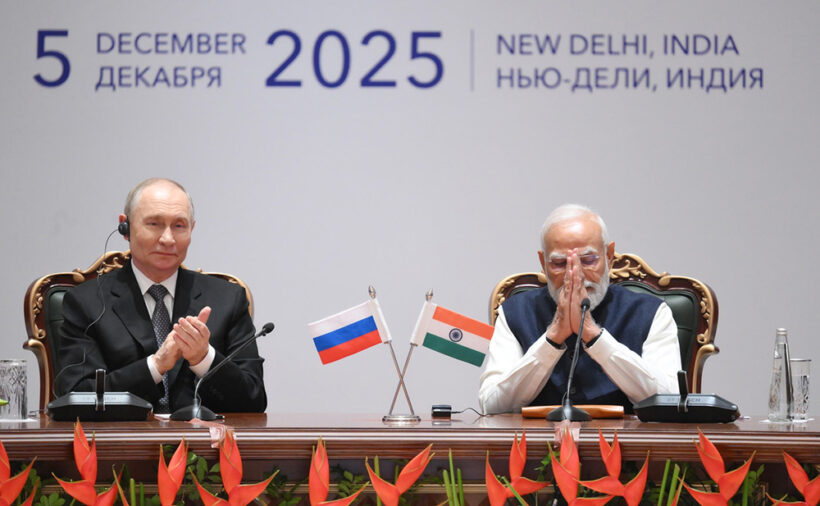
India and Russia have opened a new chapter in their bilateral relations in December 2025, with an official visit of President Vladimir to New Delhi, India. Series of meetings held were create new business opportunities, expand prospects for strengthening economic cooperation. In fact, one of the most significant interaction was President Vladimir Putin and Prime Minister of India Narendra Modi in the plenary session of the Russia-India Business Forum, heavily attended by top entrepreneurs from both countries.
New Delhi hosted representatives of ministries and departments, the heads of largest companies, banks and regions, as well as members of parliament – that is, all those who are engaged in practical efforts to promote multifaceted Russian-Indian cooperation in imports and exports, finance and investments.
Based on the fact that Russian and Indian businesses are among the most powerful pillars of the privileged strategic partnership, both parties have mutually agreed on a number of concrete areas of multifaceted economic cooperation:
(i) Expaning bilateral trade. Clearly, the opportunities for expanding bilateral trade and investment are enormous. Both Russia and India boast large consumer markets and impressive economic, technological, and resource potential. They have underlined the growing opportunities in many spheres, that need and diversified ties and further opening up markets for mutual development. Trade continues to grow steadily, with the dynamics hitting record highs of up to 80 percent over the past three years. Last year, the volume of Russian-Indian trade reached $64 billion. Modi and Putin, however, set to bring trade to $100 billion by 2030.
(ii) The intergovernmental commission has concluded a preferential trade agreement between India and the Eurasian Economic Union. It is important for both to work together, in close coordination, to remove the remaining customs and administrative barriers that impede the reciprocal flow of goods, services, and capital within the region. Free trade cannot exist without a stable system of bilateral settlements and reliable payment and insurance mechanisms. The use of national currencies also provides tangible advantages, ensuring uninterrupted financial transactions regardless of external conditions.
(iii) Naturally, the development of transport and logistics infrastructure is of particular importance. Much is already being done: the project to establish the North–South Corridor from Russia and Belarus to the Indian Ocean coast is advancing, as is the modernisation of the Northern Sea Route infrastructure, including its use for delivering Indian goods to global markets.
(iv) India and Russia plans to cooperate in the field of artificial intelligence, and for broadening this partnership Russia is interested in taking part in the AI summit planned for February 2026 in India.
(v) Collaborating as friends across a wide range of sectors, Prime Minister Modi further suggested, without much delay, adopting a number of measures, such as compliance reforms, to make doing business easier. New opportunities have opened up for the private sector, which created additional potential in this area of engaging in needed compliance reforms.
(vi) The meeting looked at logistics and connectivity. During the talks, President Putin focused on ensuring the full potential of connectivity between the two countries, whether through the North-South International Transport Corridor, the Northern Sea Route, or the Chennai-Vladivostok corridor. Showing full fledged commitment to advancing logistics and connectivity, will cut transport time and lower prices and shipping costs. It will also open new markets for businesses.
(vii) Digital technologies. The use of digital technologies can help us simplify customs procedures and regulations and create virtual trade corridors. This will speed up customs processing, reduce paperwork, and make the movement of goods more seamless.
(viii) The maritime sector is anothher priority. Recently, Russia has expanded the list of dairy product exporters from India, for example, which has expanded the opportunities for exporters engaged in trade with India. India is rich in seafood and a wide range of processed foods that enjoy high demand around the world. Creating joint ventures and promoting technological cooperation can support maritime logistics, deep-sea fishing, and automation of fishing harbours. Doing so will not only help meet demand in Russia but also create a new market for Indian-made products.
(ix) The next priority is the automotive sector. India is a global leader in the production of affordable and cost-effective electric vehicles and other modes of transportation. Russia is an important producer of advanced materials. Together, in partnership, both can ensure highly efficient production of electric vehicles, automotive components, and various other mobility technologies. Achieving this will also contribute to the development of the Global South, particularly the African continent.
(x) The pharmaceutical industry. India supplies high-quality medicines at affordable prices worldwide. This is precisely why India is often referred to as the “pharmacy of the world.” Together, India and Russia have agreed to collaborate on the joint development of vaccines and cancer therapies and strengthen pharmaceutical supply chains. This will not only bolster healthcare systems but also foster the growth of new industries.
(xi) The textile industry. India possesses vast potential in the production of both natural and synthetic fabrics. Globally, India is recognised as a leader due to advanced designs and manufacturing expertise. Russia is a key producer of polymer and synthetic materials. Together, they plan also to establish a sustainable textile industry supply chain.
(xii) There are also further opportunities for cooperation in sectors such as fertilisers, cement production, and electronics.
(xiii) Population mobility plays a crucial role in strengthening cooperation across all sectors. Today, India is emerging as the global capital of skilled human resources. It has the potential to meet global demands across all fields, including technology, engineering, healthcare, construction, and logistics. Given Russia’s demographic and economic priorities, this partnership could prove immensely beneficial for all participating nations. By providing opportunities for Indian citizens to learn the Russian language, this can cultivate a workforce that is proficient in Russian, thereby contributing to the prosperity of both nations.
(xiv) Cultural tourism. Today, highly significant decisions have been agreed upon and adopted regarding tourist visas for citizens of both countries. This will facilitate increased tourism flows, create new business opportunities, expand prospects for tour operators, and open up new employment opportunities.
In conclusion, India and Russia together stand side by side in this new journey of joint economic initiatives, undetaking production and creation, – these aim at ensuring the well-being of humanity, and the need for long-term solutions to the existing global challenges. India is prepared to work shoulder to shoulder with Russia on this new path, and perhaps for the benefit of the entire world.



