

Across the arid pampas of Tarapacá and Antofagasta, in the late nineteenth and early twentieth centuries, Chilean nitrate mining camps erected a system of total domination that went far beyond ordinary labor exploitation. Thousands of workers—Chileans, Bolivians, Peruvians, Croatians, Italians—lived in isolated company settlements, surrounded by barbed wire and armed guards, where the English or German overseer not only controlled their bodies during twelve-hour shifts under the scorching sun, but also their pockets and their inner lives. Wages did not arrive in silver sovereigns or in free pesos that could circulate in open markets; instead, they came in tokens or vouchers—company-store tokens—redeemable exclusively at the firm’s own shop. That store, its dusty shelves filled with rancid flour, salt-cured meat at usurious prices, kerosene for lamps, and cheap liquor to drown misery, was the only “market” available. The cycle was perfect and closed: the worker left the shift with tokens that immediately returned to the owner when he purchased goods inflated up to 200 percent above external market prices. There was no real freedom of choice; consumption was predetermined, the impoverished diet induced illnesses like beriberi and syphilis, and any attempt at evasion—selling tokens outside or boycotting the store—was punished with dismissal, beatings, or prison. The strikes of 1907 and 1925, the bloody massacres of Santa María and Marusia, demanded not only higher wages but the abolition of this economic tokenism: they wanted free currency, open markets, sovereignty over their own consumption. The company store was not just a shop; it was the emblem of a power that pretended to be commerce while perpetuating servitude—a regime where the form of free transaction masked the essence of absolute control.
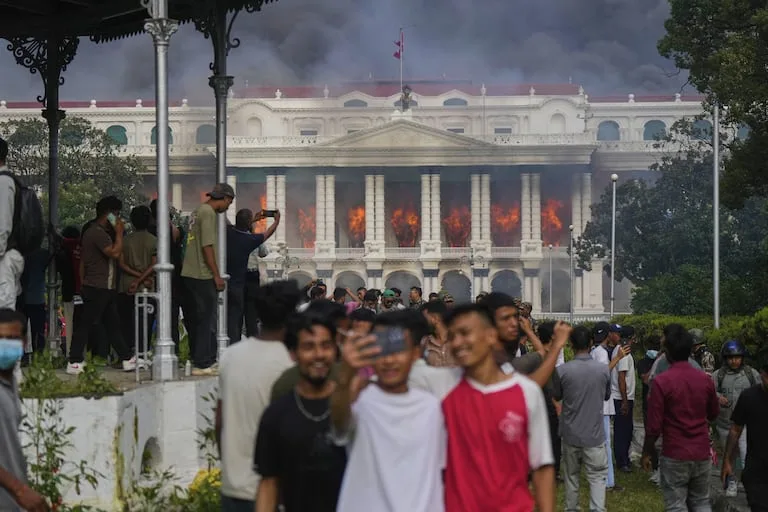
This mechanics of the nitrate company stores—tokens issued by the owner, redeemable only within his own circuit, perpetuating a one-directional flow of wealth back into his vault—finds its exact echo in today’s representative democracy. It is precisely against this “company-store democracy” that Generation Z refuses to reject the democratic ideal; instead, it judges it implacably and delivers a sentence without appeal. Across every cited study—from Joshua Kurlantzick at the Council on Foreign Relations to the theses of the Tricontinental Institute, alongside the surveys of CIRCLE-Tufts, the Friedrich Naumann Foundation, and Jean-François Bayart’s post-Marxist analysis—a unified thesis emerges: young people do not reject democracy as a principle—free elections, equality before the law, accountability—but declare it failed in its current version because it operates like those company stores. Political parties and candidates are the “tokens” the system issues every four years: a reduced menu of options pre-fabricated by party elites, financed by corporations and lobbies, representing not popular will but transnational accumulation agendas. You vote for the “red” or the “blue,” but both tokens return to the same owner—financial capital, corporate think tanks, bureaucratic cúpulas—in a closed cycle in which public policy prioritizes sovereign debt, bank bailouts, and privatizations over affordable housing, universal healthcare, or ecological transition. Kurlantzick, from his liberal-centrist vantage point in Asia, documents how Gen Z in Nepal and Bangladesh topples governments not out of ideological anti-capitalism but because rampant nepotism turns the state into a family company store; CIRCLE reveals that 62 percent still values democracy in the abstract, but only 40 percent finds it “good” in practice because it does not resolve real precarity; Naumann certifies support for human rights but warns of erosion under oligarchic illiberalism; Tricontinental denounces neoliberal exhaustion where the vote becomes a useless token before imposed austerity; and Bayart, anti-national-liberal, sees in these revolts the ambivalence of a political subjectivity that demands breaking factional clientelism. The verdict is clear and global: this democracy is not representative because there is no real freedom of choice—only tokens issued by the owner—and Gen Z, from Morocco to Indonesia, judges it guilty and condemns it to radical reform or collapse, prioritizing direct participation, recall mechanisms, and citizen oversight over the empty electoral ritual.
The current crisis of democracy, exposed and accelerated by Generation Z, is forcing a rewriting of governance rules across almost every continent. This is not a “left-wing” or “right-wing” revolt but a transversal insurrection against systems that preserve the democratic form while hollowing out its representative substance.
How does this crisis of democracy, spearheaded by Generation Z, affect governance? This is the thesis: it is transversal.
The analytical narrative from end to end
The current crisis of democracy, exposed and accelerated by Generation Z, is forcing a rewriting of governance rules across almost every continent. It is not a “left-wing” or “right-wing” revolt but a transversal insurrection against systems that retain the democratic form while emptying its representative content.
From the ballot box to the control dashboard
Joshua Kurlantzick, a U.S. liberal-centrist analyst and senior fellow for Asia at the Council on Foreign Relations, describes Gen Z movements in Nepal, Indonesia, Sri Lanka, and Bangladesh as capable of toppling governments but still too weak to transform that energy into sustained governing and legislative capacity. His diagnosis is crucial for understanding governance: governments can no longer limit themselves to electoral ritual; they must share agenda and power with a young citizenry demanding measurable results in corruption, public services, and inequality.
The joint report by CIRCLE (an academic center at Tufts University, without explicit partisan affiliation) and Protect Democracy (a U.S. liberal pro-democracy NGO) emphasizes that most young people support democracy in principle but consider that actually existing democracy neither resolves their problems nor meets their expectations. For governance, this means operating amid eroded legitimacy, where decisions perceived as technocratic or elite-captured face immediate contestation in the streets and online.
The Global South as laboratory
From the Global South, the Tricontinental Institute for Social Research, socialist and anti-neoliberal in orientation, reads youth uprisings in Chile, Colombia, Sri Lanka, Nepal, Peru, and Morocco as signs of exhaustion in the neoliberal governance model: states subordinated to markets, austerity policies, privatization of the public sphere. Its “seven theses” on Gen Z uprisings argue that they speak out against the combination of economic precarity, ecological crisis, and “democratic” authoritarianism, forcing states to reopen debates on redistribution, commons, and democratic control of strategic sectors.
This interpretation is complemented by analyses from the Atlantic Council, an Atlanticist-liberal Western think tank, which shows how youth pressure in Nepal, Madagascar, Peru, and Morocco has led to dissolved governments, interim cabinets, or withdrawal of unpopular policies—even as traditional elites and armed forces attempt to reconfigure regimes without surrendering real power. Governance thus enters a logic of “permanent crisis,” in which stability is no longer achieved through citizen apathy but through the capacity to incorporate—or co-opt—youth demands.
Democracy in dispute, not in retreat
Surveys by the Friedrich Naumann Foundation for Freedom, associated with German classical liberalism, show a Gen Z that continues to believe in human rights but is deeply concerned about illiberal drift and the rise of authoritarian actors within formally democratic systems. The “democratic erosion” they describe is not a rejection of democracy itself but of its oligarchic version: closed parties, top-down lists, corporate capture of the state, and public policies aligned more with creditors than voters.
From critical political sociology, Jean-François Bayart, a French scholar specializing in Africa and globalization and linked to post-Marxist and anti-national-liberal traditions, interprets these waves as symptoms of a broader crisis of representation: states continue to speak in the name of “the people,” but power practices remain organized around clientelist networks, transnational interests, and social-control devices. In this context, Gen Z revolts, though fragmented, force governments to rethink their relationship with civil society, borders, and citizenship.
Governing under generational surveillance
Organizations like Amnesty International, from a human-rights perspective, emphasize that young people from Myanmar to Iran and from the United States to Australia risk their lives and freedom to demand accountability for police abuse, mass surveillance, environmental destruction, and structural discrimination. That constant vigilance—with mobile phones, cameras, and social networks—turns governance into an exercise of permanent exposure: any abuse can go viral, any concession may be read as victory or co-optation.
At the same time, the Tufts/Protect Democracy report warns of profiles of “disengaged apathy” and “hostile dissatisfaction” within Gen Z: a minority frustrated with actually existing democracy that flirts with authoritarian solutions or with the idea of “burn it all down and start over.” Governance thus moves in a gray zone: to contain both cynicism and authoritarian temptation, it must open channels of substantive participation—participatory budgeting, youth councils, recall mechanisms—that restore meaning to the term “representation.”
A transversal spearhead
What unites these diagnoses—from the pro-institutional liberalism of Kurlantzick and CIRCLE to the critical socialism of Tricontinental and Bayart’s post-Marxism—is the recognition of Generation Z as the spearhead of a systemic crisis, not a generational whim. Students toppling governments in Bangladesh or Nepal, precarized youth overwhelming plazas in Chile, app-based workers in the U.S. or Europe unionizing algorithms: all point to the same core problem, even when confronting ideologically distinct regimes.
In terms of governance, the message is direct: either democracy ceases to behave like a political company store—a closed circuit where only the “tokens” issued by elites circulate—or the generation leading today’s protests will seek, justifiably, other ways of exercising popular power. The dispute is not between democracy and authoritarianism in the abstract but between low-intensity democracy serving the few and substantive democracy, conflictive and monitored by a citizenry that no longer accepts being a captive clientele of any regime color.
NOTE: * Term coined by the author.



