

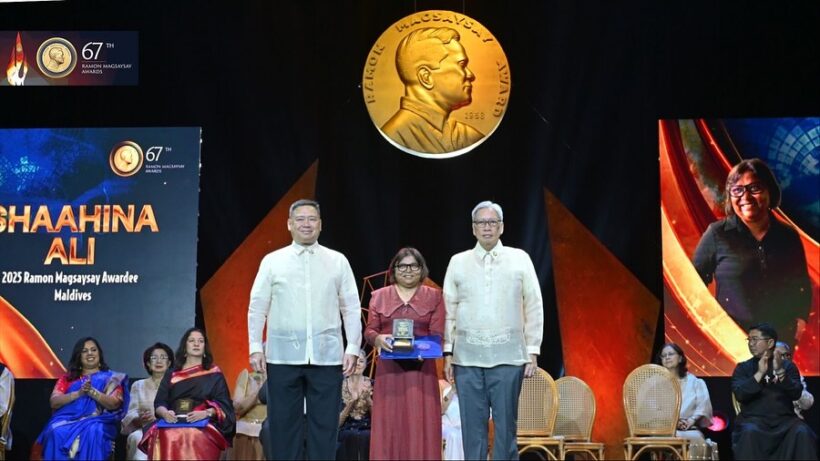
Manila, Philippines – Environmental network Global Alliance for Incinerator Alternatives (GAIA) and Break Free From Plastic (BFFP) in Asia Pacific representing thousands of organizations across over 93 countries, express strong disappointment over the Ramon Magsaysay Award Foundation’s panel on November 5, 2025 during the 67th Ramon Magsaysay Awards Festival Season in cahoots with the Asian Development Bank (ADB) which further peddle false solutions to the pollution crisis
In a letter addressed to the foundation, the giant environmental network said that this year’s Ramon Magsaysay Awards, which used to be a space for celebrating environmentally sustainable and just solutions, served as a dagger struck into the hearts of communities fighting for their rights to clean air, soil, water, health, and the environment. These communities have firsthand experience of the toxic impacts of waste-to-energy (WtE) plants, and are fighting to have these removed.
During the event, awardee Ms. Shaahina Ali described incineration as a “transitional solution” to plastic pollution. Ali also said that newer WtE technologies address pollution concerns and that these facilities offer the best option for the Maldives. These messages are promoted by international financial institutions (IFIs), such as the ADB, to legitimize incineration as a formal waste management method in the region. WtE releases high levels of greenhouse gases that worsen the climate crisis. It also threatens food and water systems, damages ecosystems, and exposes communities to rising sea levels and more extreme weather.
The civil society organizations emphasize that ADB remains one of the largest financiers and policy architects promoting WtE incineration in the Asia Pacific. Since the Paris Agreement was adopted by countries in 2015, ADB provided USD 15.3 billion to 49 projects with incineration components and policy reforms institutionalizing false solutions such as plastic credits through loans, grants, equity investments, and technical assistance. ADB’s financing for plastic pollution locks countries into a linear and unsustainable model of plastic production.
“In a world where urgent actions are needed to address plastic pollution, debt burdens, and limiting the rise in global temperatures to 1.5 degrees Celsius, we urge the Ramon Magsaysay Award Foundation to inhibit from staging unethical, inappropriate, and unjust development alternatives,” said Mayang Azurin, Deputy Director for Campaigns at GAIA Asia Pacific. “RMAF must instead set the development discussions toward empowering community solutions moving toward transformative shifts instead of echoing the agenda of international financial institutions like the ADB and World Bank.”
Civil society organizations also urged the award-giving body to seriously rethink the narratives of what sustainable and just solutions are celebrated in the region by recognizing community voices, and respecting science-based facts and policy directions against what is peddled as solutions by IFIs such as the ADB. International groups offered cross-learning with the award-giving body to navigate complex but solvable problems without resorting to false solutions.
Civil society leaders from the region have this to say:
Marian Ledesma, Zero Waste Campaigner, Greenpeace Philippines, said:
“It is disappointing to see a prestigious award for ethical leadership promote waste-to-energy. This is a false solution that harms communities and distracts from real action on plastic pollution. RMAF must widen its understanding of the crisis. Downstream fixes are outdated, and burning waste is dangerous. Communities and institutions across Asia have already shown that upstream solutions, such as reduction and reuse systems, not only work, but bring benefits to communities.”
Arpita Bhagat, Plastic Policy Officer, GAIA Asia Pacific, said:
“Asian values call for living in balance with nature. Incineration, plastic credits, and offsets do the opposite. They let industries keep polluting while communities bear the cost. These approaches echo a colonial mindset that treats Asia as a dumping ground. By elevating ideas that fuel toxic pollution and the linear take-make-waste model, RMAF undermines the grassroots fight for environmental justice.”
Wahyu Eka Styawan, Campaigner of WALHI Jawa Timur:
“WALHI regrets RMAF’s collaboration with the Asian Development Bank, which is funding waste-to-energy projects in the region. With air quality monitoring support from GAIA, we found PM2.5 spikes around the Benowo WtE plant that exceeded WHO guidelines. This matches Surabaya’s high respiratory infection rates. WtE has worsened environmental and health risks, and ADB’s role in RMAF indirectly reinforces a harmful project.”
Atty. Zelda Soriano, Founder and Executive Director, Community Legal Help and Public Interest Centre (C-HELP), said:
“RMAF has long honored leaders tackling environmental challenges through community-driven, sustainable solutions. This legacy reflects its core mission. Endorsing waste-to-energy technologies promoted by institutions like the ADB would break from that tradition. It would signal a shift away from genuine, people-centered efforts toward approaches that do not advance real sustainability.”
Shey Levita, Campaigner for False Solutions, Ecowaste Coalition:
“It is troubling that RMAF would even consider waste-to-energy incineration as a solution to the plastics crisis. It is the old habit of hiding the problem instead of confronting its root causes. If RMAF wants to honor true Asian excellence, it should uplift community-led, Filipino-driven zero waste solutions, not props that enable shortcut thinking and more environmental harm.”
########
-
Full letter to the Ramon Magsaysay Awards Foundation with the full list of signatories is available here.
- Protecting Paradise: Maldives on the Frontline of the Global Plastic Crisis: https://www.youtube.com/watch?v=cxbTyvvuIXU
Press contacts:
-
Robi Kate Miranda, robi@no-burn.org, Communications Officer for Campaigns, GAIA Asia Pacific
-
Eah Antonio, eah@breakfreefromplastic.org, Senior Communications Officer, #BreakFreeFromPlastic Asia Pacific
GAIA is a worldwide alliance of more than 1,000 grassroots groups, non-governmental organizations, and individuals in over 90 countries. With our work, we aim to catalyze a global shift towards environmental justice by strengthening grassroots social movements that advance solutions to waste and pollution. We envision a just, zero-waste world built on respect for ecological limits and community rights, where people are free from the burden of toxic pollution, and resources are sustainably conserved, not burned or dumped.
#BreakFreeFromPlastic is a global movement envisioning a future free from plastic pollution. Since its launch in 2016, more than 3,500 organizations representing millions of individual supporters around the world, have joined the movement to demand massive reductions in single-use plastics and push for lasting solutions to the plastic pollution crisis. BFFP member organizations and individuals share the values of environmental protection and social justice, and work together through a holistic approach to bring about systemic change. This means tackling plastic pollution across the whole plastics value chain—from extraction to disposal—focusing on prevention rather than cure and providing effective solutions. www.breakfreefromplastic.org



