

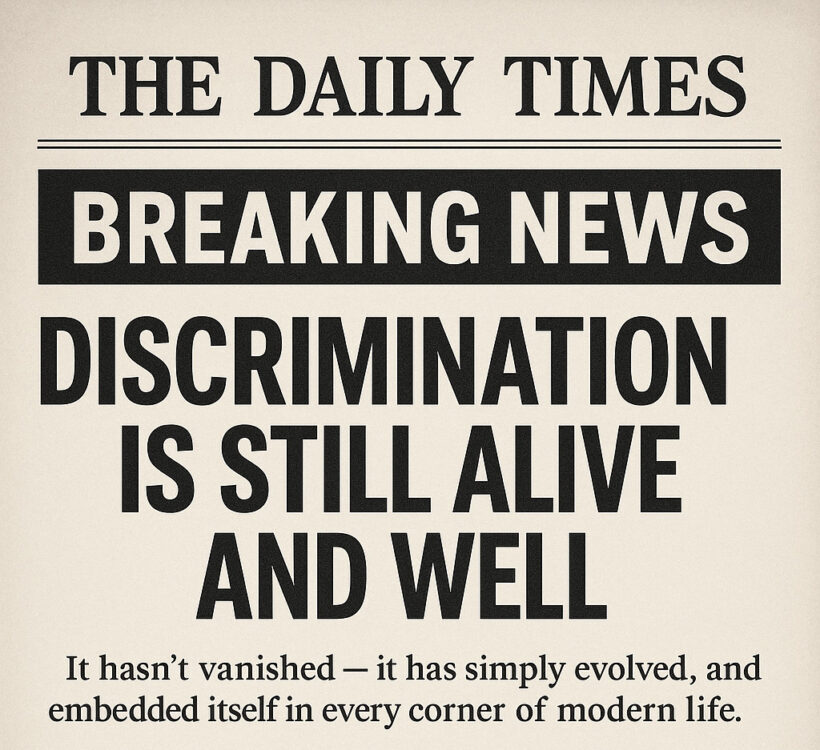
It hasn’t vanished — it has simply evolved, adapted, and embedded itself into every corner of modern life.
When former U.S. President Trump—the Discriminator-in-Chief—goes into a frenzy about Somali immigrants and calls them “garbage,” many treat it as a personal flaw, an individual eruption of bigotry. We comfort ourselves with the idea that society has moved past such barbarism, that our institutions and values have transcended discrimination as a cultural tool for diminishing human beings.
And on the surface, it seems true. We celebrate Martin Luther King Jr. with a federal holiday. Segregated bathrooms are gone; African Americans hold leadership roles across public life. Workplace harassment that was once normalized is now punishable.
But these symbols of progress can create the illusion that discrimination has been defeated. Trump’s rhetoric is an old-fashioned version—explicit, hostile, loud. Yet today’s discrimination often works very differently. What if it hasn’t disappeared at all, but quietly changed its form? What if it has adapted to modern norms while retaining its power and precision?
Consider, for example, disability rights. Buildings may be ADA-compliant, yet companies inside them rarely employ people with disabilities—and when they do, it is often symbolic rather than substantive. Accessibility has improved, but inclusion has not followed at the same pace.
Or consider New York City’s financial industry—Morgan Stanley, Goldman Sachs, AIG, and others. These institutions operate through a mix of written policies and unwritten cultural expectations that shape who gets hired, who advances, and who fits in. These unwritten norms are rarely discussed openly, yet they are widely understood and consistently upheld.
One such norm is quietly, but unmistakably, present: you will almost never see an overweight person working on the finance floor—whether in investment banking, at the trading desks, or in other high-visibility roles. This is discrimination in its modern form: subtle, culturally reinforced, and effective without ever needing to announce itself.
In truth, discrimination threads through our everyday behavior. The poor judge the rich; the rich judge the poor. North Americans discriminate against Latinos; white people against people of color; urbanites against rural residents; Republicans against Democrats, and Democrats against Republicans. And that’s without touching the religious sphere.
We see socially sanctioned hierarchies everywhere: the stereotype of the “lazy” public-sector worker versus the “productive” private-sector professional; the dismissal of “poor kids” in public schools contrasted with the praise heaped on “cool kids” in private institutions. These biases are not harmless—they shape policies, expectations, and life trajectories.
If we agree that discrimination is so widespread, so old, and so resilient, then the deeper question for us becomes unavoidable: What is its origin? How does it replicate itself—silently, relentlessly—century after century?
Science has poured resources into understanding the origins of life, the universe, and consciousness. Yet the origins of discrimination—one of humanity’s most universal and destructive behaviors—remain largely unexamined at a structural level. We once created academic fields to understand genetics, psychology, anthropology, and neuroscience. Perhaps today we need a new one: a Department of Discrimination Studies—a discipline dedicated not just to documenting the outcomes of discrimination, but to interrogating its roots, mechanisms, and its deep psychological and social reproduction.
We must confront an unsettling possibility: Is our sense of self built in opposition to others?
Do we define who we are by negating who we are not? If so, discrimination is not merely a flaw in society—perhaps it is a structural distortion embedded in human identity itself, shaping not only how we perceive others but how we perceive ourselves.
Do we recognize how much discrimination still flows through our daily reactions, judgments, and narratives? Most of the time, we don’t see it.
MLK’s famous line continues to inspire:
“I have a dream that my four little children will one day live in a nation where they will not be judged by the color of their skin but by the content of their character.”
But have we ever truly unpacked those words—content of their character? Do we teach this? Practice this? Understand this? If someone asked, “What is the content of your character?”—what would you say?
For centuries, society has tried to regulate discrimination externally—through laws, policies, and reforms. These are necessary, but not sufficient. The next frontier is internal: transforming the structures that shape perception, the stories we inherit, and the reflexes we rarely examine.
Do we have the courage to dismantle the forces, both internal and external, that allow discrimination to thrive? Unless we confront discrimination at its roots—in identity, in culture, in consciousness—it will continue to reappear in a thousand new disguises.



