

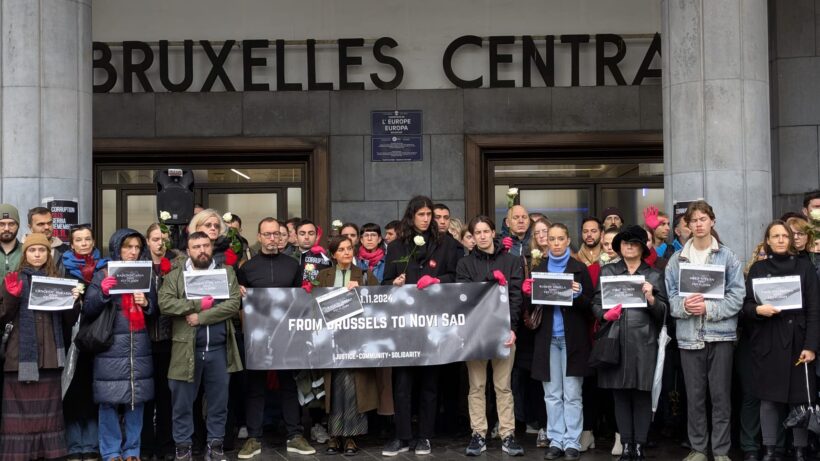
Exactly one year after the collapse in Novi Sad, candles flickered once again across continents. In hundreds of cities worldwide — from almost every European capital to major cities in the Americas and Australia — the Serbian diaspora gathered under grey skies and steady rain to honour the sixteen lives lost, and to defend something greater than remembrance: the fragile hope that truth and accountability might still prevail, and that the social movement born from tragedy might yet achieve what it set out to do.
The movement that rose from the ruins of that November day — the most powerful student mobilisation Serbia has witnessed since the fall of Slobodan Milošević, and among the first to unite people globally around a single nation’s call for change — has travelled far beyond the city where it began. It started in grief, when a handful of students refused to accept the official silence and the convenient narrative of a “tragic accident.” They replaced that euphemism with one word, printed on banners, chanted in the streets, and projected onto buildings: Odgovornost! — accountability. Within weeks, it became a rallying cry recognised even by those who did not speak Serbian.
They asked, and they continued to ask. Week after week, in vigils and marches, with banners and megaphones, in universities and in the streets, they repeated their six demands for accountability. When doors closed, they walked — from Niš to Novi Sad, from Belgrade to Strasbourg, from Serbia to the heart of Europe — on foot, by bicycle, carrying their own food and sleeping in strangers’ homes. Without leaders, without funding, without permission. What bound them together was not ideology or party loyalty, but conviction: that silence was complicity.
In early spring 2025, tens of thousands gathered in Niš for an eighteen-hour blockade. Many had walked hundreds of kilometres. They read aloud a Students’ Edict, inspired by Emperor Constantine’s Edict of Milan of 313 AD — a text born in that same city, which had once proclaimed freedom of faith. The students’ version became a manifesto for civic freedom: “We will no longer accept injustice, corruption, and a system that limits us. We want institutions that serve us all. We want a country that values knowledge and effort, not obedience.”
Their courage proved contagious. The movement spread beyond campuses and city centres into villages and rural communities, which had long been neglected by national politics. Plenums — open assemblies where every voice counts — appeared across the country and soon drew the attention of scholars abroad. The chant Pumpaj! (“Pump it or Keep going!”) echoed in every demonstration, becoming both a call to resilience and a heartbeat of solidarity, now familiar even beyond the protest movement itself.
On this first anniversary, tens of thousands once again filled Novi Sad’s streets. More than four thousand students, some marching for over two weeks from cities as distant as Novi Pazar, arrived at the station where it all began. At exactly 11:52 a.m. — the moment the canopy fell — the crowd stood silent for sixteen minutes, one for each life lost. The same gesture was repeated across the world, wherever commemorations took place. Many had arrived on foot or by bicycle, just as they had done a year earlier.
That silence spoke louder than any speech. It condemned a system where corruption is the norm, oversight fails, and public trust collapses as easily as concrete. The tragedy of Novi Sad, born of negligence and greed, has become not only a national wound but a moral crossroads.
Responsibility remains unacknowledged. However, the tragedy has amplified scrutiny of Serbia’s governance and strengthened demands for transparency, human rights, environmental protection, and systemic reform. The call for odgovornost — accountability — along with the struggle against corruption and the growing resistance to the political structure surrounding President Aleksandar Vučić, in power since 2017, has become a central theme of civic discontent and mass mobilisation.
In Belgrade over the past months, protesters — including students and professors — were attacked by lower-ranking officials and members of the ruling Serbian Progressive Party outside the Faculty of Dramatic Arts. The assault triggered a wave of faculty occupations and university blockades. Through plenums, students organised with striking efficiency and determination. What began as a student revolt became a national — and later global — civic movement, reinforced by the active involvement of the Serbian diaspora, including their operational support for the Ride to Strasbourg and the Marathon from Belgrade to Brussels.
In Brussels, hundreds gathered once again under umbrellas at the Carrefour de l’Europe, opposite Central Station. They held a banner listing all sixteen victims, as they had done for months, and as they did when the student marathoners reached the European Parliament after their seventeen-day Run to Brussels. At 11:52, they too stood in silence, holding candles and roses.
For their persistence and peaceful courage, the Serbian students were shortlisted for the 2025 Sakharov Prize for Freedom of Thought, alongside imprisoned journalists in Belarus and Georgia, and humanitarian workers in Palestine. Although the award went elsewhere, their nomination marked a milestone — the recognition of a movement that turned mourning into mobilisation.
Yet the struggle continues. Freedom of the press in Serbia remains under siege. Since the Novi Sad collapse, Reporters Without Borders has documented at least eighty-nine physical attacks on journalists. Many face intimidation, censorship, and harassment simply for reporting the truth. In October, the European Parliament condemned the government’s hostility toward independent media, urging Belgrade to end its campaign of disinformation and fear. The technical experts of the Media Freedom Rapid Response (MFRR) have likewise described the situation as a “state of emergency,” following its April 2025 monitoring mission to Belgrade and Novi Sad.
Censorship, political pressure, media capture, smear campaigns, and judicial harassment have created a climate of impunity in which perpetrators — including state officials — act without consequence. Investigations, when opened at all, are slow, superficial, and seldom deliver justice. As recalled during the Brussels gathering, held on the eve of the UN’s International Day to End Impunity for Crimes against Journalists, this struggle for truth is not only Serbia’s — it mirrors a broader European crisis of democracy and rights.
Closing the event, Vula Tseti, Co-Chair of the European Green Party, spoke beneath the rain:
“What matters most is that we are here — to honour the victims, to thank the students, to stand for democracy and accountability. Without them, without their courage, everything would go on as if nothing had happened. This is not only for the families, not only for Serbia — it is for Europe, for democracy, and for justice.”
As the crowd dispersed, the candles continued to burn. One year on, Novi Sad remains both a wound and a warning — a reminder that even amid rubble, conscience can rise, and that sometimes the most powerful revolutions begin in silence.