
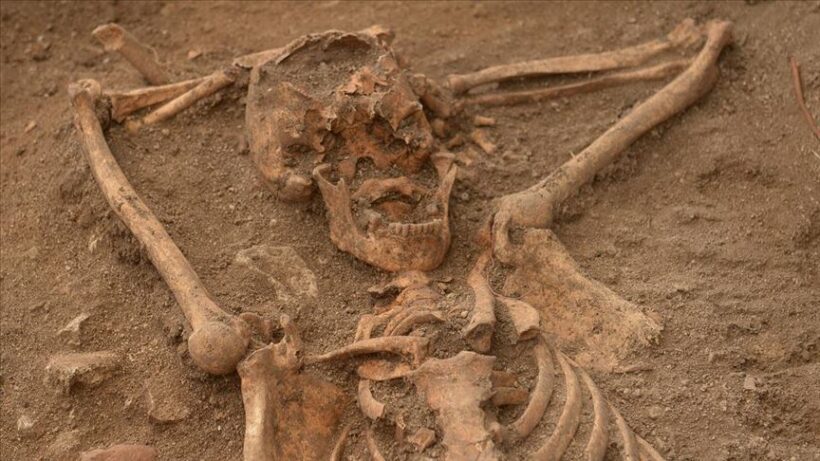
The earth groans when the shovels of the Madres Buscadoras —the Searching Mothers— strike what the State ignored: black plastic bags and bones amid the disturbed soil of Zapopan, Jalisco. Less than twenty kilometers from the green grass of the Akron Stadium, where the World Cup spectacle is being promoted, a corridor of graves emerges, already holding more than four hundred bags filled with human remains: approximately 270 in the site known as Las Agujas, around 89 in Nextipac / Plan de la Noria, and 48 in Arroyo Hondo. The magnitude imposes silence, yet the mothers chose noise. How can that silence persist while the machinery for real estate and mega-events escapes ethical scrutiny?
In that stretch of unearthed land, the bodies do not rest: they were “segmented,” mutilated, divided into bags as if they were rubble, then buried to disappear twice—first the being, then the memory. It is here that the thought of philosopher Achille Mbembe (Cameroon, 1957) —who defined necropolitics as the sovereign’s power over death— acquires tangible flesh. These are not merely homicides: this is an economy of disappearance embedded within an urban project governed by accumulation and silence. The stadium, the machinery, and real estate ventures advance over ground that devours bodies, while the State has gradually delegated the work of true archaeologists of horror to collectives of women with shovels. Can a State govern when it leaves the graves to those it does not recognize as authorities?
Philosopher Judith Butler (United States, 1956) has written that some lives are considered grievable, and others are not; those bags hold lives deemed unworthy of mourning, bodies that political normality decided not to weep for. The Madres Buscadoras have given faces to what the system forbade us to mourn: photographs, GPS coordinates, maps, bodies unearthed while authorities declared the zone “already intervened.” In the Las Agujas site, 270 bags were mentioned, and behind each number are faces, names, mothers digging at dawn, husbands waiting for a phone call that never came, fathers who no longer ask for permission. Philosophy becomes witness: how do we grieve what institutional neglect dismissed as “unidentified remains”? Who mourns what the State refused to acknowledge?
When Giorgio Agamben (Italy, 1942) speaks of the “state of exception” devouring the rule, here there is no exception—the exception has become the norm. A site declared “resolved” by the Prosecutor’s Office turns into a second and third grave in the hands of the collectives who managed to reenter it by judicial order. The rule vanishes into bureaucracy, the verdict lies in the mud clinging to their knees. And meanwhile, construction continues. Can urban normality exist when its foundations are bones? What legitimacy does a city have when it builds stadiums and fills graves at the same time?
Anthropologist Rita Segato (Argentina, 1951) has shown how patriarchy, territory, and violence converge: here the searchers are women—many mothers—carrying the weight of excavation while public authorities look away. That this work is done by women is no coincidence: it reveals who is pushed to serve as the active memory of victims and demands public accountability. And in that gesture, they interrupt invisibility. They unearth not only bodies but also truth. Why is that image not front-page news in Mexico, or anywhere in Latin America? Who decides which pain deserves public attention?
From the lens of critical sociologist Nancy Fraser (United States, 1947), capitalism devours the commons: in this case, it devours bodies, soil, and truth. Globalized urbanism erases the violent history of its own territories and silences their testimony. And Boaventura de Sousa Santos (Portugal, 1940) reminds us that valid knowledge can come from below, from the epistemic South: those mothers with rods and shovels embody a subterranean epistemology. Official figures take weeks, months, years to acknowledge what they already knew the morning they smelled decomposition as the heavy machinery tore open the ground. Which knowledge carries more weight—the forensic report to be written in years, or the shovel that opened the earth today?
The economy of horror intertwines with the illusion of development. The 2026 FIFA World Cup is promoted in the nearby stadium, yet this grand event coexists with the buried bags. It is a territory doubly marked: by the promise of international spectacle and by the clandestine burial below it. What is the human cost of the dispossession that sustains the global infrastructure of sport? Who pays for that soil that answers to the name of death?
The answer begins with the bodies that once were. The bags are not just bags—they are divided lives, families never restored, memories seeking closure while the institutional machinery repeats its bureaucratic refrain: “unconfirmed,” “under process,” “intervened area.” That second disappearance—the erasure of justice, of recognition—is part of the crime. Can there be justice when the State only acknowledges what is convenient? What does it mean that mothers must map, excavate, identify, and document while the State appears only once they have already marked the terrain?
Democracy—and journalism—are measured by their capacity to name those whom power has sought to bury without witness. This essay is a trench against the normalization of horror. If we accept that bodies buried beside a stadium do not deserve public outrage, we accept the burial of the State’s own script: the State that was meant to protect not only permitted mass disappearance but industrialized its concealment. The Madres Buscadoras have exhumed twice: the bodies and the truth. Our task is to ensure that truth circulates, that those bodies regain their faces, that those bags cease to be nameless souls and become demands for justice.
This is not a local issue; it is a mode of governance. Necropolitics operates under the mask of development. And here, beside the Akron Stadium, that convergence takes place. The question is whether we are seeing it. Whether we are saying it. Whether, as a society, we will continue to pretend that the spectacle of sport can stand upon impunity. For those who dig are not only searching for bodies—they are searching for a future in which pain can finally be truth. And that search demands that we, too, dig—with our pens, with our eyes, with our memory.