
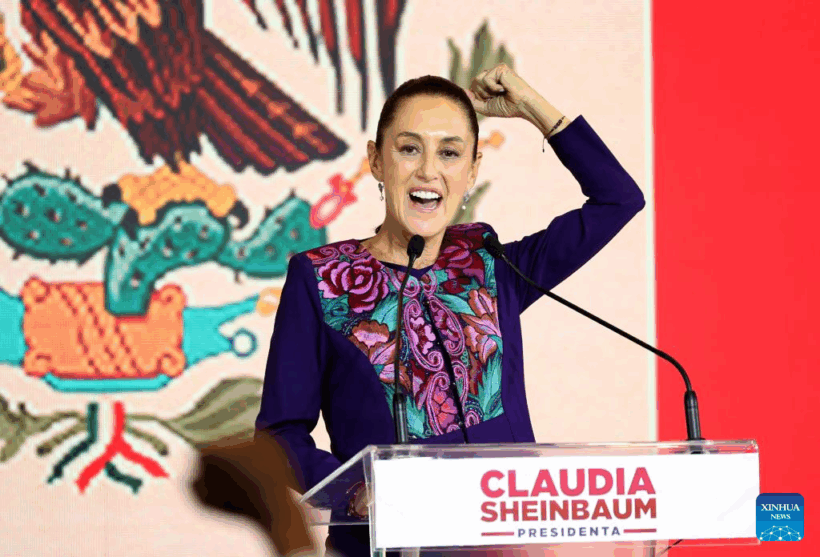
No one can deny the abilities of President Claudia Sheinbaum Pardo. If we were to draw an analogy between her performance in public office and that of, say, an outstanding professional athlete, we would observe above-average “physical condition”; we would observe excellent positioning, meaning she is always where she planned to be, taking into account any variables that may arise; we would notice her sense of timing in executing a move at the right moment; on the other hand, she shows a high degree of professionalism when making decisions, never losing her footing or letting her emotions get the better of her. She has also shown good strategic skills, which she learned very well from her “coach,” Andrés Manuel López Obrador.
Just rewind the first-year accountability speech he gave in the Zócalo on October 5 and review the number of constitutional reforms and amendments to laws, the number of projects and budget allocations in different areas. Without exaggerating, it is impressive. To mention a few, those related to energy sovereignty, reversing those approved during Peña Nieto’s term, another is that in the face of the threat from the country to the north and the desire of the anti-Mexican political opposition for our country to be invaded by those military forces, Claudia Sheinbaum mentioned that in Article 40 of the Constitution, the following paragraph was made very clear and detailed:
“The People of Mexico, under no circumstances, will accept interventions, interference, or any other act from abroad that is detrimental to their integrity, independence, and sovereignty, such as coups d’état, interference in elections, or the violation of Mexican territory, whether by land, sea, or airspace.”
Of course, she does not act and design the project alone, according to her imagination and criteria. She is part of a government that emanates from the fourth transformation movement, in which there are many strengths but also weaknesses, there are mistakes, there are pending issues that are not given the necessary attention, and official figures and data must be reviewed daily and thoroughly. There is friction and disagreement in a diversity that interacts in the direction of fulfilling a project. This organization, with progressive and humanistic principles, still has its political side and is made up of flesh-and-blood politicians with personal interests and group pressures.
While the Scientist increases her acceptance and popularity, the political apparatus (the Party) and some figures increase their rejection and bad reputation. How is this?
A few weeks ago, a reporter from Hidalgo asked the President during her morning press conference how to tackle corruption in the municipalities. She simply replied that one should not generalize, and that if there are acts of corruption, they should be reported with evidence. On the other hand, a few days ago, a Morena congressman mentioned verbatim at a religious congregation meeting that “70% of the country is dominated by drug traffickers.” Later, in an interview, he clarified that this problem occurs in the municipalities and that he was not referring to a narco-government, but rather that we have a “narco society.” So, beyond the exaggeration, hidden agendas, and propaganda battles, our attention must be focused on the indicators that are emerging, not only at the national level but also at the grassroots level, which is where most social, political, and economic activity takes place.
If you had the opportunity to witness some conversations between officials in a municipality in any region of the country, if you could listen to certain exchanges between deputies, senators, bureaucrats from any agency at the three levels, or even party activists themselves, if you could learn about their attitudes or some of their aspirations, you would be surprised to find that their relationship with this transformation project is very superficial or almost non-existent. I hope it is understood that I am not talking about the political opposition on the right, such as the PAN, the PRI, or the MC, which, as one journalist says, “no longer matter” on the scene. I am only referring to the spectrum of the 4T.
The back-and-forth about who should be the candidate for such and such a position in 2027 and 2030; the disputes over members and territory between groups to expand a voter base that can be mobilized when the time comes; the tactics to sabotage the opponent’s meeting or to give them a bad public reputation through a newspaper article or on social media, are just a small taste of what is going on behind those smiling faces, behind those bold statements in which they claim to be very committed to the country.
So who is Claudia talking to?
When listening to the statements of a president who leads an entire administrative apparatus and, at the time, President López Obrador, anyone would think that, although there are differences, that enormous apparatus made up of bureaucracy, the party, and its members are on the same page and that everything is falling into place toward the same goal and with the same sentiment, resolving issues through dialogue, a fundamental tool of politics, a dialogue that today is so distorted, so lacking in rigor and substance.
In the case of the President, dialogue also extends to all other social partners: the political opposition, the legislative and judicial branches, the business and financial classes, different religious institutions, various indigenous communities, youth, senior citizens, feminist groups, the media, the international community, and many others. And once again, it is clear that the most solid and lasting dialogue a leader can have is and will always be the one established with the people, whether this is tangible, as in the now traditional speeches in public spaces, through social media, or simply in sentiment.
A doctoral thesis on dialogue by the humanist writer Silo states:
“There is no complete dialogue if the pre-dialogical elements on which the need for such dialogue is based are not considered.”
In other words, if we take this as a theoretical framework, we would say that among those who express the desire to promote this great undertaking that is the transformation of a country, there must be minimum conditions for dialogue. There may be disagreement, agreement, or heated discussions, and even with all that, there can be a genuine connection. But another situation that often arises is a disconnection and disinterest in the issue at hand, and at all times, the exchange is carried out in an atmosphere of “dialogue of the deaf” or “everyone to their own.”
In defending his thesis, this Latin American thinker stated, “for a dialogue to be coherent, it is necessary that the parties,
1°.- Agree on the topic at hand
2°.- Weigh the topic with a similar degree of importance
3°.- Have a common definition of the decisive terms used.”
In light of recent corruption and fuel theft scandals, the lavish spending of politicians that exceeds fair moderation, the fires that the President has to control due to constant blunders, ravings, or disputes among members of the movement, the corrections she has to apply to them, for all this and more, since the early days of 2018, the initial enthusiasm prevented us from distinguishing, it is now evident that many who have taken up positions, even won elections since AMLO and Morena came to power, are far from agreeing on the main issue, which in this case is the transformation and revolution of consciousness; Nor are they interested in “cleaning the stairs,” in weighing the importance of the target issue in a manner more or less similar to what is expressed in the principles. Finally, if the terms used are not common in the meaning given to them, the exercise of exchange will ultimately be hindered.
The conditions for dialogue are disrupted by factors such as the hidden intentions of each of the active parties. These intentions derive from beliefs, experiences, or assessments, according to the sensibilities of the era in which they live, and in their practical consequences, each person goes in a different direction and uses some not very ethical means to further their own interests, resorting to betrayal and attacks, even though on the surface there appears to be perfect harmony and understanding. That is how things are.
Continuing with this philosopher’s doctoral arguments, if
“Dialogue is something alive in which the exchange of ideas, affections, and experiences is tinged with the irrationality of existence, (and) this human life with its beliefs, fears, and hopes, hatreds, ambitions, and ideals of the era, are the basis of all dialogue.”
Then “dialogue, a decisive factor in human construction, is not reduced to the rigors of logic or linguistics.”
Therefore, from the question, “Who does Claudia talk to?” (which will remain open), the following question arises:
What sustains the country’s project with so many internal and external attacks?
The President, in her documentary on her first 365 days, once again lets slip a sign from deep within when she said: “…I think that is what our movement represents, what he (AMLO) leaves in government, in his struggle, and what we want to continue, which is a profound humanism, a love for one’s neighbor. Ultimately, that is what moves us.”
“It’s not just what we do, but why we do it, (and she recommended): always fight for your country, don’t be swayed by individualism, the desire for money, power, fame, think about your colleagues, about the people who are suffering, give meaning to your life from a collective perspective and for the collective good.” So far, the President.
This signal, for now, is just a brushstroke that is gradually sketching out the model of society we want to build.
The founder of the school of thought known as “universalist humanism” or “new humanism,” upon being recognized by the Russian Academy of Sciences with an honorary doctorate on October 6, 1993, when neoliberalism was silencing populations with pessimism and resignation, revealed a hope for the future:
“In some latitudes, something new has begun to move, something that, starting with a dialogue among specialists, will then occupy the public square.”