

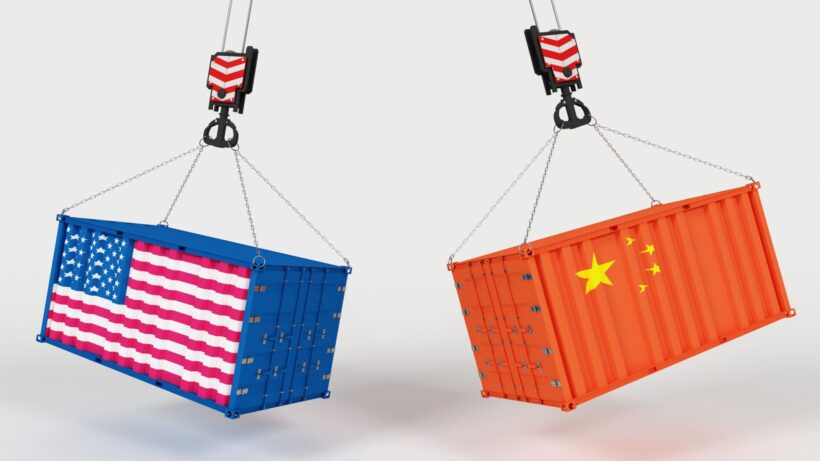
“The planet’s fate is no longer decided on isolated battlefields, but in the permanent tension between two giants competing for trade, technology, and power.”
The 21st century has no fixed center. It shifts to the rhythm of the rivalry between the United States and China. This is not a mere bilateral dispute. It is a struggle shaping the world order, already cutting across the economy, technology, maritime trade, and political alliances. Washington clings to its role as the established power, while Beijing projects itself as the rising force intent on displacing it. Together they account for roughly 42% of global GDP and about 50% of the planet’s military spending—turning any clash into a systemic risk.
The competition shows up in colossal numbers. Bilateral trade tops USD 600 billion a year, yet it is riddled with sanctions, tariff wars, and tech bans. China holds more than USD 3 trillion in foreign exchange reserves, while the United States maintains control of the dollar as the hegemonic currency. Artificial intelligence, semiconductors, energy, and biotechnology are the battlegrounds that will determine who leads the fourth industrial revolution.
What is at stake goes far beyond the balance between two countries. What happens in the South China Sea, the Taiwan Strait, or across the Pacific routes will affect every nation, because roughly 30% of global trade flows there. The question is stark. Will this rivalry power a new cooperative balance—or spark a global confrontation that drags the entire planet into crisis?
Origins of the Rivalry
The U.S.–China clash did not appear out of thin air. It is the product of half a century of strategic moves. In 1972 Richard Nixon shook Mao Zedong’s hand in Beijing, hoping to pry China away from the Soviet Union. That turn opened the door for China to enter the global economy and, four decades later, become the greatest growth story on earth. Between 1980 and 2010 China’s GDP grew at an average of nearly 10% per year, an unprecedented leap that lifted more than 700 million people out of poverty and turned the country into the world’s factory.
That ascent was not neutral. As China amassed more than USD 3 trillion in reserves and became the largest global exporter, Washington began to see a challenger capable of eroding its hegemony. Barack Obama’s 2011 “pivot to Asia” set the stage, but it was Donald Trump who broke the equilibrium in 2018 by launching a trade war that slapped reciprocal tariffs on more than USD 360 billion in goods.
Today, under Xi Jinping and with Trump back in the presidency, the rivalry is etched in steel. It is not only economic, but political and technological. China presents itself as an alternative to a U.S.-led order; the United States responds with sanctions, restrictions, and military deployments in the Pacific—making clear the 21st century will be defined by this structural contest.
The Numbers Behind Economic Power
At the heart of the rivalry lies the economy. The United States remains the world’s largest power with about 24% of global GDP, while China has reached roughly 18% and keeps closing the gap year after year. Bilateral trade surpassed USD 600 billion in 2023, making the two countries both indispensable partners and irreconcilable competitors. That paradox sustains the planet’s fragile equilibrium because every container crossing the Pacific is also a reminder of interdependence.
China holds over USD 3 trillion in foreign reserves—the largest stock on earth—giving it a financial cushion most nations can only dream of. The United States, by contrast, wields the dollar, which accounts for more than 58% of global reserves and remains the reference currency for energy trade and financial transactions. This duality turns the international economy into a board where both exercise power in different yet decisive ways.
The tariff war unleashed in 2018 hit more than USD 360 billion in products and showed that interdependence does not eliminate conflict—if anything, it amplifies it. U.S. companies depend on Chinese factories, and millions of Chinese jobs depend on U.S. consumers. Within that vicious circle lies the choice between pragmatic cooperation and a rupture that could smash supply chains and push the world into a synchronized recession.
Technology and the Battle for Chips
The true battlefield of the 21st century is not at sea or in trenches. It sits on a fingernail-sized slice of silicon. Taiwan Semiconductor Manufacturing Company produces over 90% of advanced chips under 7 nanometers—the brains powering artificial intelligence, hypersonic missiles, data centers, and high-end smartphones. The key to the fourth industrial revolution is concentrated on that island, where Washington’s and Beijing’s red lines intersect.
The United States is trying to shield itself with the 2022 CHIPS and Science Act, earmarking more than USD 52 billion to subsidize fabs and attract TSMC and Samsung to produce on U.S. soil. China has responded with a technological self-reliance plan mobilizing over USD 140 billion in subsidies and credit to reduce critical dependence. The result is a frantic race in which each side seeks control over the most strategic value chain on the planet.
The contest extends beyond chips. It encompasses artificial intelligence—projected to be a USD 1.5 trillion market by 2030—the rollout of 5G, where China leads through Huawei and ZTE, and biotechnology, where both invest billions in genomics and advanced pharmaceuticals. Control of these technologies determines not only who wins contracts and markets, but also who writes the rules of global power in the decades ahead.
The Sea as Frontier
The most visible stage of U.S.–China rivalry is at sea. In the South China Sea and the Taiwan Strait, routes concentrate more than 30% of global maritime trade—flows worth over USD 3.5 trillion a year. Tankers, containers full of chips, and the grain that feeds half the planet move through waters both giants consider vital.
China claims nearly 90% of the South China Sea via the so-called nine-dash line and has built artificial islands with runways and radar to cement control. The United States counters with “freedom of navigation” operations—destroyers and carriers sailing within sight of those bases. In the Taiwan Strait, every naval drill is a show of force that raises the risk of an accident with global consequences.
Sovereignty disputes involve the Philippines, Vietnam, and Malaysia, but the central struggle is between Beijing and Washington. China seeks to safeguard import routes for oil and export routes for manufactures that together represent more than 40% of its GDP. The United States believes ceding those waters to Chinese control would mean losing the ability to guarantee allied security in Asia. On that maritime frontier hangs not just regional balance, but the stability of world trade itself.
The Military Front
Beneath the diplomatic rhetoric lies muscular force. The United States maintains the world’s largest defense budget—USD 877 billion in 2023, about 40% of global military spending. Eleven aircraft carriers, more than 2,000 combat aircraft, and hundreds of overseas bases give it unrivaled power projection. For Washington, that supremacy is the guarantee that no rival can overturn the order built after 1945.
China has multiplied its defense spending fivefold since 2000 and now invests around USD 224 billion—roughly 13% of the global total. Under Xi Jinping, the People’s Liberation Army has modernized with next-generation destroyers, hypersonic missiles, and J-20 stealth fighters. The priority is clear: secure control over the Taiwan Strait and deter any U.S. intervention in a crisis.
Scenarios of armed clash are no longer distant hypotheticals. The Pentagon warns that by 2030 China could have the capacity to attempt a blockade or even an invasion of the island. A direct confrontation would pit two nuclear powers against each other and likely pull in Japan, South Korea, and Australia—with incalculable consequences for global stability. Asia’s military balance is increasingly unstable, and any miscalculation could ignite a war no one can win.
Alliances in Collision
The rivalry does not play out in isolation. It radiates through alliance networks that are reshaping the global power map. Washington anchors itself in NATO, which in 2023 devoted over USD 1.2 trillion to defense across its 31 members. It adds AUKUS—its partnership with the UK and Australia to build nuclear-powered submarines worth more than USD 70 billion—and the Quad with Japan, India, and Australia, a grouping designed to counter China’s influence in the Indo-Pacific.
China answers with its own architecture. The Belt and Road Initiative has channeled more than USD 1 trillion into infrastructure across 140+ countries, becoming the broadest economic influence network in recent history. An expanded BRICS—now including energy powers like Saudi Arabia, Iran, and the UAE—represents about 31% of global GDP and offers a financial counterweight to the dollar. Its alignment with Russia, reinforced after the war in Ukraine, and energy ties with Iran consolidate a Eurasian axis openly challenging U.S. primacy.
The new geometry of power sketches two blocs concentrating resources, markets, and critical routes. The question is not whether there will be cooperation, but how long coexistence will last before these alliances collide in the open. Multipolarity advances, but in the permanent shadow of confrontation.
The World Economy on Edge
This rivalry is not confined to political headlines; it strikes at the heart of the global economy. More than 50% of world maritime trade crosses the Asia-Pacific—over USD 9 trillion in goods each year. From semiconductors to oil, from grain to industrial components, everything depends on routes now overshadowed by warships and sanctions.
An open conflict in the region would be devastating. The IMF estimates that a war in the Taiwan Strait or the South China Sea could shave up to 5% off global GDP in a single year—over USD 4.5 trillion in losses. Inflation would surge amid shortages of chips and energy, and recession could synchronize across continents as supply chains fracture, from Europe’s auto industry to Latin American manufacturing.
The shock is already palpable. The United States applies tech sanctions that hit Chinese firms; China responds by restricting exports of critical minerals like gallium and germanium, vital for electronics. Europe faces the dilemma of relying on U.S. technology while maintaining more than USD 800 billion in trade with China. Interdependence turns the world economy into a hostage of this dispute—and the ransom is paid in volatility and constant risk.
Latin America and Africa in the Contest
The rivalry also plays out in regions once dismissed as periphery but now central pieces on the board. In Latin America, China has become the top trading partner for almost all South American countries. Brazil, Chile, and Peru send more than 30% of their raw material exports to China and have received over USD 140 billion in infrastructure investment in the past two decades. Lithium from the Andean triangle and Chilean copper are essential inputs for Beijing’s tech industry as it seeks to secure the global energy transition.
In Africa the Chinese footprint is even more pronounced. Investments exceeding USD 150 billion have financed ports, railways, roads, and dams binding the continent to the Belt and Road. More than 20% of Africa’s oil goes to China, and state-owned firms control cobalt mines in the Democratic Republic of Congo—key to electric-vehicle batteries.
The United States is trying to claw back influence through energy, military, and trade agreements, but it is late. U.S. financing is smaller and fragmented, while Beijing offers fast credit and visible projects. The result is structural change. Latin America and Africa are no longer neutral terrain. They are battlegrounds where the giants lock in the future of minerals, energy, and diplomatic votes that will decide the global balance of the 21st century.
The Artificial Intelligence Race
Artificial intelligence is the new oil, with projected value surpassing USD 1.5 trillion by 2030. Both the United States and China know it, and the tech race has become a struggle for control over digital infrastructure and the algorithms that will shape the future economy. Silicon Valley leads in software, university research, and global talent, with firms like OpenAI, Google, and Microsoft accounting for more than 40% of private AI investment.
China leads in data volume and mass applications. With 1.4 billion people online and a digital ecosystem moving more than USD 4 trillion a year, Beijing holds the essential raw material of modern AI: data at near-infinite scale. Alibaba, Tencent, and Baidu have already embedded AI in payments, e-commerce, and surveillance, and the government has earmarked over USD 60 billion in subsidies to accelerate development.
The chip remains the heart of this battle. Without advanced semiconductors there are no supercomputers or cutting-edge models. Taiwan has become the neural point of the contest, and any disruption at TSMC would throw both superpowers—and with them the world—into disarray. The AI race is not a technical competition alone; it is the definition of who will control Industry 4.0 and the political power that comes with it.
The Energy Factor
The duel also runs through energy—the motor of every modern economy. Beijing depends on foreign sources for around 70% of its oil consumption, much of it traveling through the Strait of Malacca and sea lanes watched by the U.S. Navy. That vulnerability makes energy security a weak point for China and explains its multi-billion-dollar investments in overland pipelines with Russia and Central Asia, along with deeper footprints in Africa and the Middle East.
The United States, meanwhile, is undergoing a historic shift. Thanks to fracking it became a net exporter of oil and gas, with liquefied natural gas shipments exceeding USD 100 billion in 2023. That change gives Washington not only energy independence but leverage over Europe and Asia, which rely on U.S. gas to replace Russian supplies after the war in Ukraine.
The rivalry extends to clean energy. Both giants are pouring money into renewables and hydrogen. China controls more than 80% of the solar supply chain and has installed over 400 GW of solar capacity, while the United States is trying to catch up with USD 370 billion in subsidies under the Inflation Reduction Act. The energy transition is a geopolitical contest, because whoever dominates clean technologies holds the keys to tomorrow’s economy.
Public Opinion and Narratives
This rivalry is not only fought in trade figures or military budgets. It is waged in the symbolic realm. In Beijing, nationalism coheres around the “reunification dream,” a narrative that legitimizes Xi Jinping’s leadership and frames Taiwan’s return as a non-negotiable historic goal. More than 70% of Chinese citizens support that aim, according to official surveys, fueled by a story blending national pride with resentment toward a Western-dominated order.
In Washington, the narrative centers on defending democracy. U.S. politics casts America as guarantor of a rules-based international system and protector of Taiwan against China’s authoritarian threat. Over 60% of Americans view Beijing as the main strategic rival, and Congress has approved military aid packages for the region totaling more than USD 14 billion over the last decade.
Social media and news outlets amplify confrontation. TikTok and WeChat are seen in Washington as tools of foreign influence, while CNN or The New York Times are denounced in Beijing as imperialist mouthpieces. The risk is that mutual demonization closes any space for cooperation and primes societies to accept the unthinkable—a war with no winners and a planet defeated by its inability to talk.
Scenarios Toward 2035
The future of U.S.–China rivalry could follow several paths, each shaping not only their destinies but that of the entire planet.
• A new cold war. Rigid blocs form, with Washington leading the West and Beijing organizing a Eurasian axis with Russia, Iran, and an expanded BRICS. Trade fragments into parallel chains, and global GDP growth could slow by 30% by 2035, according to major bank projections.
• Open war. The most feared scenario: a conflict over Taiwan or in the South China Sea. The cost would be incalculable. A prolonged war could cut up to 10% from global GDP in the first two years—losses above USD 8 trillion—and displace millions across Asia. The world economy would suffer chronic inflation and food crises.
• Pragmatic cooperation. Commerce and climate change force a minimum modus vivendi. Together Washington and Beijing emit over 40% of global CO₂; without coordination, climate goals are impossible.
• Managed multipolarity. Europe, India, and Africa emerge as arbiters in a less concentrated order. Rivalry becomes regulated competition and opens the door to a balance that provides stability. It may not be the most likely option—but it is the most necessary for a planet that must survive a clash of giants.
The clash between the United States and China is not written in stone. It can be a global catastrophe—or an unprecedented chance for equilibrium. The planet’s future depends on whether these giants understand that power is not measured in ships or missiles, but in the ability to guarantee peace, prosperity, and dignity for all humanity.
In this 21st century—marked by climate crises, persistent inequalities, and dizzying technological leaps—the relationship between Washington and Beijing concerns not only their citizens, but all the peoples of the world. If they can turn rivalry into cooperation, they could lay the foundations for a fairer, more sustainable global governance. If they fail, they will condemn humanity to repeat the mistakes of empires that confused greatness with domination.
Bibliography
• International Monetary Fund, World Economic Outlook (2024)
• SIPRI, Military Expenditure Database (2024)
• World Bank, Global Trade Statistics (2023)
• US Department of Defense, Indo-Pacific Strategy (2024)
• Chinese Ministry of Commerce, Belt and Road Reports (2023)



