

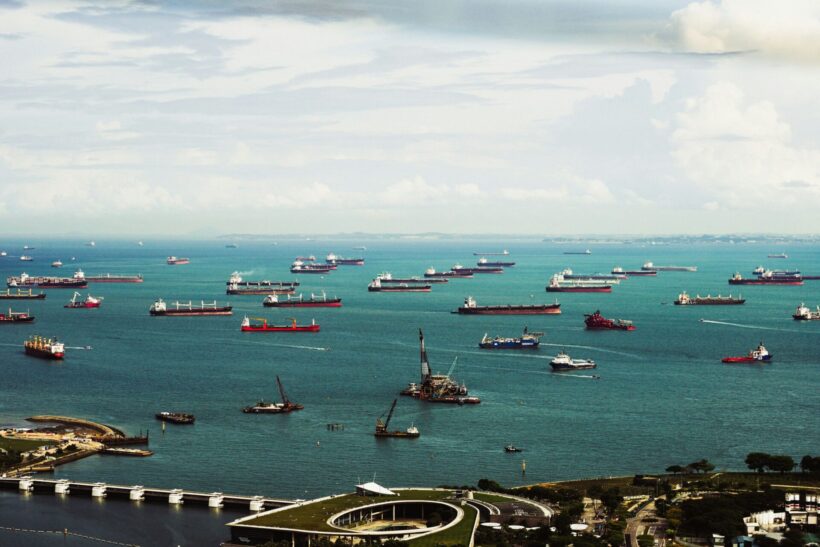
“It’s not a sea, it’s a chessboard. On its waters float aircraft carriers, millions of tons of goods, and the promise of an energy bounty. Here the great powers stare at themselves in the mirror of greed and the fear of losing control.”
The South China Sea is the blue heart of global tensions. More than 30% of the world’s maritime trade crosses these waters, carrying goods with an annual value exceeding USD 3.5 trillion. Through its straits and corridors flows the oil that feeds Japan and South Korea, the containers that supply Europe, and the gas that keeps China’s industrial machinery running. Beneath the surface lie 11 billion barrels of crude and 190 trillion cubic feet of natural gas, roughly 10% of proven global reserves.
This sea concentrates the paradox of our century. It can be the highway that guarantees shared prosperity or the spark that ignites a global conflict. Fleets sailing under the banner of free trade do so with missiles on board. Islands that should be refuges for fishers are turned into air bases. The question is simple and brutal: will the South China Sea become a space for cooperation, or the stage that confirms power outweighs law?
The Economic Value of the Sea
The South China Sea multiplies both wealth and tension. Every day more than 200,000 vessels traverse it, moving raw materials, fuels, and finished goods worth over USD 9.5 billion daily. That figure equals 7% of global GDP sliding along a single maritime artery. No other body of water concentrates such a volume of wealth in constant motion.
Fishing is another contested treasure, with more than 20 million tons landed annually—about 12% of global catches. The industry is worth over USD 100 billion a year and feeds roughly 500 million people in the region. Overexploitation is becoming as serious a threat as a military blockade. For Japan, South Korea, and China, this sea is an economic lifeline. For ASEAN it can mean the difference between sustained growth and external dependency. What is at stake here is not just shipping; it’s the financial pulse of the 21st century.
The Sovereignty Disputes
The South China Sea has turned into a board of contradictory maps. Beijing sketches the so-called nine-dash line over nearly 90% of these waters, a claim that seeks to turn a shared space into an almost exclusive sea. That assertion overlaps with the historical and legal rights of the Philippines, Vietnam, Malaysia, Brunei, and Taiwan, which view it as a direct threat to their sovereignty and vital resources.
The emblematic case erupted in 2013 when the Philippines brought its claim before the Permanent Court of Arbitration in The Hague. Three years later, in 2016, the tribunal ruled categorically that the nine-dash line lacks legal foundation. Manila celebrated a historic victory, but China immediately dismissed the ruling and reinforced its military and economic presence. The paradox is stark. An international decision recognizing the rights of a country of 110 million people is neutralized by the clout of an economy worth USD 18 trillion and a military whose spending grows more than 7% per year.
The consequences go beyond jurisprudence. If an international ruling cannot be enforced, the legitimacy of international law is wounded. For small littoral states the doubt is existential. Either they trust a weakened legal system or they align with military powers that promise protection. Sovereignty in this sea is measured not on maps, but in ships and political will.
Hidden Oil and Gas
The South China Sea doesn’t only carry merchant ships. In its depths lie an estimated 11 billion barrels of crude and 190 trillion cubic feet of natural gas—an energy bounty worth more than USD 2.5 trillion at the 2024 average price. This sea is therefore an energy board disguised as a territorial dispute.
These magnitudes explain the feverish interest of the powers. China has invested more than USD 20 billion in offshore prospecting and platforms over the past decade. Vietnam and the Philippines have signed contracts with foreign corporations in hopes of extracting part of this submarine treasure. For ASEAN, gas from these waters could cover up to 15% of its energy demand by 2030, reducing reliance on unstable Middle Eastern suppliers.
The dilemma is that none of these reserves lie in uncontested areas. Concessions overlap, maps contradict each other, and drilling ships operate under naval escort. The energy that could power Asia’s transition to cleaner sources threatens to become the spark for a naval clash. Instead of technical cooperation, the region has opted for intimidation. The sea doesn’t just hold oil and gas; it holds proof that energy greed can sink any peace discourse.
Fishing as a Strategic Prize
In the South China Sea, fish are as coveted as oil. Each year more than 20 million tons are hauled in, sustaining an industry valued at USD 100 billion. For some countries it’s an export business; for others a matter of survival. In the Philippines fishing contributes 1.5% of GDP and directly employs more than a million people. In Vietnam nearly three million jobs depend on these waters.
But the sea is not infinite. FAO studies warn that nearly 50% of species could collapse by 2040 due to overfishing. Tuna, mackerel, and shrimp have already seen declines of up to 30% over the last decade. Governments have not cut catches; they have increased fleets and subsidies. China fields a fishing armada of more than 200,000 vessels, many operating in disputed waters under coast guard protection.
The food on the plates of 500 million Asians depends on this sea. What should be a shared resource has become a silent war of nets and engines. If fisheries collapse, the cost won’t be only economic—it will be social and human. Hunger and displacement will replace fish on coastal families’ tables.
The International Dilemma
The South China Sea is a resonance chamber for the world order. ASEAN has tried for two decades to draft a binding code to curb militarization and regulate resource extraction, but drafts dissolve in meetings without effect. While Southeast Asian countries tally over USD 600 billion in annual trade with China, they have found no way to check its advance into disputed waters. Economic dependency becomes diplomatic silence.
The United States plays the opposite card. It has tightened alliances with the Philippines, Japan, and Australia through joint exercises and the AUKUS pact, which commits over USD 70 billion in nuclear submarines for the next decade. The White House doesn’t speak of international law; it speaks of freedom of navigation—and it does so with carriers under way. In 2024, more than 25% of US defense spending in Asia went to operations in this sea.
The dilemma is clear. A region representing 7% of global GDP and holding up to 10% of global gas reserves functions as a laboratory of multipolarity. Here we learn whether shared resources can be managed through cooperation rather than cannons.
ASEAN’s Position
ASEAN was born as a cooperation bloc but appears fractured over the South China Sea. Its ten members swing between direct confrontation and cautious diplomacy. Vietnam and the Philippines denounce Chinese expansion and deepen military ties with Washington, while Cambodia and Laos align with Beijing under the weight of investments exceeding USD 10 billion in infrastructure.
Trade is the great constraint. ASEAN-China trade already surpasses USD 600 billion annually, making Beijing its main economic partner. That dependency means pressure for a binding code to resolve maritime disputes dissolves into vague communiqués no one enforces. In 2023 Malaysia’s exports to China equaled 17% of its GDP, a reminder that economics speaks louder than geopolitics.
The internal contradiction is obvious. Coastal states demand security against Chinese incursions, while other members block any resolution that could discomfort their major investor. ASEAN presents itself as a united voice, but at sea it tests its credibility. The result is an organization trapped between the need for sovereignty and the reality of dependence.
The United States and Its Allies
For the United States, the South China Sea is not a distant quarrel: it is a vital corridor for 25% of its maritime trade with Asia. Washington knows any blockade would lift global oil prices by more than 20% within weeks and strike its own supply chains, which rely on semiconductors and manufactured goods that cross this sea.
Its military footprint is visible. Bases in Japan, Guam, and the Philippines ensure rapid response, with more than 80,000 troops in the region and a carrier force whose annual operating costs exceed USD 50 billion. In 2024 Washington increased maritime defense spending in Asia by 8%, emphasizing freedom-of-navigation patrols.
The AUKUS agreement with the UK and Australia directs more than USD 70 billion to nuclear submarines that will strengthen deterrence in the Pacific. Add to this joint exercises with Japan and South Korea that mobilize tens of thousands of personnel each year. The United States projects power not only to protect trade routes but to send Beijing a clear message: the sea does not belong to a single flag.
The Global Risk to Trade
The South China Sea is an invisible artery of world commerce. Sixty percent of East Asia’s exports—more than USD 2 trillion a year in goods headed to Europe and the Americas—travel its waters. This concentration turns any flare-up into an immediate threat to market stability.
Japan depends on these routes for 80% of its oil imports. South Korea and Taiwan rely on the same energy and strategic goods flows for over 70%. In 2023 more than 15 million barrels of crude per day crossed these sea lanes; every delayed tanker moves energy and food prices.
The IMF warns that a disruption of just two weeks would raise global energy costs by 20% and could shave up to 1.5% off world GDP in a single quarter. In an interconnected system, an incident here doesn’t stay in Asia; it multiplies inflation in Europe, unemployment in Latin America, and financial volatility in Africa. This sea is a thermometer for the global economy.
The Role of International Law
The South China Sea is also a mirror of the limits of international law. The UN Convention on the Law of the Sea, adopted in 1982 and ratified by more than 160 countries, guarantees freedom of navigation in international waters and defines exclusive economic zones up to 200 nautical miles.
On that basis, the Philippines took China to the Permanent Court of Arbitration in 2013 and won a favorable ruling in 2016 invalidating the nine-dash line. The problem is that law without enforcement becomes wet paper. China dismissed the ruling and increased its military presence on artificial islands. The inability to compel a power that accounts for 18% of global GDP and spends over USD 220 billion annually on defense exposes the system’s fragility.
International norms aim to limit power, but in this sea the opposite occurs. Naval strength imposes rules, and law becomes a political argument rather than an effective guarantee. For small countries the message is blunt. Relying solely on treaties risks surrendering sovereignty to those who can buy warships and flout resolutions without real consequences.
The Peoples of the Sea
In the South China Sea, geopolitics is measured in warships, but daily life is measured in nets and fish. Around 500 million people depend directly on these waters for food and work. Entire communities in the Philippines, Vietnam, and Malaysia have lived for centuries from coastal fishing and now face a double blow: resource depletion and militarization that restricts their movements.
The presence of coast guards and foreign fleets pushes out artisanal fishers who already lose up to 30% of annual income. In the Philippines, a sector worth 1.5% of GDP watches catches shrink as costs rise. In Vietnam, maritime conflicts have forced thousands of families to leave the coast and migrate to cities, where many end up in sprawling belts of poverty.
Human rights are drowned out by diplomatic communiqués. Each time a fisher dies in a maritime incident, the numbers vanish under the noise of carriers and cruisers. What should be a shared sea has become a zone of exclusion where the weakest pay the price of confrontation. For millions of families, security is not a map—it’s the ability to put food on the table.
Scenarios Toward 2030
The future of the South China Sea can diverge sharply, with costs counted in money and in lives. One scenario is a limited war between China and US-aligned states which, even if brief, could interrupt trade flows worth more than USD 3 trillion a year. The Asian Development Bank estimates that a regional conflict would cut Southeast Asia’s GDP by up to 5% and drag the world into an immediate recession.
Another scenario is resource-sharing agreements in which China, Vietnam, and the Philippines jointly develop oil and gas. Under that model, revenues could exceed USD 50 billion over two decades and ease sovereignty pressures. Yet historical mistrust makes this look more like a mirage than a real exit.
A multipolar alternative would be common navigation codes under a regional cooperation framework. That would guarantee the free transit of goods equal to 30% of global trade and reduce the risk of military incidents. For the world economy this would mean stability and an additional 1% of global GDP growth by 2030. The dilemma is clear. Either confrontation prevails, or a pact turns this sea into a space of shared prosperity.
Who Has the Greater Right to the Sea
The central question cuts through every dispute. Who has the greater right over the South China Sea and its islands? Beijing argues that 90% of these waters belong to it for historical and cultural reasons. Washington replies that it lies on the other side of the world but defends freedom of navigation because 25% of its maritime trade with Asia—over USD 1 trillion in goods annually—depends on these routes.
• China builds artificial islands and deploys a navy now exceeding 350 warships.
• The United States maintains bases in Japan, Guam, and the Philippines, and spends around USD 60 billion a year on Pacific defense.
• The dispute is not only about sovereignty but about control of energy and technology corridors that will shape the next decade.
• Taiwan is an inevitable point on this board.
If Beijing seeks to consolidate maritime dominance, it cannot leave out an island that produces more than 60% of the world’s semiconductors. For Washington, defending Taiwan is defending its own tech chain. This sea is not just a physical space; it is the prelude to a larger conflict that could define the global balance of the 21st century.
Hard Numbers from the South China Sea
• This sea is not just a map of disputed islets; it is an ocean of figures that reveal its strategic weight.
• About 30% of global maritime trade transits its waters, equal to USD 3.5 trillion per year.
• More than 15 million barrels of crude per day move through it, nearly 25% of world oil trade.
• Estimated reserves: 11 billion barrels of oil and 190 TCF of natural gas (US EIA 2023).
• Fisheries underpin food security for more than 300 million people in the Philippines, Vietnam, Malaysia, and China.
• China has built over 3,200 hectares of artificial islands since 2014, with seven military bases capable of hosting bombers and medium-range missiles.
• China’s fishing fleet in the area exceeds 12,000 boats, backed by the so-called “maritime militia.”
Table
• Global trade: 30% | USD 3.5 trillion
• Oil: 15 million barrels/day | 25% of world trade
• Reserves: 11 billion barrels oil | 190 TCF natural gas
• Artificial islands: 3,200 ha | 7 military bases
Military Spending and Presence in the South China Sea (approx. 2023–2024)
• United States: spends over USD 50 billion annually on naval operations in the Indo-Pacific (Pentagon, 2023). Maintains the Seventh Fleet in Japan with more than 50 ships and 20,000 personnel.
• Japan: record 2024 defense budget of USD 52 billion, with new frigates and submarines oriented to the South China Sea and its alliance with the US.
• Malaysia: about USD 5 billion per year on defense; in 2023 acquired new coastal patrol vessels and radars to protect its maritime claims.
• Vietnam: around USD 6 billion annually; purchased Russian Kilo-class submarines and coastal missiles to bolster its position on disputed islands.
• Philippines: raised 2024 defense spending to USD 4 billion, signed agreements with the US for base access, and expanded its patrol fleet.
• Russia: not a direct claimant, but has sold over USD 7 billion in arms to Vietnam and other Southeast Asian countries over the past decade, indirectly shaping the balance.
• China: the main actor, with a 2023 military budget exceeding USD 225 billion, a significant share dedicated to its navy and militarized artificial islands.
Table
• US USD 50B | Japan USD 52B | China USD 225B
• Vietnam USD 6B | Malaysia USD 5B | Philippines USD 4B | Russia USD 7B (arms sales)
A sea that could unite cultures and feed peoples has become a battlefield for ships and corporations. The South China Sea is not doomed to be the spark of a global war. It can be a laboratory of unprecedented cooperation—open routes, sustainable resources, respect for international law. The choice is stark: turn it into a sea of blood or a sea of justice for humanity.
The world does not need more trenches, but agreements. Turning this sea into a space of encounter rather than confrontation is the test that will show whether the great powers are ready to govern the planet responsibly—and not with cannons.
Bibliography
• United Nations Convention on the Law of the Sea (UNCLOS)
• Permanent Court of Arbitration, Award in the Matter of the South China Sea (2016)
• US Energy Information Administration, South China Sea Energy Estimates (2024)
• ASEAN Secretariat, Trade and Maritime Reports (2023)
• SIPRI, Military Expenditure Database (2023)