
by George Banez
“Wake up!” I heard my late mother say. I remember not budging. The faint flashes my half-opened eyes caught appeared more like midnight stars. We, four children and mom, likely went to bed at eight that night because we had nothing else to do. The entire island had no running electricity.
Even before I could fully engage, I sensed everyone’s glee and urgency. I listened to the joyful chatter. And from the glow around the charcoal pit, I saw faces and movement. Fishermen were hauling their catch, while the women roasted the freshly caught fish — lots of them.
The new moon of April, or May, made it easy to catch plenty of adult rabbit fish, Siganus fuscescens, so named for its darker appearance. Known to mother’s clan only as “Bataway,” this Mottled Spinefoot rabbit fish came in large schools. They foraged on algae and seagrass in beds and coral reefs between Cagraray Island, where my late great-grandparents lived, and Cagbulauan, the island across the narrow strait.
But I did not know any of that then. I must have been seven or eight years old, the youngest of four kids. Also, my mother left town decades earlier to study in the capital, Manila, some 310 miles (500 km) away. I was born to her late in life in that city. So, I had no clue what the early dawn commotion was about.
On this, during our annual summer visit to my late grandfather’s coconut plantation in Cagraray Island, we stayed at the house of one of the tenant farmers. The one-room hut sat about 30 feet from the western shore of the passage.
Already unenthused about the heavy mud on this shore, we children could also not appreciate its thick mangrove forests. They stood in the way of a picture-perfect beach. Little did we know that my late grandfather, Victor, chose this parcel of land because of the mangroves. They nurtured lots of delectable mud crabs, Scylla serrata, called “Hâ-nit” in the local dialect. Those intact mangroves augmented fish abundance. They directly supported seagrass and reef ecosystems where schools of “Bataway” grazed.
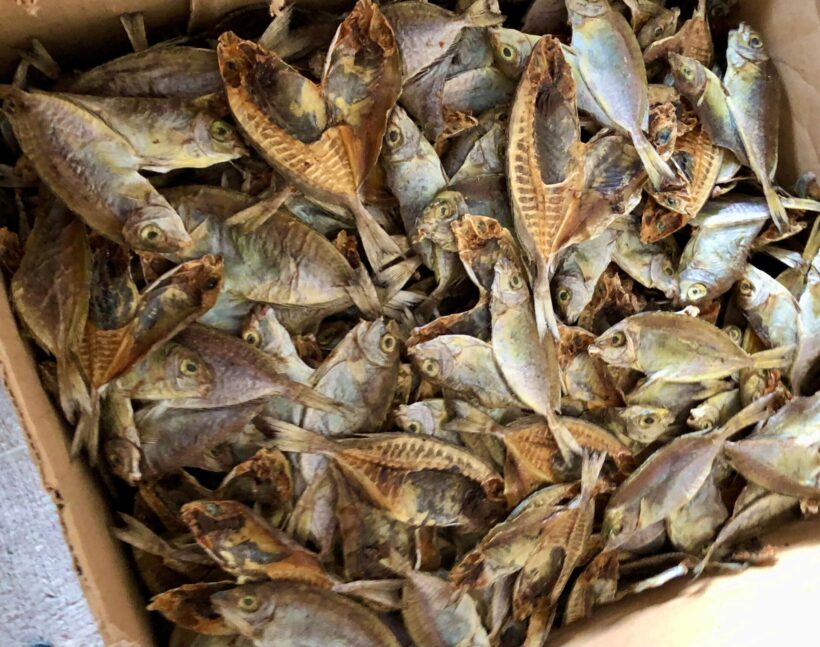
Mother woke us up so we could eat “dinarang.” The word referred to “anything grilled” but in that context, it meant charcoal grilled fresh “Bataway.” In the city, we only knew or ate “Bataway” as dried fish. So, savoring it cooked right out of the boat at first light was worth waking us up, I guessed. With no refrigeration, fish would have started to spoil had we waited for daylight. So, islanders dried “Bataway” to preserve them.
Nothing Can Compare
Treasured by my mother’s big extended family, both the dried fish and the process of drying evoked childhood memories of the bounty of the seas around them. Family spoke of helping to butterfly open boatloads of rabbit fish, washing them in sea water, then drying them under intense sun. A day or two after, they washed them again in seawater before a second drying.
With no extra salt added, the dried fish meat remained leathery in texture, but crispy when fried. The family called them “Badî.” Preserved, they lasted for months and could be shipped to family living elsewhere. Back then, they were between 6 to 8 inches long. And one or two pieces could be eaten with a vinegar dip, rice, and fried egg as a breakfast staple, like bacon was to the younger generation.
Still, nothing compared to eating “Bataway” fresh. The clean-tasting flesh was tender, moist, flaky, and delicately sweet. Even more unexpected to the young me was the deliciousness of sweet potatoes grilled over the same charcoal bed. Literally soil to grill fresh, the sweet potatoes were dug the previous afternoon. So, even by the following daybreak, the sugars in them had not been altered or completely degraded.
The natural sweetness and velvety texture of fresh sweet potatoes paired with grilled “Bataway” was a match made in heaven. Yet more gifts came from the sea for us to enjoy. Pregnant female rabbit fish yielded “piga,” their roe or eggs to us humans. They were fried when fresh or preserved in brine to keep. The other endowment to the family, “Kuyog,” was an umami-rich, thick fish sauce condiment. Made by fermenting the inch-long “Bataway” juveniles, “Kuyog” went well with sweet potato or rice, straight from the jar or sautéed with aromatics.
The Sea’s Generosity Once Ran Deep
By the time we were feasting on grilled rabbit fish that summer in the ‘70s, my grandfather, Victor (1891-1950 ), had long passed away. And so did his father, my great grandfather Gaspar (1870-1942). Married at 17 to my great-grandmother Petronila (1872-1955), Gaspar woke up at 3 am to fish for a living.
Their house stood on the shoreline of Nagtapis hamlet in Cagraray Island. Petronilla, also up that early, made mats out of the processed leaves of “Karagumoy,” or Pandanus simplex. She also planted sweet potatoes in their small plot in the hills.
Together, they saved enough to invest in a “parao,” the sailboat Gaspar needed to go deep-sea fishing outside the strait. Soon after, he eventually became the middleman. He traded fish right there in the middle of the sea. He bought from other fishmen big predator fish, like “Bangkulis” Yellow fin Tuna or “Malasugi,” Blue Marlin, caught in the deeper Lagonoy Gulf that opened into the Pacific Ocean. There, he sold fish to buyers from towns and cities along the Gulf; my mother told me.
Gaspar had made enough money from other business ventures to send Victor, his first-born, to study in a boarding school in Manila at 14. When Victor returned after college, he settled in the town of Bacacay, the municipal center. Back then, it was a day-long journey by “parao” from Nagtapis, their home in Cagraray Island.
Mother grew up in Bacacay, a town on the southwestern shores of a sound-like expanse separated from Lagonoy Gulf by the islands of San Miguel and Cagraray. Her favorite fish growing up was “Sibubog,” or Indian scad, a fish that swims in fast-moving schools along coastal oceanic waters.
Its slender, elongated, and silver body bear a striking resemblance to “Galunggong,” the Mackerel scad, a popular, staple fish in Manila. Both are easily mistaken for being the same. Part of the same genus, Decapterus, the two likely belong to different species.
But mother refused to eat “Galunggong.” She craved “Sibubog,” instead. Unlike “Bataway” that fed on algae and seagrass, “Sibubog” ate animal-like planktons, or zooplanktons, and crustaceans, tiny shrimp-like creatures. As such, they were moderately oily, pairing well with Filipino vinegar, other souring agents, and soy sauce.
The Silence Beneath the Waves
Today, preference for certain fish flavor or freshness is perhaps the least of concerns. The Philippine Statistics Authority (PSA) released in August the “Fisheries Situation Report for April to June 2025”. It indicated a 2.6% decrease in the total volume (in metric tons) of fisheries. Production was down from the same quarter the previous year in 2024 for both commercial and marine municipal fisheries.
Noting the PSA report for 2024, Oceana, an international organization dedicated to oceans, shared the findings that fisheries output declined by 5% in 2024. For marine municipal fisheries, the drop was at 8.8% from 2023.
In 2009, scientists from Bicol and Kochi universities in the Philippines and Japan, respectively reported their study on the overfishing of three Siganid species in Lagonoy Gulf. These species belong to the same family as “Bataway.” In fact, one of the three is considered synonymous to the “Bataway” species.
The scientists wrote: “Exploitation rates of three species were higher by 34-64% beyond the level that would be sustainable.” They added that: “Capture lengths were generally lower than their reported maturity size.” That meant fish were caught before they could possibly reproduce. This explains why dried “Bataway” sold in markets today appear to be between 4-6 inches in length.
It had only been a century since my great-grandfather Gaspar’s family flourished on the bounty of the sea. In 2019, the Philippine Journal of Fisheries, published the “Assessment of Fishery Resources in the Lagonoy Gulf, Philippines.” The authors from the Bureau of Fisheries and Aquatic Resources (BFAR) noted that “Lagonoy Gulf suffers from overexploitation.”
Most of Gaspar’s direct descendants, including my mother, made their living far from Cagraray Island. They are gone now. But the voices I heard in those early dawn hours still echo. They mingle with the memory of the soft lapping of waves against the muddy shore. But what was once an invitation to feast now tolls like muffled alarm.