

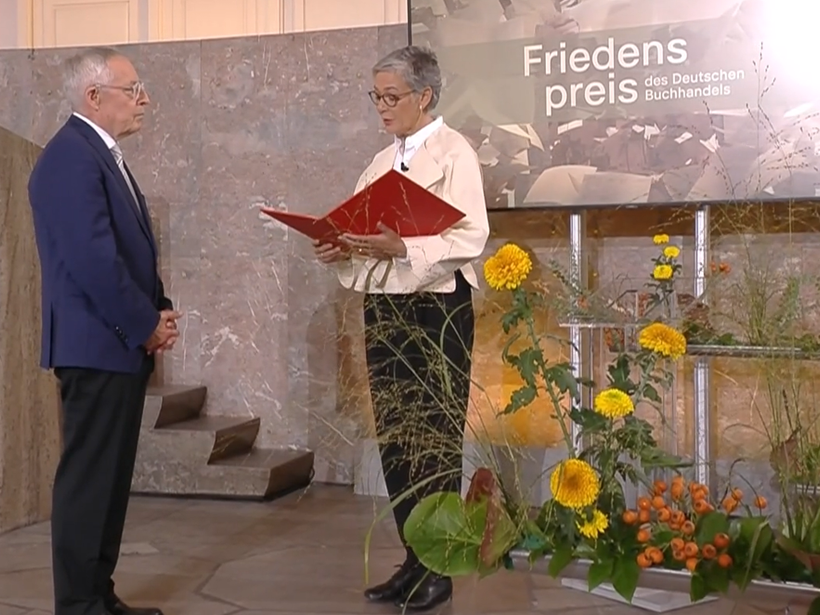
Karl Schlögel was once a conscientious objector during the Vietnam War. Today, he calls for the reintroduction of military service—and has been awarded the Peace Prize of the German Book Trade for his efforts. It is a symbolic act so grotesque that it fits perfectly into our times: an era in which war is once again being sold as a policy of peace and armament as a responsibility.
If Karl Schlögel had been sincere enough to say that he had only flown his flag in the wind and refused military service because it was “in” at the time, he would now only have had to say that he had remained true to himself. But he does not do that – he defends his change of heart.
The decisive difference between the 1970s, when Schlögel refused military service, and today lies not in the “return” of war, but in “Germany’s role.” Back then, the Bundeswehr was an army on standby – symbolically embedded in the Cold War, but without any real combat missions. Today, on the other hand, it is globally active, involved in military operations, logistically and technically linked to a hot war in Ukraine.
Schlögel’s U-turn seems like a gesture that goes down well in the current intellectual climate: those who support Ukraine militarily are considered to be on the right side of history.
But those who argue this way reveal less a new way of thinking than a forgotten memory.
In Karl Schlögel’s case, this is not a mistake in thinking. It is a strategy. Because the intellectual class of our time needs narratives, not contradictions. Those who are “on the right side” are allowed to sacrifice logic. Thus, the former pacifist is transformed into a ‘realistic’ advocate of war, (here, some will protest and say: “He may be wrong, but he doesn’t want war!”)
True, he does not want to start a war! But he wants to fight war with war; he is therefore an advocate of “defensive war,” not so much to protect life and property, but to protect “dignity.” This brings us damn close to the brown logic we thought we had left behind.
Karl Schlögel no longer rejects “war to enforce political interests,” as he did in the 1970s, but only “war of aggression.” Yet all modern wars, including the invasion of Poland in 1939, have been legitimized as defensive wars.
The former conscientious objector would have every reason today to reaffirm his former stance—as a reminder that peace is defended not through armament, but through political reason, historical memory, and self-restraint.
Schlögel is not a naive man. He knows what he is saying. And that is precisely what makes his argument so frightening. When a historian of his stature claims that war has “returned to Europe,” it is not ignorance, but intention. He knows about the Balkan wars, the NATO bombing of Serbia, the Chechen wars – the Armenians also belonged to Europe, at least culturally. He knows that war never disappeared from Europe. By now having it “return” with the Russian attack on Ukraine, he is deliberately shifting the historical perspective in order to construct a moral line: here is good, there is evil. But that is the basis for legitimizing all wars!
“Germany and Europe,” he says, “must finally understand that Putin’s Russia is waging a war against the West.”
He has obviously not noticed that the “West,” i.e., NATO, has been advancing against Russia for decades. Anyone who ignores all this does not want to enlighten, but to reinterpret.
At first glance, Schlögel’s call for “defensibility” seems reasonable. But a historian of all people should know that defensibility has never historically been a protection against war. On the contrary, it has often been its driving force.
The military build-up before the First World War, the competition between systems in the interwar period, the nuclear arms race during the Cold War – they all followed the same logic: security through strength. But this “security” has always been an illusion. Every increase in military strength generated counter-tension, every armament provoked rearmament. Peace was never the result of this spiral, but only a brief pause in it.
Schlögel’s ignorance of this connection is no accident. It is a symptom of our present: intellectuals declare war preparations to be peace policy because the political-industrial consensus demands it.
The fact that he has hung his flag in the right direction is proven not only by the undeserved prize and the shameful applause for his speech, but also by what Carsten Otte, cultural presenter at SWF, writes about him and the book fair: The authors who came to the book fair in military camouflage uniforms were “an unusual, but enlightening sight.”



