

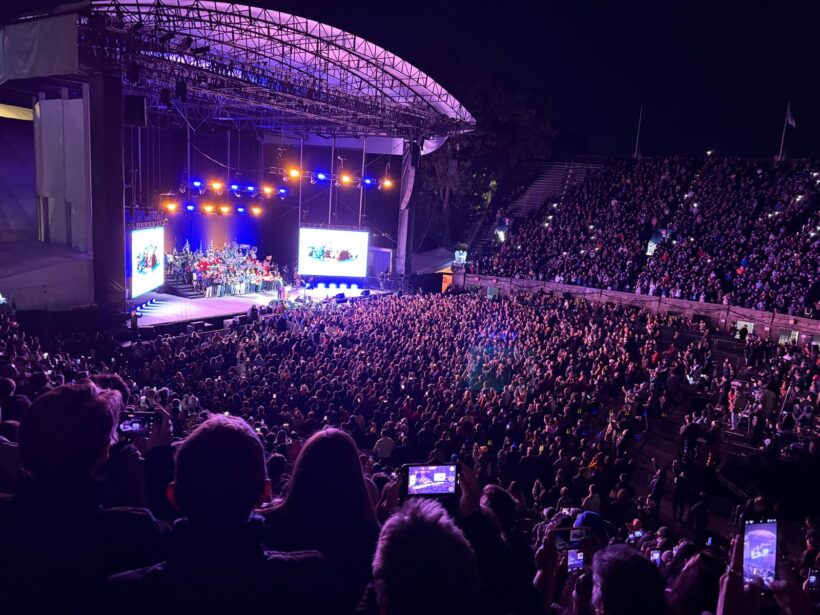
Sunday, October 26, 2025: Night has slowly fallen. For hours, we’ve been sitting in the cold stands of Forest Hills Stadium, and the air has become biting. We’re all numb, but not our hearts, which, filled with passion, spur us to shout and clap ever louder. We’re all waiting for Zohran Mamdani.
For those of us who, like me, are new to American politics, it’s important to know that during a raduno [Italian for gathering] (which they call a rally here), the candidate’s supporters file onto the stage one by one to vigorously and passionately explain the reasons that led them to support him or her..
The speakers are numerous. Representatives of various worker groups speak first—doctors, nurses, researchers, teachers, educators, taxi drivers, and others. They all struggle to make ends meet. Then come the representatives of the city’s three main religions—a rabbi, an imam, and a pastor—all three eager to build a community where there is room for every faith and where each not only respects the other, but also seeks dialogue and friendship. Prominent figures from the labor union scene and the Democratic Socialists of America (DSA) political organization follow, including Alexandria Ocasio-Cortez, New York’s representative to Congress and the youngest member ever elected (born 1989), and Bernie Sanders, one of the longest-serving and most combative Democratic senators in American politics.
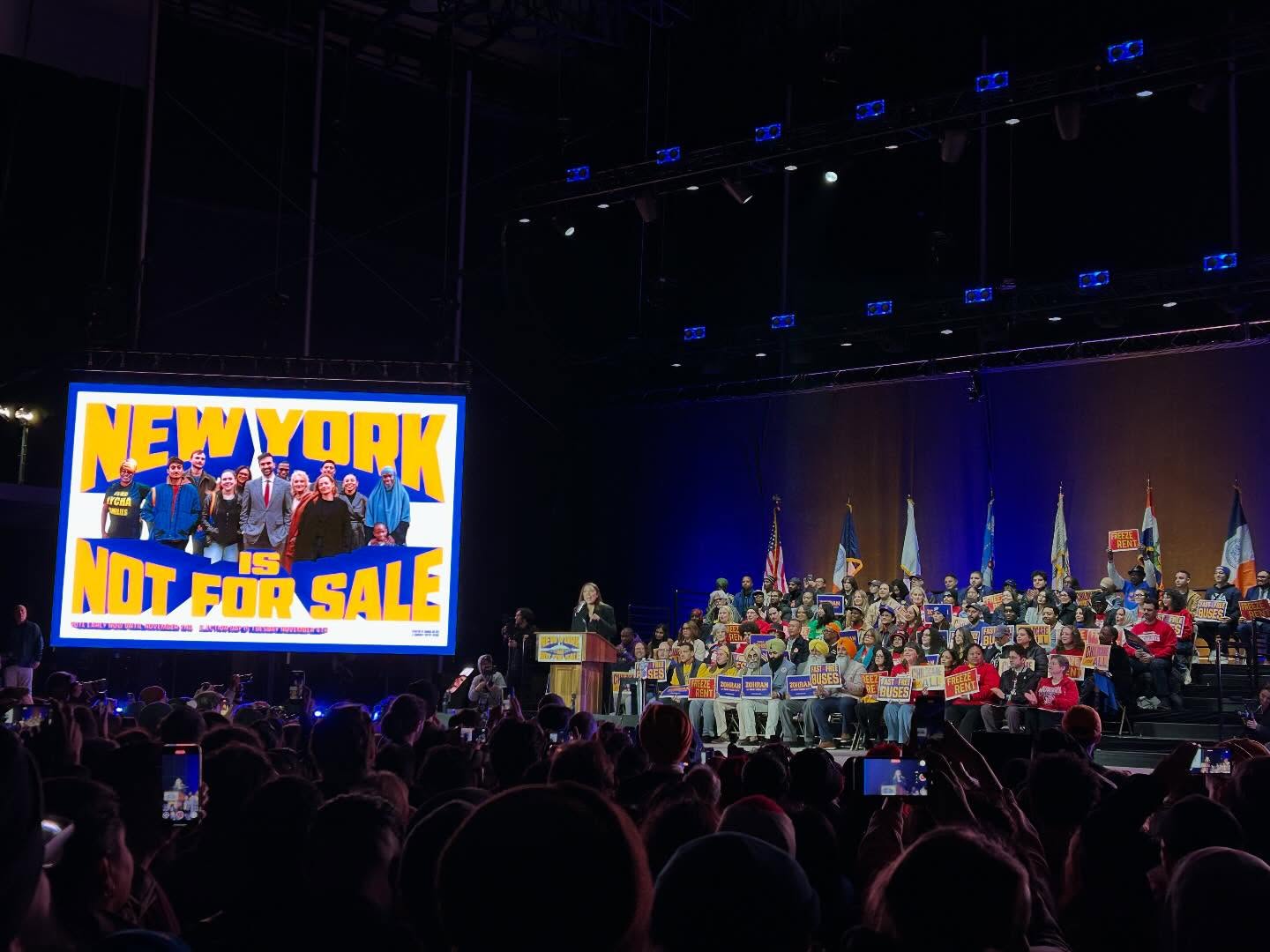
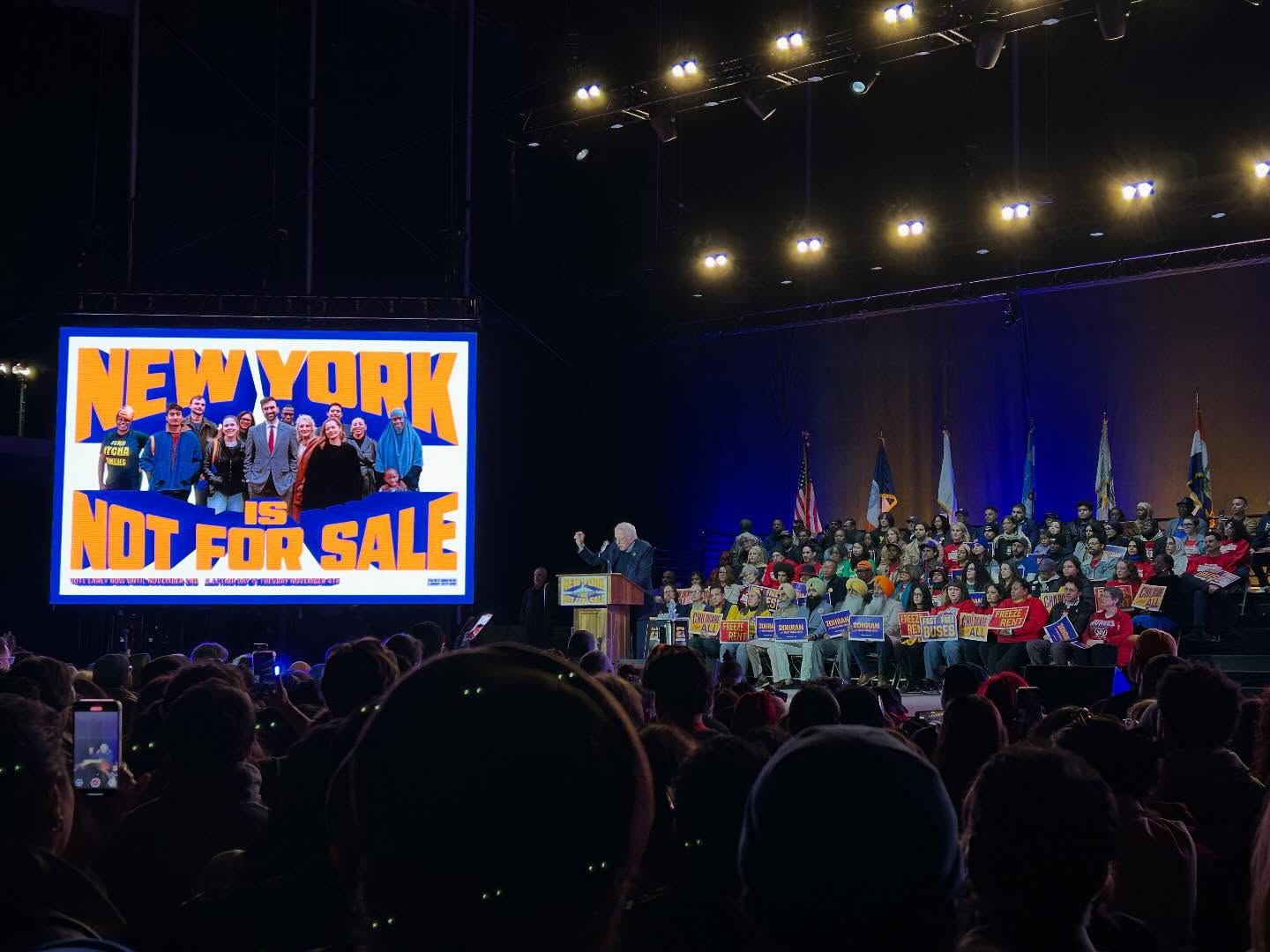
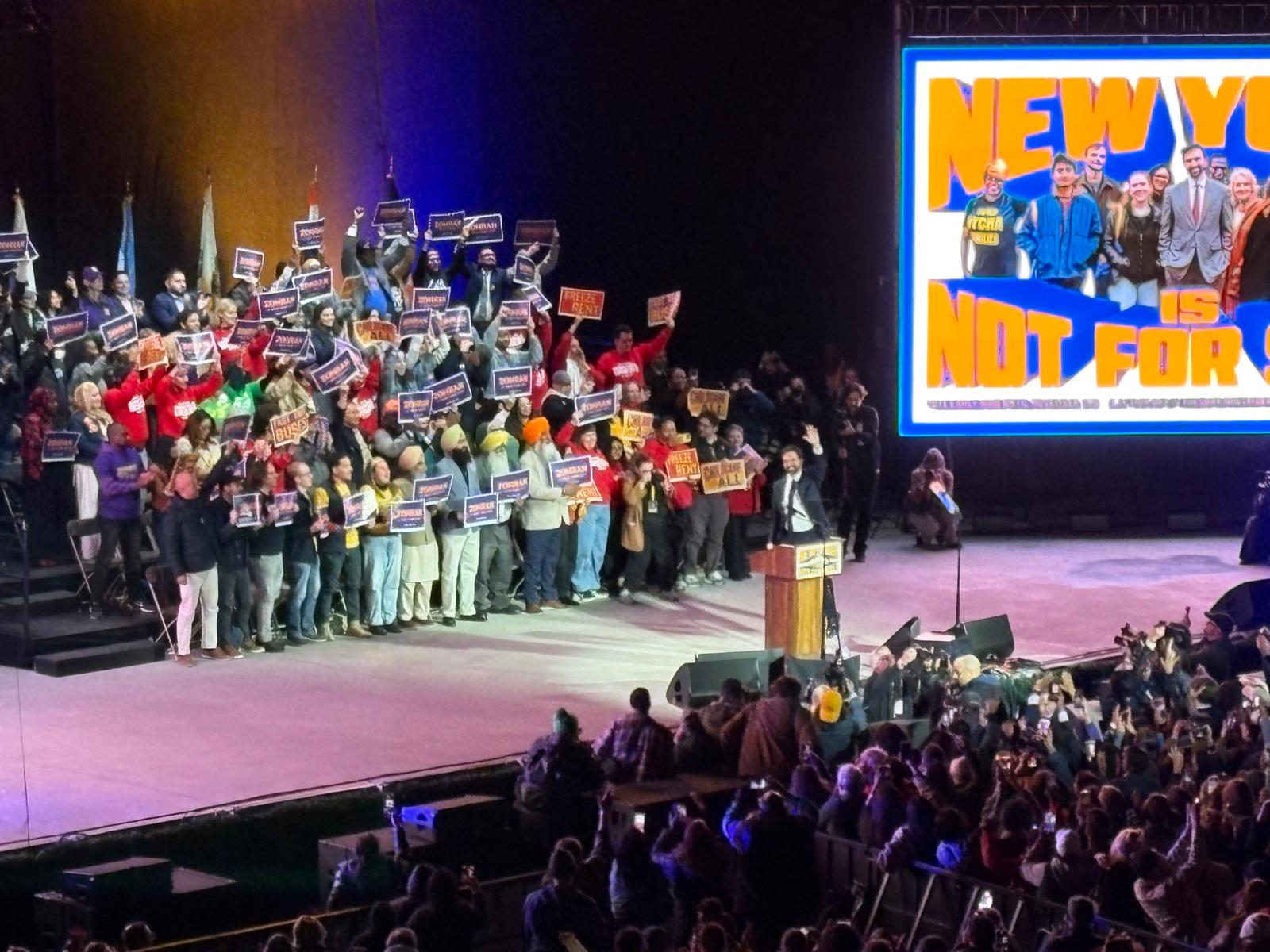
Finally, amid a blaze of applause and cheers that lasted a good few minutes, it was the aspiring mayor’s turn to step out on stage; the moment had come to give himself to his audience. I don’t feel like exaggerating by saying that Zohran’s encounter with the 15,000 people gathered around him tonight had something to do with love. He acknowledges everything: without them, he would have remained a statistical anomaly (as he jokes about how the initial polls had defined him). They, the workers, thank him for listening to them. Indeed, it’s been a while since this country, and not only there, hasn’t been listening to the people; in New York City, Zohran seems to be the first politician to reopen the interrupted dialogue between the institution and the people.
For years, the city’s needs have been analyzed and planned using theoretical models that are increasingly out of touch with reality, no longer addressing the needs of the citizens, but those of corporations and millionaires. From this recognition and denunciation comes the rally’s name: New York City is not for sale. We shout the slogan so many times that it seems the entire city, from Harlem to Staten Island, can hear it. Zohran himself invites us to get even louder, so that Cuomo (the rival) can hear us from his $8,000-a-month apartment and so can even the billionaires holed up inside the White House!
Although it is experiencing a moment of great strength and creativity, the DSA movement did not emerge from nowhere (the reference is to the patient seed-setting work done by our friend Bernie Sanders), and the road will be long and uphill. Winning on November 4th will not be enough, a goal we must dedicate ourselves to relentlessly, assuming we are five points behind our opponent (not ahead as the polls indicate); from then on, every worker must be aware of their rights and ready to fight for them every day; the city must be brought back into line with humane and egalitarian values. Because it is not radical (extremist) to want to live in a decent home at an affordable price; it is radical to be accused of having such demands. In truth, the rent freeze only concerns a particular type of contract, the “stabilized” (fixed-rent) one, which nevertheless involves more than two million families. Free childcare for children up to age six could have a greater social impact. But even in this case, it is not radical to desire a family; it is radical to force oneself to choose between a career and one’s loved ones. These seem like obvious things, yet from the excitement I detect around me, it seems that these elementary desires have been suffocated, perhaps under the weight of surviving in a reality that has become hostile.
The city itself, beautiful New York City, is the protagonist tonight. I feel it loved by the candidate and its citizens gathered here. Over and over, listening to the back-and-forth—the applause, the waving of cell phone flashlights, the loud boos, the shouts and laughter—I get the impression that those present want to free it from the sordid businessmen whose infinite greed is poisoning its soul. The point is that a city isn’t just made of bricks, steel, and concrete: something else also flows through its arteries, something we might also call “love.” And just as every creature becomes happy and welcoming when it feels loved, New York, too, becomes lovable. Love is a topic of conversation at the rally; the word is on every participant’s lips, and I want to understand it that way, 360 degrees and without barriers.
A billionaire, living who knows where, offered yet another real estate deal following evictions from entire lots in Bed-Stuyvesant (the neighborhood where I live in Brooklyn) would build another relationship, or rather, he wouldn’t build “any relationship.” He might not even care about the name of the neighborhood where he invested money, much less its history, steeped in life and civil battles.
But the city belongs to those who live in it, not to those who exploit it, and at a certain point it either dies or rebels. Zohran asks loudly: “Do you want to surrender or fight?” The chorus responds in unison: “Fight!”
At tonight’s rally, all generations are present in varying degrees. I have a sample right next to me. To my right sits an elderly woman, not very tall and rather stout; her shoulders are those of a Mexican-Indian, but her face could be any ethnic group. The overall figure shows the signs of someone who has struggled to live. To my left sits a young man with a hippie look and delicate manners: he wears a leather jacket, scarf, and wool hat, and even round glasses like John Lennon. He expresses his enthusiasm vigorously, jumping like a cricket and fidgeting with every joke; she is much more composed in her reactions, not clapping every thirty seconds and always standing last (he is always first), but she can’t resist Zohran’s jokes, and finally, now that we’re at the finale, I see her laughing almost freely.
This woman, bundled up like me to ward off the evening chill, reminds me of one of the first people I met when I set foot in America eight years ago. I was lost in the maze of Port Authority Station when an employee helped me, directing me to the right platform for the bus I needed to take, a few floors above where I’d gotten lost. In the elevator, we exchanged a few words: I was the enthusiastic tourist, she was the stressed worker. Her words stuck with me: “This is the city that never sleeps; you think it’s fascinating, but we’re going crazy. I need a vacation too… Italy must be beautiful… but here it’s impossible to imagine having more than a week of rest, and with so little time, what do you do? You stay home, you try to catch up on everything you’ve left behind, because in New York you always have to rush, otherwise you end up in trouble, on the street. I don’t know where we’ll end up, I don’t know how much longer we can hold out.”
I wonder if she’s here tonight. I wouldn’t recognize her, but I really hope she is.
Photos by Marina Serina and https://www.facebook.com/32BJSEIU



