

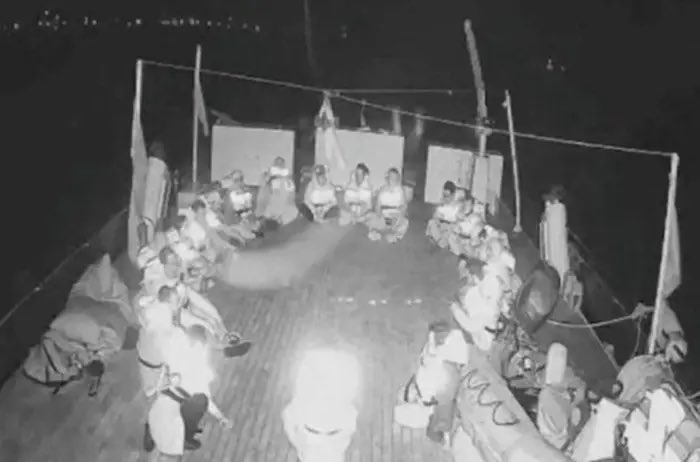
As the flotilla begins to be attacked by Israel, we need to clarify and refocus our attention on what is really at stake.
Among Silo’s Principles of Valid Action, there is one that says: “Do not oppose a great force. Retreat until it weakens, and then advance with resolution.” This principle is worth recalling in moments like these.
David Sawson, in his article “How Not to Halt a Genocide,” criticized the Global Sumud Flotilla, questioning its strategy and whether it could truly stop the genocide in Gaza. Many articles describe the flotilla as a “nonviolent action,” but the term is being used very loosely. What makes this action genuinely nonviolent? Is confronting the current Israeli government—at a moment when it devotes most of its energy to daily bombings—really appropriate? Does merely doing something against violence qualify as nonviolence?
At the same time, we must acknowledge the courage of those who have chosen to sail into danger. Facing military drones and possible imprisonment or death is not a trivial act. Their commitment to taking risks for the people of Gaza deserves respect. Yet courage alone does not make an action nonviolent in the strategic and transformative sense that history has shown us.
I am not even sure whether all the sailors consider themselves nonviolent. Have they studied the tradition of nonviolence? How much do they know of Tolstoy, Gandhi, Martin Luther King Jr.? How much personal inner work have they done? Nonviolence is not spontaneous catharsis in the face of horror—it is a profound and strategic practice, grounded in study, personal transformation, and a vision of the future.
Putting on sneakers and walking down the street with a sign does not necessarily make one a nonviolent activist. Nonviolence has centuries of experience to draw from. Across the world, people have developed methods, strategies, and frameworks that need to be studied and adapted to today’s conflicts. Each new stage of history has demanded more complexity, discipline, and creativity from those who dedicate themselves to it. Silo himself linked nonviolence to personal development: overcoming suffering, transforming one’s own landscape, and embodying coherence between action and inner life.
Some people say we should not criticize those “who are at least doing something.” But by that logic, should we also avoid criticizing anti-immigrant protests in the UK or the far-right AfD movement in Germany, since they are acting “democratically”? Doing something is not enough: what is being done, how it is being done, and with what consequences are what truly matter.
There are serious flaws if the flotilla is to be understood as a genuine nonviolent movement. Its media strategy is thin, reduced to the slogans of “ceasefire” and “humanitarian aid,” which do little to mobilize or involve the broader global public. Its political strategy remains vague; framed as a direct confrontation with Israel, the initiative risks being undermined before it even begins. Even the humanitarian dimension is precarious—as Israel’s drone strikes on the boats already demonstrate, what is presented as aid can quickly turn into vulnerability.
What troubles me most is that as the world grows more complex, people in the West increasingly insist on seeing everything as simple. The belief takes hold that anyone can do anything—without knowledge, without study, without commitment, without perseverance. Our consumer society thrives on selling this illusion: if you’re sick, take a pill; if you want to act, download an app; if you want to be rich, go viral on social media. And now, in the same vein, if you want to “do nonviolence,” you just get on a boat.
Nothing could be further from the truth. There is no “cheap nonviolence.” Nonviolence requires effort, intelligence, perseverance, and above all, faith in the future and in humanity. It is inseparable from self-knowledge and personal transformation. It is not a tactic of convenience—it is a way of life.
All of the iconic references in nonviolence—Tolstoy, the Quakers, Gandhi, Martin Luther King Jr. and the civil rights movement, Silo and the New Humanist movement—were marked by deep dedication. They united sharp analysis, moral clarity, and a creative spark that turned vision into powerful action. That is the lineage we should honor, and the path we must develop today.
If or when the world wants to stop the genocide, it will require not symbolic gestures but the organized, disciplined, and profound force of true nonviolence.