

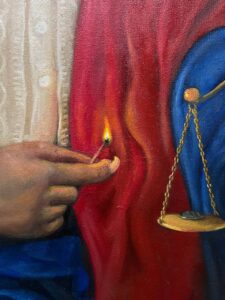
 In one hand, the creature holds a lit match near a roaring flame.
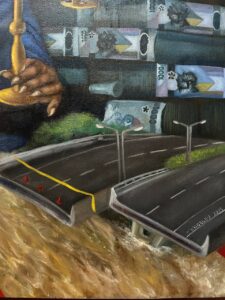
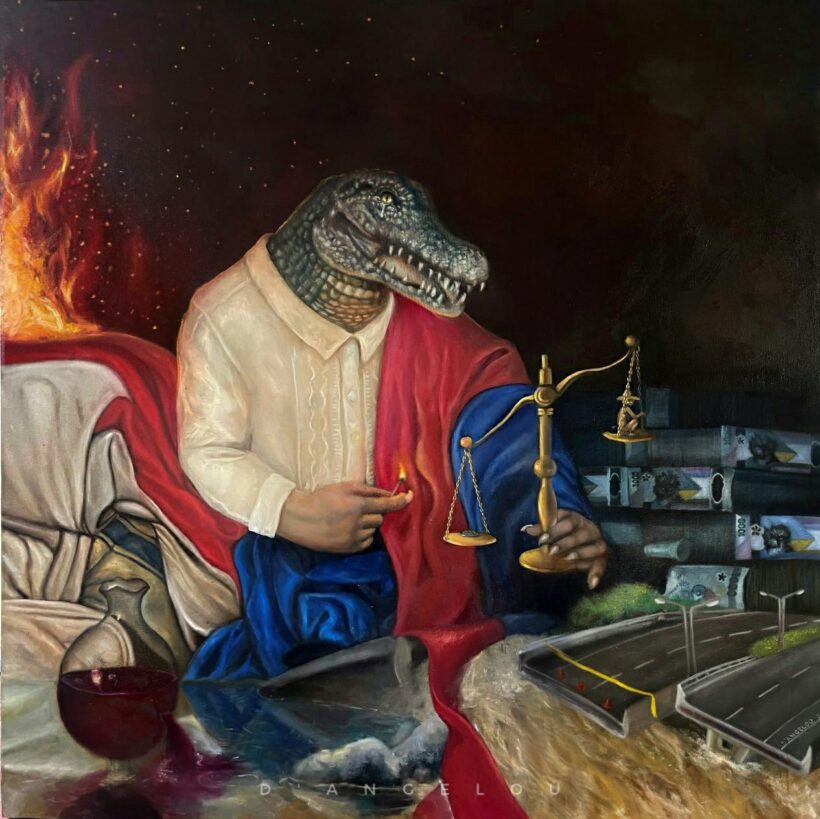
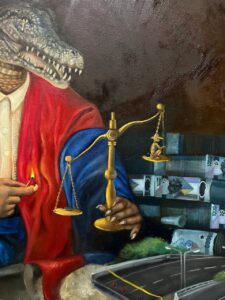
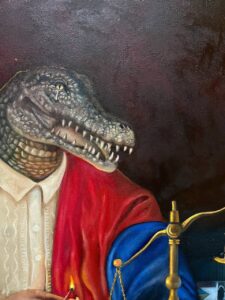 Through this painting, Laureta reimagines the Filipino idiom “Luha ng Buwaya” or the crocodile’s tear as a portrait of false remorse. The crocodile sheds tears not from sorrow but from hunger and deceit. In Filipino culture, the image of the crocodile has long been associated with the corrupt and the greedy, those who consume and exploit without conscience. Laureta’s crocodile, dressed in formal wear and cloaked in the nation’s colors, becomes a damning symbol of the elite who manipulate power while feigning sympathy for the people.
Yet beyond the rage and accusation, “Luha ng Buwaya” is also a work of witness and remembrance. It compels viewers to confront uncomfortable truths about complicity and silence. It is not just a painting of the corrupt but a reflection of a society that has learned to live with corruption as if it were normal. By depicting this moral decay in such vivid, allegorical terms, Laureta forces us to see what we often choose to ignore.
Don Angelou Laureta is an Architectural Drafting student at Sorsogon State University and a member of both the Kurit-Lagting Art Collective and CAP Bicol. He is passionate about drawing, painting, photography, and music. His creative practice extends beyond the gallery, reaching communities through murals, photography exhibits, and collaborative art projects. For Laureta, art is not only self-expression but also a tool for education and social change. His works often engage with the struggles of ordinary Filipinos, turning visual storytelling into a form of activism.
In “Luha ng Buwaya,” Laureta channels this commitment with striking clarity. The piece does not simply accuse; it documents. It holds accountable those who burn the country’s future for personal gain and invites reflection on how ordinary citizens can resist through awareness, art, and solidarity. The painting’s realism, blended with symbolic surrealism, mirrors the contradiction of a nation where truth often competes with illusion.
#KORAPTOBER amplifies voices like Laureta’s, reminding us that art remains one of the most powerful forms of protest. When words are censored and justice is delayed, the image becomes testimony. CAP’s campaign urges artists to take part in the fight against corruption, not by preaching but by creating. Each artwork becomes a record of resistance, a spark for dialogue, and a call to conscience.
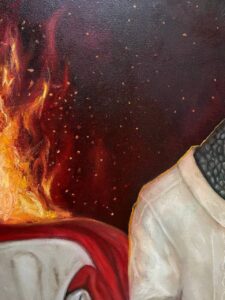 As flames rise in Laureta’s painting, they seem to consume not only the canvas but also the collective patience of a people long betrayed. The crocodile may hold the match, but the fire it kindles can also symbolize awakening, the burning desire for truth and accountability.
In the end, “Luha ng Buwaya” is more than an indictment of corrupt leaders. It is a mirror held up to the nation, urging every viewer to ask whose tears are we shedding, and when will we stop mistaking the crocodile’s for our own. Through his art, Laureta reminds us that silence is complicity and that even in the darkest times, art can still light the way toward justice.



