

“Illegal power is neither periphery nor shadow; it is a global system fed by formal politics and the formal economy” — inspired by Lucía Dammert
Illegal power is neither accident nor exception. It is a parallel system spanning continents, sustained by collusion with states, the capture of politics, and the global economy. These are not isolated gangs but networks moving trillions of dollars and influencing elections, governments, and markets.
Every continent has its anatomy. In Latin America, drug trafficking fuses with political corruption. In Africa, illegal mining finances wars and perpetuates misery. In Asia, synthetic-drug labs and jade trafficking prop up military regimes. In Europe, gas and oil bribes blend with smuggling and financial mafias. In the United States and Canada, the line between legal and illegal blurs in tax havens and the arms lobby.
The numbers are brutal. More than $11 trillion circulates in offshore accounts. Drug trafficking moves $320 billion a year. Human trafficking generates $150 billion annually. Cybercrime reached $8 trillion in 2023. Illegal power is no longer marginal; it is structural. Its economic muscle surpasses the GDP of dozens of countries combined.
The anatomy of illegal power rests on three vertebrae: money, violence, and politics. Money flows through banks and cryptocurrencies, violence dominates territories from the favelas to the Sahel, and politics legitimizes with speeches and contracts what it should be fighting. That convergence makes it the most dangerous threat of the 21st century.
This text does not aim for moral condemnation but to show—with hard figures and concrete examples—how the illegal has become indispensable to the functioning of the legal. The map is uncomfortable, because behind every plundered mine, every enslaved child, and every expelled refugee lies a global mechanism feeding on impunity. The anatomy of illegal power is the planet’s broken mirror.
Clandestine Finance
Illegal power has its heart in money. It doesn’t move in black satchels but in the same banks that underpin the formal economy. An estimated $11.3 trillion is hidden in offshore accounts, protected by financial structures in the British Virgin Islands, Panama, Delaware, or Luxembourg.
That money travels by private jet and also through digital transactions invisible to the very states that denounce it yet tolerate it. It is a business larger than most legal exports from Latin America and Africa. Every shipment of cocaine, every ton of methamphetamine, every synthetic pill ends up converted into dollars laundered through the global banking system.
Money laundering equals 2% to 5% of world GDP, a figure that lays bare the hypocrisy of financial institutions. While banks penalize ordinary citizens for small movements, they open doors to gigantic flows from organized crime, political corruption, and arms trafficking.
The line between legal and illegal vanishes in the ledgers. The anatomy of clandestine power is not in dark alleyways but in tax havens where illicit fortunes are stored—the fortunes that prop up governments, corporations, and mafias.
The Political Business of Illegal Power
Lucía Dammert warns that illegal power plays out not only in the streets but within politics itself. It captures parties, finances campaigns, buys loyalties, and weakens states from within. Structural corruption becomes the main tool of expansion.
1. Latin America: Over 40% of campaigns investigated in the last decade had ties to illicit money. In Mexico, cartels inject resources into local elections to secure territorial control. In Colombia, drug trafficking financed presidential and legislative candidates in more than one electoral cycle. In Brazil, the Lava Jato scandal showed how companies mixed bribes with dark funds from criminal networks.
2. United States: Illegal power disguises itself as legal lobbying. The military–industrial complex channels over $100 million in campaign contributions each year. Arms, energy, and private security corporations directly influence Congress, which approves defense budgets exceeding $800 billion annually. The line between national interest and private business is practically invisible.
3. Canada: Drug trafficking and money laundering found refuge in Vancouver and Toronto real estate. Official reports estimate that billions of dollars from Asian and Latin American cartels were laundered through property purchases, inflating housing prices and triggering a social crisis.
4. Europe: The Azerbaijan Laundromat and Qatargate exposed how dictatorships and autocracies buy influence with bags of cash. Corruption cuts across parliaments and international bodies.
5. Africa: The marriage of illegal arms and mining concessions secures fortunes for presidents and armed groups, while people are trapped in endless wars.
6. Asia: The line between single-party rule and illegal business is blurred. In Myanmar, jade and methamphetamine finance both the military and insurgents. In China and Russia, criminal networks operate under state protection, acting as informal arms of geopolitics.
The political business of illegal power is global. It does not distinguish democracies from dictatorships. It infiltrates campaigns, parliaments, and cabinets. It does not merely buy wills; it redraws the power map.
Drug Trafficking and Synthetic Drugs
Drug trafficking is the backbone of illegal power in the Americas and one of its most profitable engines in Asia, Europe, and Africa. Its anatomy is global, its routes cross oceans, and its profits are laundered in international banks.
1. Latin America: Cocaine remains the epicenter. Colombia, Peru, and Bolivia produce over 90% of the world’s cocaine. Ports in Ecuador and Brazil are key for trafficking to Europe and the United States. The expansion of cartels has turned the Pacific into a strategic corridor moving tons invisible to the state’s eye.
2. Mexico: Cartels consolidated as criminal corporations. Their revenues exceed $50 billion annually—rivaling formal sectors like auto manufacturing or tourism. They control territories, finance campaigns, and negotiate directly with organizations in the U.S., Canada, Europe, and Asia.
3. Asia: The Golden Triangle (Myanmar, Laos, Thailand) is today the world’s main methamphetamine factory. Production has surged to flood markets in China, India, and Australia, generating a multibillion-dollar business that persists despite military regimes and sanctions.
4. Europe: Illegal power is measured in ports. In 2024, a record was set: over 300 tons of cocaine were seized in Antwerp and Rotterdam. That flow shows how the continent has become the most lucrative final destination for Latin American drug trafficking.
5. West Africa: International cartels found a perfect corridor. States with fragile institutions and long coastlines became transit platforms to Europe. Cocaine arrives from South America, is warehoused in Guinea-Bissau, Sierra Leone, or Ghana, and crosses the Atlantic to the Iberian Peninsula.
The drug map is not static. It adapts, globalizes, and shifts routes and methods with the same logic as any multinational. Its difference is that it pays no taxes and answers to no one—while financing wars, buying governments, and leaving thousands dead each year.
Illegal Mining and Organized Crime
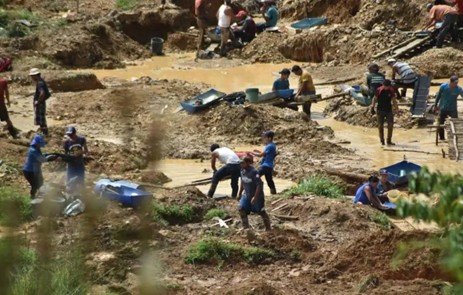
Illegal mining is a global business intertwined with organized crime, political corruption, and environmental destruction. It is not a phenomenon of poor countries; it is a chain linking extraction territories to financial centers and consumer markets on every continent.
1. Peru and Colombia: Illegal gold generates more revenue than drug trafficking in several Amazonian regions. Thousands of hectares are destroyed with mercury and dredges, and the metal is exported as if legal, with forged certificates. This gold ends up in Swiss banks, Miami refineries, and European jewelry.
2. Congo and Central African Republic: Coltan, cobalt, and diamonds finance wars and sustain armed militias. Global phone and e-mobility supply chains depend on these minerals, and although camouflaged in legal contracts, much comes from illicit extraction and slave labor.
3. Myanmar: Rare earths and jade generate more than $30 billion annually in illegal markets. This money sustains both the military regime and rebel groups. The wealth flows to China and through Asian networks, feeding the global tech industry.
4. Brazil: Illegal garimpo devastates the Amazon. Rivers contaminated with mercury poison Indigenous peoples and destroy ecosystems. Despite military operations, the business keeps growing because international demand is insatiable.
5. Africa: The trafficking of illegal diamonds remains active despite the Kimberley Process. Stones extracted in conflict zones end up in Dubai, Hong Kong, and Antwerp. The black market keeps the myth of “blood diamonds” alive.
6. United States: Illegal mining concentrates in gold and coal extracted without permits in states like Nevada, West Virginia, or Alaska. Domestic smuggling blends with international laundering networks, and the legal/illegal border is blurred by weak oversight in remote areas.
7. Mexico: Illegal mining of gold, silver, and iron is controlled by cartels. In states such as Michoacán and Guerrero, armed groups charge “protection fees” to formal companies and run clandestine mines exporting minerals to Asia and North America.
8. Canada: A global mining power, where illegality appears as unregulated artisanal mining and in complicity by firms operating in Africa and Latin America. Reports by NGOs have denounced Canadian miners’ indirect links to conflicts over gold, silver, and copper in Guatemala, Tanzania, and Peru.
The anatomy of illegal mining shows no country is outside it. It is a global system combining clandestine extraction, local corruption, international smuggling, and end consumers who never ask where what they buy comes from.
Block 5. Arms Trafficking
Arms trafficking is the blood that feeds illegal power. The black market is estimated at over $8.5 billion annually, and there are 1 billion small arms in circulation worldwide—of which about 25% are illegal. No continent escapes this anatomy.
1. Africa: More than 40 million illegal small arms circulate. The Sahel and Somalia have the highest clandestine possession rates, with arsenals sustaining conflicts that have left over 250,000 dead in the last decade. A significant portion of these weapons comes from diverted European and Russian military surpluses via Libyan and Gulf of Guinea smuggling networks.
2. Middle East: Yemen and Syria are epicenters of a trade surpassing $3 billion over the last decade. Kalashnikovs, M16s, and improvised drones circulate in a market where borders dissolve. Weapons arrive from Iran, Russia, and the United States, proving suppliers are global, not ideological.
3. Eastern Europe: The war in Ukraine opened a new diversion route. The EU acknowledges that part of the millions of weapons delivered to Kyiv since 2022 have ended up on illegal markets. The precedent is clear: after the Balkan wars, more than 750,000 weapons remained in criminal hands and still circulate in Europe.
4. United States: Over 400 million civilian-owned firearms for a population of 335 million. More than 13 million new guns are produced each year. Trafficking to Mexico is constant: the ATF estimates that 70% of guns seized from Mexican cartels originate via U.S. smuggling.
5. Mexico: Armed violence caused more than 30,000 homicides in 2024, most with firearms. The black market supplies cartels that pay up to $2,000 per assault rifle. Smuggling routes cross the northern border in trucks, small planes, and tunnels, moving thousands of weapons each month.
6. Canada: The issue shows in rising gun homicides: 37% of murders in 2023 were committed with illegal firearms, many entering from the U.S. Smuggling is estimated to generate over $100 million a year for gangs in Toronto and Vancouver.
7. Asia: Southeast Asia concentrates a small-arms market estimated at $2 billion annually. Myanmar is supplied from Thailand, Cambodia, and Laos, while North Korea exports clandestine weapons to Africa and the Middle East to obtain hard currency despite sanctions.
The global illegal arms trade is not parallel to the legal one—it is complementary. While the formal industry bills over $600 billion a year, the black market feeds on leakage, corruption, and war.
Human Trafficking and Irregular Migration
Human trafficking and irregular migration are the most brutal face of illegal power because they turn human lives into merchandise. This business moves more than $150 billion annually—exceeding several legal export industries in Africa and Latin America.
1. From Sub-Saharan Africa to Europe: Routes are dominated by criminal networks controlling the Mediterranean. In 2024 alone, more than 250,000 migrants attempted the crossing, and over 3,000 died at sea. Women and children are the main victims: 1 in 3 African migrant women suffers sexual violence en route.
2. Middle East: The trafficking of migrant workers is a hidden business involving millions. In the Persian Gulf, over 23 million foreign workers live under hiring systems that in many cases become modern slavery. Illegal networks in the region are estimated to generate more than $40 billion annually.
3. Latin America: The Darién jungle has become a corridor of horror. Over 500,000 migrants crossed in 2024, most from Venezuela, Haiti, and Africa. Criminal networks operating in Panama, Colombia, and Mexico charge fees that add up to hundreds of millions of dollars a year. On reaching Mexico, these same organizations charge between $2,000 and $10,000 per person to cross into the United States.
4. United States: An estimated 11 million undocumented migrants reside in the country. Part of them arrived via trafficking networks generating about $6 billion a year.
5. Canada: Alongside legal migration, there is a rise in illegal human trafficking—especially Asian women for sexual exploitation. Recent reports estimate criminal profits in this market at over $400 million annually.
Human trafficking and irregular migration are not system glitches; they are part of a transnational business combining violence, poverty, and state corruption. Every closed border strengthens the mafias that cross it.
Cybercrime and Illegal Digital Power
Illegal power found in cyberspace a territory more profitable than drugs or gold. Cybercrime moved more than $8 trillion in 2023 and is projected to exceed $10 trillion in 2025—the third-largest economy in the world if it were a country.
1. Russia and Eastern Europe: Ransomware networks attack hospitals, banks, and governments. In 2024 alone, over 300,000 ransomware incidents were reported in Europe, with ransom payments surpassing $1.2 billion. These digital mafias operate like corporations, with customer service departments and negotiation manuals.
2. North Korea: The regime finances part of its nuclear program with stolen cryptocurrencies. Estimates suggest North Korean hackers have stolen more than $3 billion in crypto assets over the last five years. That money ends up in missiles and arsenals, proving cybercrime can sustain a state.
3. Nigeria: Digital scams became a parallel industry. Email fraud and global phishing networks move hundreds of millions of dollars annually. In 2023, 40% of Africa’s reported digital fraud cases came from Nigeria, confirming the magnitude.
4. United States and Canada: In 2024, online fraud losses in the U.S. topped $10 billion. Canada reported record losses of $660 million in 2023—double the amount in 2021.
Cybercrime is the new oil of illegal power. It needs no territory or armies—only computers and secure connections. Its ability to infiltrate banks, companies, and governments makes it the most expansive threat of the 21st century.
Structural Corruption
Corruption is not an administrative accident but the cement holding illegal power together. Its cost is roughly 3% of global GDP—over $3 trillion a year. No continent is spared.
1. Latin America: Brazil’s Lava Jato revealed a bribery system moving more than $2 billion and splashing presidents, parties, and builders across at least 12 countries. Odebrecht admitted paying $788 million in bribes in the region.
2. Mexico: Corruption became a cog in illegal power. The Pemex–Odebrecht case showed top officials receiving millions in bribes to influence contracts and elections; estimates put corruption’s cost at over $60 billion per year, about 9% of GDP. This institutional weakness enabled cartel expansion that buys police, judges, and governors.
3. Africa: Corruption in mining and oil contracts diverts more than $89 billion annually. Angola, Nigeria, and the Democratic Republic of the Congo concentrate the biggest scandals tied to oil, diamonds, and cobalt.
4. Asia: Kleptocracies such as Turkmenistan and Kazakhstan channel fortunes into accounts in Europe and the U.S. Over $500 billion is estimated to leave Central and South Asia each year through corruption and bribes linked to energy and mining.
5. Europe: Corruption runs from the East to Brussels. Qatargate showed MEPs receiving bribes from Gulf states. In the Balkans, systemic corruption diverts over 15% of public spending in some states.
6. United States: Corruption hides in legal lobbies: more than $4 billion was spent on political lobbying in 2023, with part of those funds coming from corporations investigated for fraud or padded contracts.
7. Canada: Federal audits report annual losses over $5 billion due to corruption in procurement and evasion linked to extractive firms.
Structural corruption is the mortar of illegal power. It lets drugs flow, gold be laundered, weapons cross borders, and public contracts become private fortunes. Without corruption, the other criminal economies would not have such deep roots.
The Human and Environmental Cost
Illegal power is measured not only in money but in shattered lives and destroyed ecosystems. More than 50 million people live in modern slavery worldwide—trapped in forced labor, sexual exploitation, or domestic servitude. One in four modern slaves is a child, revealing the system’s cruelest face.
Criminal violence displaces millions each year. In 2024, more than 43 million were forcibly displaced by wars, mafias, and illegal groups. Mexico and Central America contribute hundreds of thousands of refugees due to cartel control; Sub-Saharan Africa concentrates more than 15 million internally displaced; and in Asia, Myanmar and Afghanistan continue to expel entire populations.
The environmental impact is devastating. Illegal mining wipes out over 100,000 hectares of Amazon rainforest each year, contaminating rivers with mercury and destroying unique biodiversity. In Africa, mineral smuggling has driven deforestation across thousands of square kilometers. In Asia, clandestine exploitation of jade and rare earths leaves lakes poisoned with chemical waste. The ecological cost is irreversible: extinguished species, dead rivers, soils contaminated for generations.
Indigenous communities are among the main victims. In Brazil, more than 500 Indigenous territories have been invaded by illegal miners and loggers. In Mexico, entire villages have been dispossessed by cartels controlling mines and trafficking routes. In Canada, First Nations have for decades denounced that extractive companies—often the same ones with controversial operations in Africa and Latin America—have violated ancestral lands.
The human and environmental cost of illegal power is measured not only in figures, but in generations condemned to poverty, in cultures razed, and in forests that will not grow back.
Illegal Power as a Global System
Illegal power is not marginal or peripheral. It is global, structural, and functional to the world economy. It does not only destroy lives; it also props up governments, corporations, and banks. It feeds on corruption, hides in international finance, strengthens in armed conflicts, and is legitimized in democracies that tolerate it.
The challenge is not moral but political. It is not about good versus evil; it is about dismantling a system that benefits those who should be fighting it. The anatomy of illegal power sketches a raw but real map: banks that launder, states that corrupt themselves, companies that enrich themselves, and mafias that govern territories.
The future will depend on the global society’s capacity to confront it. We can accept living with this system as if it were inevitable—or organize to expose and dismantle it. The anatomy of illegal power reveals that the greatest threat of the twenty-first century lies not only in crime, but in the complicity that makes it part of the world order.
Bibliography
• Dammert, Lucía. Anatomy of Illegal Power. 2023.
• Tax Justice Network. State of Tax Justice Report, 2023.
• World Drug Report, 2023–2024.
• Yearbook on Armaments, Disarmament and International Security, 2024.
• Transparency International. Corruption Perceptions Index, 2023.
• Global Estimates of Modern Slavery, 2022.
• IOM. World Migration Report, 2024.
• Cybersecurity Ventures. Cybercrime Report, 2023.
• The Cost of Corruption Report, 2023.
• Global Trends: Forced Displacement Report, 2024.



