
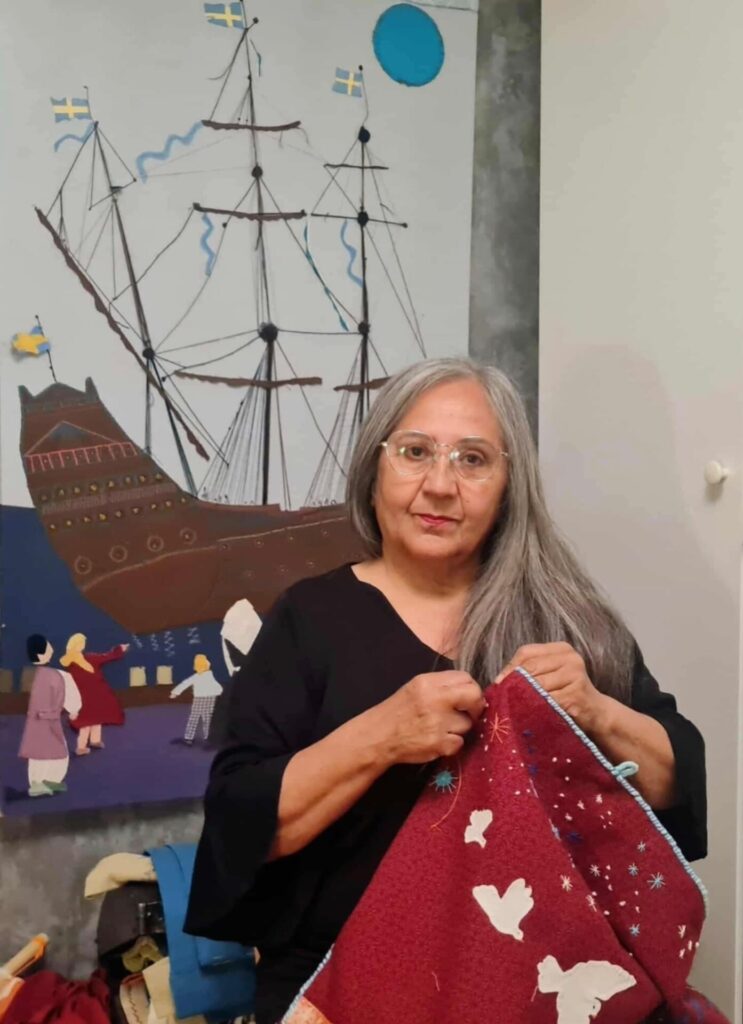
In Malmö’s Grand Square, on Palestine Day, emotion and courage took the shape of textiles, dolls, banners, and words. There, a group of grandmothers—Latin American, Palestinian, and Swedish—breathed life into a brutal and moving day: “I am overwhelmed by the emotion of doing everything for the children of Gaza,” wrote Bélgica Castro, a Chilean artist exiled in Sweden, a generous hand and voice of embroidered memory.
The birth of the collective and the urgency of the gesture
“We are a group of Latin American, Palestinian, and Swedish women who came together in August last year. Winter was approaching, along with the darkness of the moment. The horror of the genocidal assault on Gaza. A Palestinian companion named Yomn was always interested in my arpillera work. One day she commented on a post on my Facebook page, so I took the opportunity to invite her to start embroidering together. That’s how the collective Women Who Embroider for Peace was born.”
Bélgica’s initial gesture was the first seed of an interdisciplinary community: women who embroider, think, resist, and weave memory. The collective grew to include Daed Yousef, Maryam Tayeb, Sabria Hadiri, Khawla Tayeb, Elham Shakhtour, Ulrika Bernhardsson, Margareta Fryxell, Kristina Längby and, of course, Yomn Kadoura—“that’s the name of the Palestinian companion who contacted me and where it all began.”
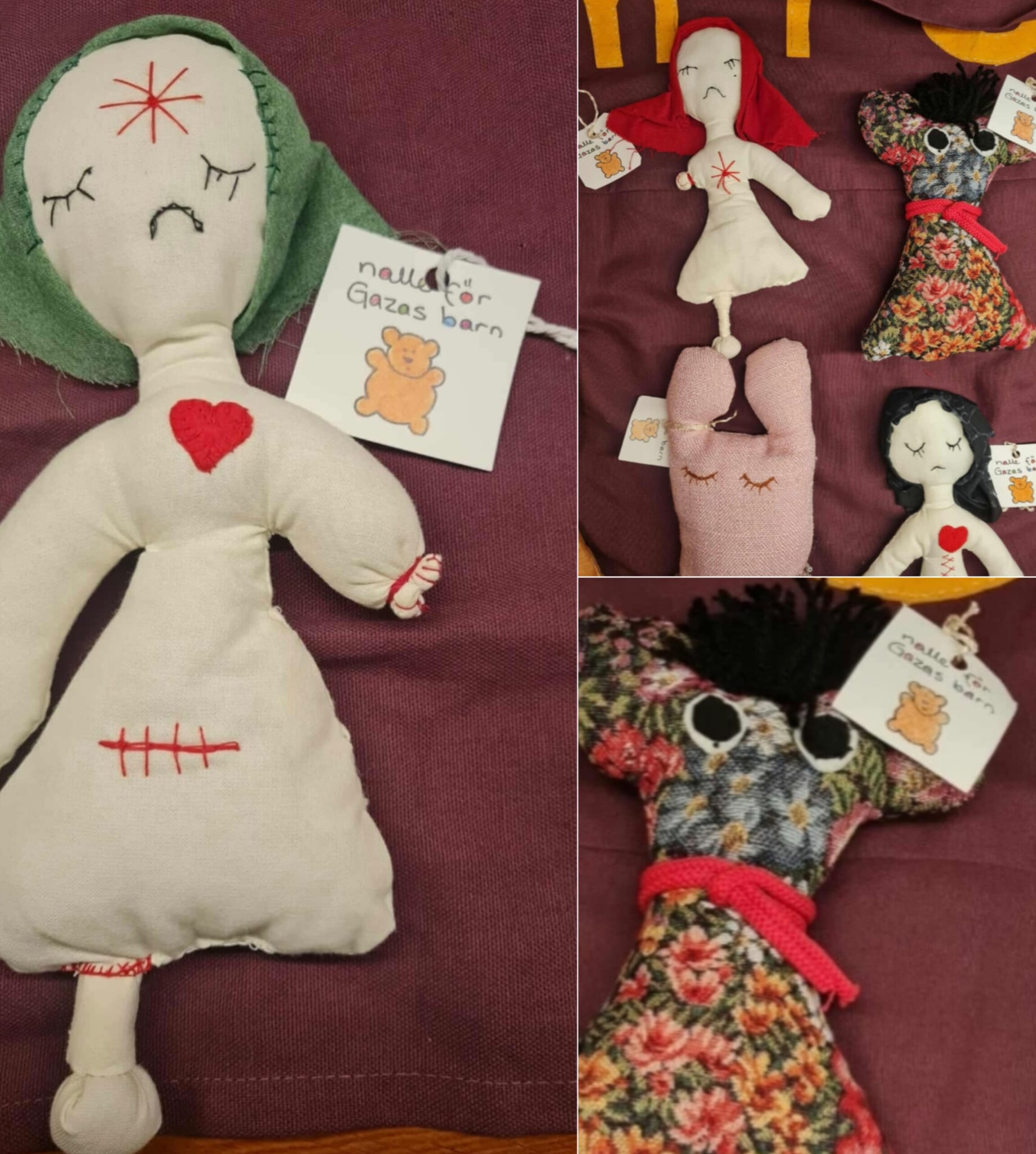
Moving collage of dolls: Amputated dolls, a deeply sensitive idea by Bélgica, made with dignity; the doll in the foreground on the right is based on a grandchild’s drawing.
Cloth dolls, prayer and symbol
“We started making small rag dolls, first based on some of my own drawings, which we then stitched onto fabric with a slogan. That’s how our first arpillera-banner was born, and with time and constant work, many more were created.”
The work is deeply collective, and the shared therapy transitions from group workshops to the intimacy of each embroiderer’s home: “All of this works as collective therapy. The companions take work home after our workshop meetings.” The dolls, hand-sewn, respond to the pain and hope of the children in Gaza and are also born from the drawings brought by all the group members’ grandchildren: “Then the great idea came that our grandchildren could give us their drawings, and from that our dolls were born—they sell like hot cakes!”, she says enthusiastically.
Some dolls feature intentionally broken, amputated, or wounded figures: “We have made mutilated dolls—like so many in Gaza are mutilated, including children. We have found it deeply touching to witness the emotion and awe with which people buy them; it moves us greatly.”
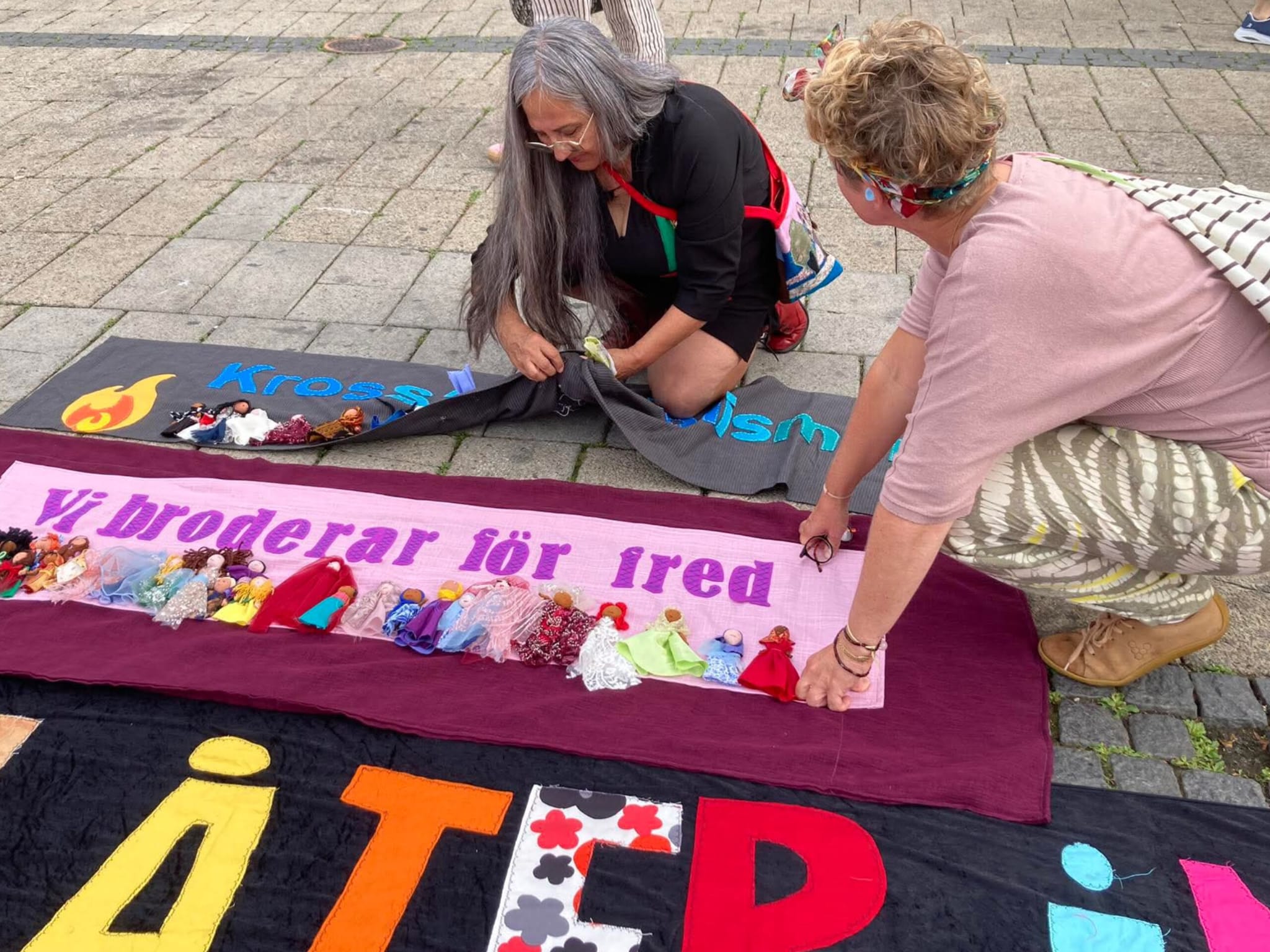
Installation of “Vi broderar för fred” embroideries: Members set up the arpillera in the square, each doll symbolizing stitched memory and hope.
Embroidering memory, denouncing genocide
As Bélgica puts it: “For us, all of this, everything that happens, is present and so powerful in our daily lives, and we feel it so closely—it becomes corporeal, all that hell the Palestinian people live.” The political and solidarity-driven force of the action is not circumstantial, but rather the consequence of a biography marked by exile and the persistence of art as testimony: “Claudia, the interesting thing is that individual ideas thrive when a collective takes them and makes them their own. That’s when the miracle happens,” she tells me, moved.
The collective is self-financed and, for some time now, supported by Sweden’s Left Party, which “helps with materials,” Bélgica notes. The money raised, Margareta Fryxell states in her public report on the event, goes “directly to Gaza through Palestinian groups.” It was a successful day of activities for children and adults: workshops, much appreciation for our t-shirts and dolls, arpilleras and banners. We shared vital information about the movement for Palestine, and everyone was very kind and stood in solidarity with Palestine and Gaza. Long live Palestine! Stop the genocide!
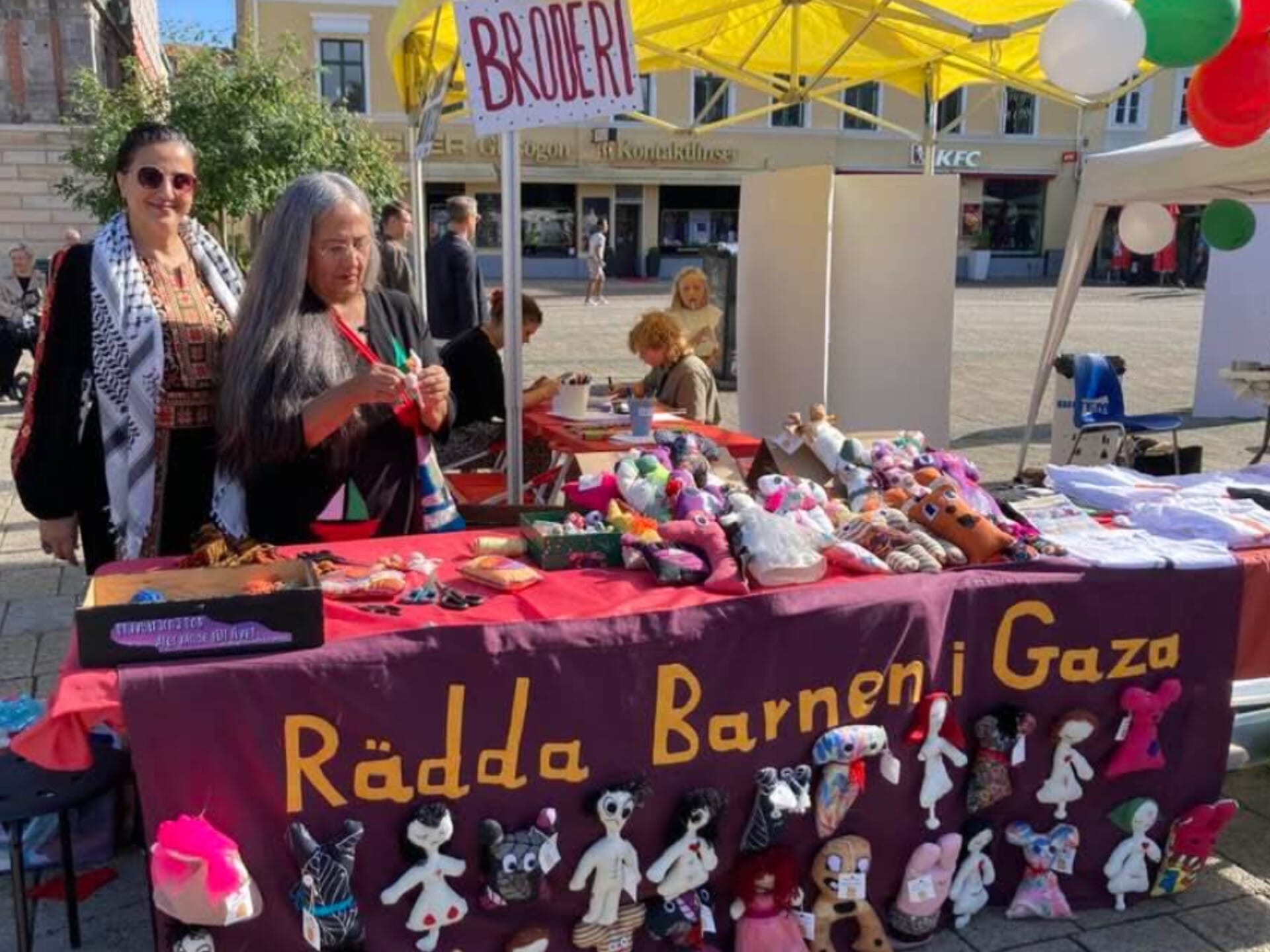
Main solidarity stand in the square: Table covered with dolls and t-shirts, bearing the phrase “Rädda Barnen i Gaza”, the center of fundraising and collective action for Gaza’s children.
Banners and standards: art as accusation and archive
The embroidered banners are both standards for marches and archives of memory. One of them—the large arpillera paraded across the square and featured in one of the photos with Bélgica—reads in Swedish and Spanish: “La mirada que acusa tu silencio / Blicken som anklagar din tystnad” (“The gaze that accuses your silence”). This really is a gaze that pierces you and makes demands. Other pieces shout their messages in color: “Vi förlåter inte / Vi glömmer inte” (“We do not forgive / We do not forget”).
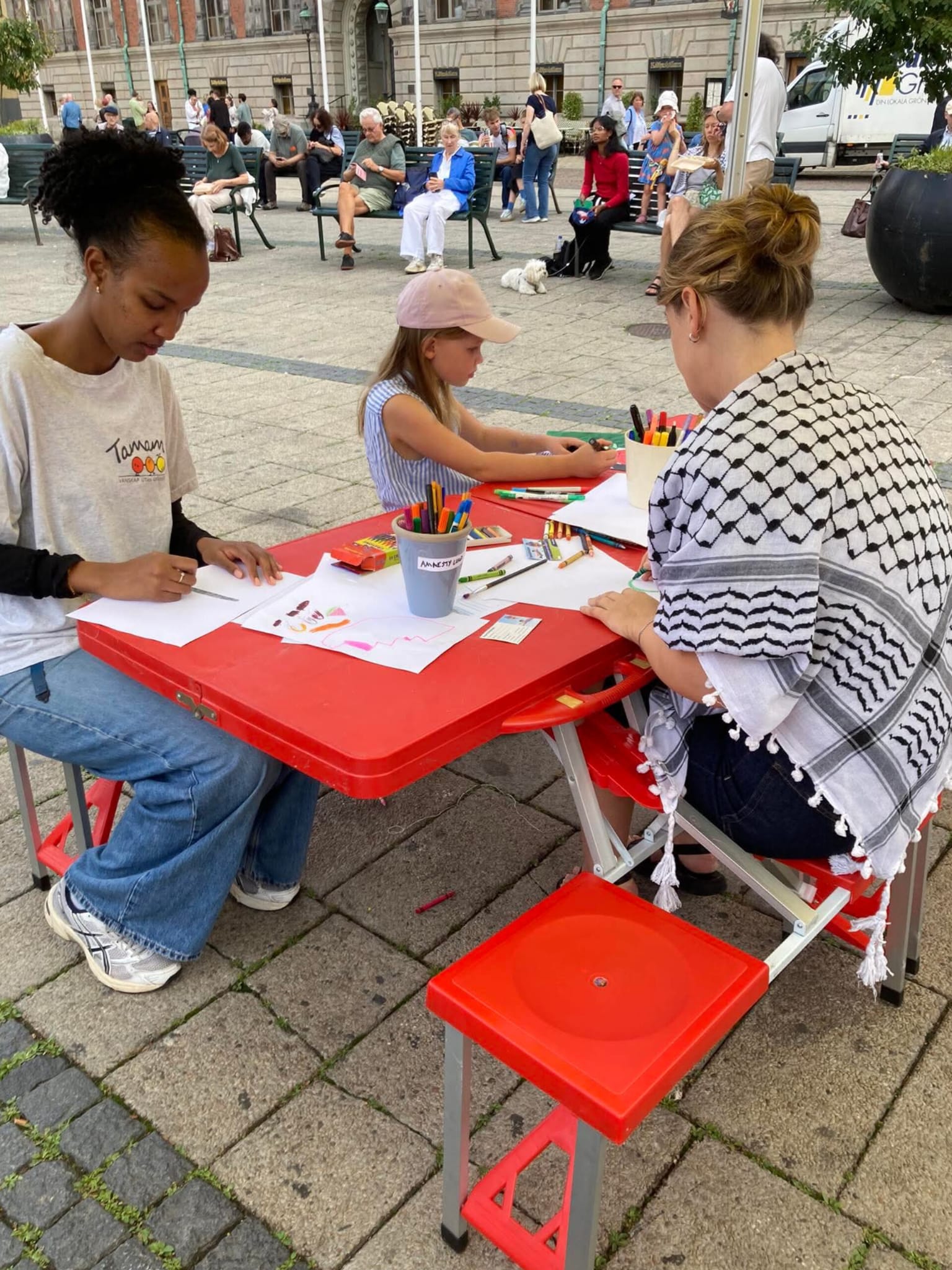
Children’s workshop and community: Girls, women, and companions drawing outdoors; ideas are born here that are later transformed into textile art.
The Chilean uprising: stitching, denunciation, and memory
Whenever something very powerful happens—and because she possesses great social and artistic sensitivity and a deep awareness of the world she lives in—Bélgica follows the news and processes events by embroidering what she sees, reflects on, feels, thinks, and proclaims. This is what this Chilean woman did in Sweden during every single day of the Chilean social uprising and as reports emerged about systematic human rights violations under the regime of Sebastián Piñera, who died in impunity. Her arpilleras of eyes mutilated by militarized police in Chile have been featured in many exhibitions, touching the soul as much as they rescue memory. Bélgica Castro is an activist full of strength, purpose, and consciousness.
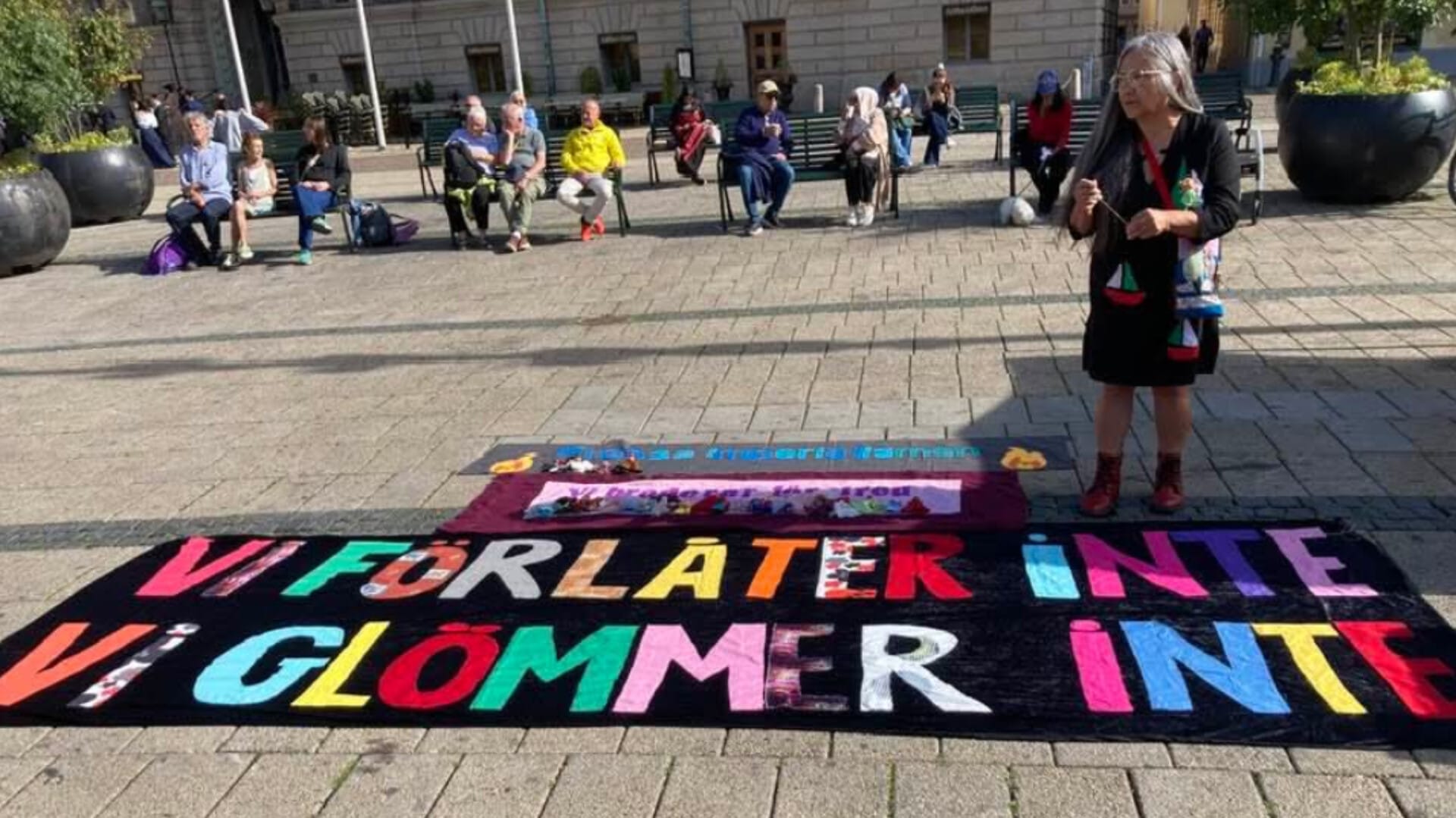
Large protest arpillera: An enormous, colorful arpillera displaying “Vi förlåter inte – Vi glömmer inte” (“We do not forgive. We do not forget”), a textile expression of memory and justice.
Creating living memory: the fair, the workshop, the square, and childhood
During the fair, the square was filled with color and presence: dolls and t-shirts set out as offerings, art workshops for children, shared creation tables, laughter, games, memory, and protest. “It is very moving how people react when they see us, because we’re just a handful of old women who have been making things directly for the children of Gaza,” she emphasizes, adding: “There are more than ten women who have made very beautiful, deep, moving things—huge arpilleras like banners for Palestinian marches, and children’s and grandchildren’s drawings turned into dolls.”
For this collective of grandmothers, embroidering is an act of resistance against forgetting, impunity, and indifference. It means denouncing criminal violence and celebrating memory and testimony, stitch by stitch, in each doll, in every slogan, in every banner on display. Each thread also carries a vow: “We do not forgive, we do not forget,” because memory is a political act, a response to injustice, and a seed for the future. There, in Malmö’s square, in the heart of a cold continent, Latin American, Palestinian, and Swedish grandmothers give their energy and warmth so the pain of Gaza may become solidarity, living memory, and defiant hope.
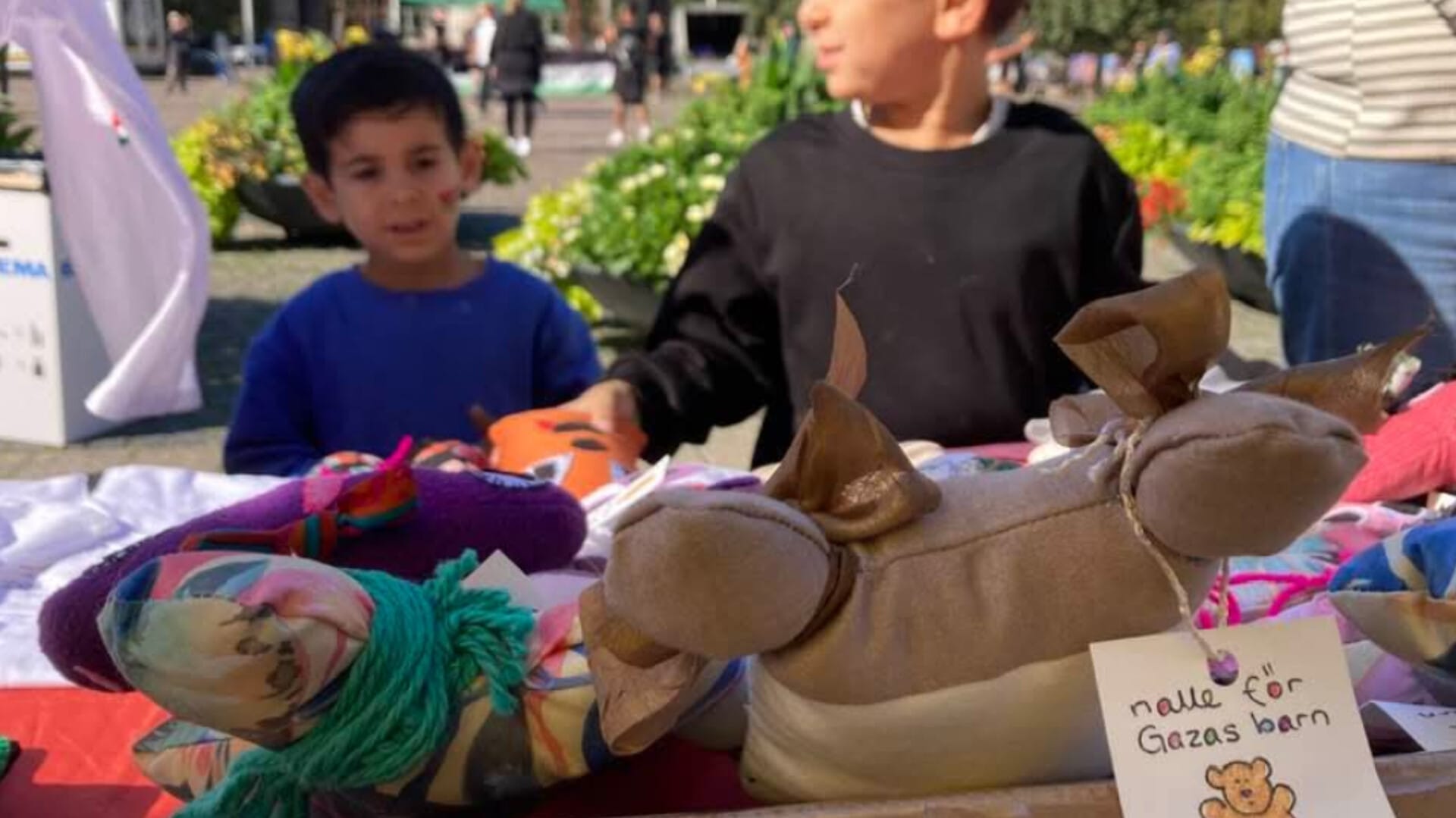
Table of dolls and childhood: Detail of the creations and the encounter between protected children who build a bridge to the children suffering in Gaza.
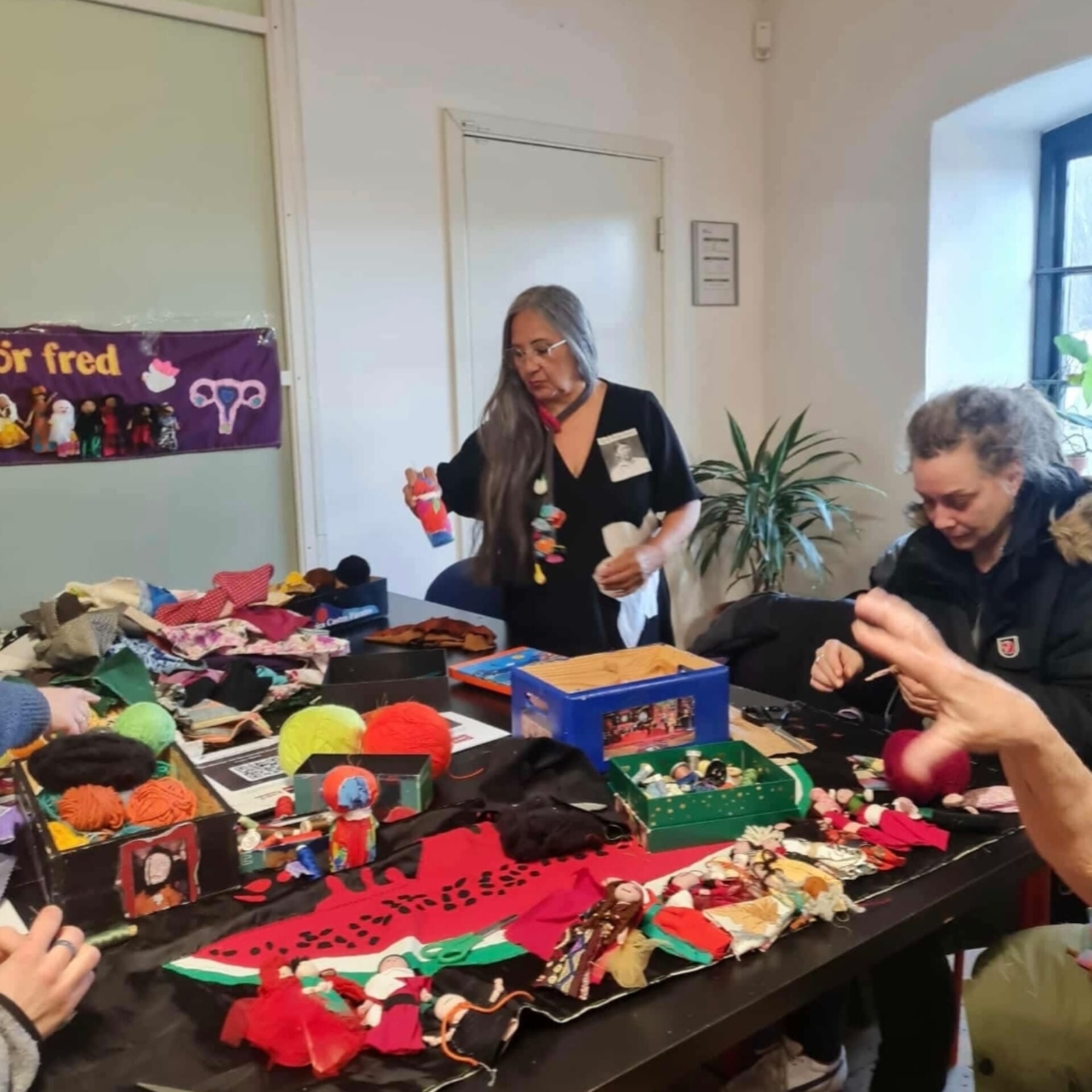
The hands of the collective workshop: Balls of yarn and thread, hands sewing and embroidering, the heart of collective labor and shared comfort.
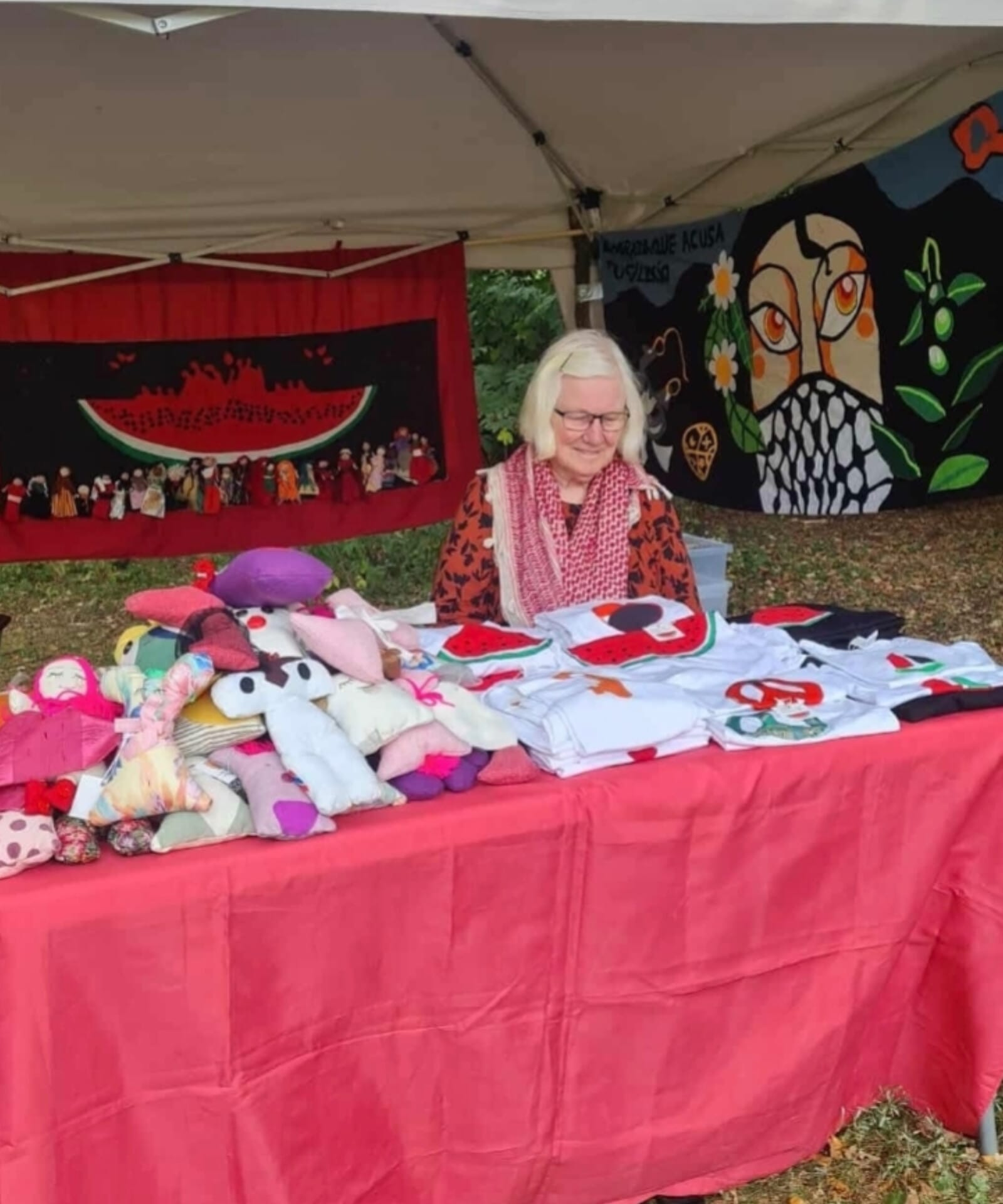
Record of another stand at pro-Palestine events: Display of dolls, t-shirts, and arpilleras, featuring the watermelon as a symbol of resistance.
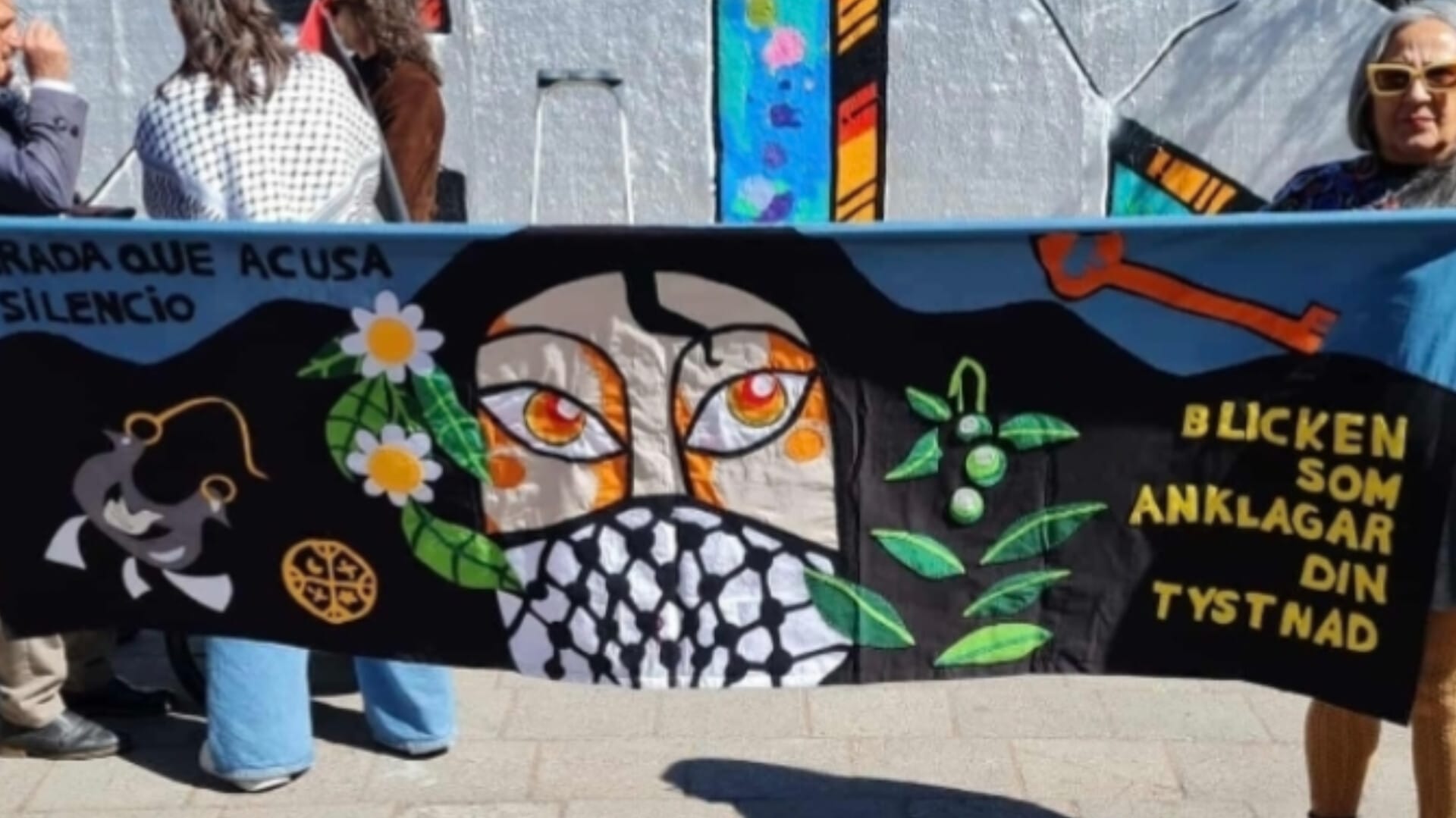
Detail of the banner cited by Bélgica: The arpillera “La mirada que acusa tu silencio / Blicken som anklagar din tystnad”, eyes that challenge, memory, and active ethics.