

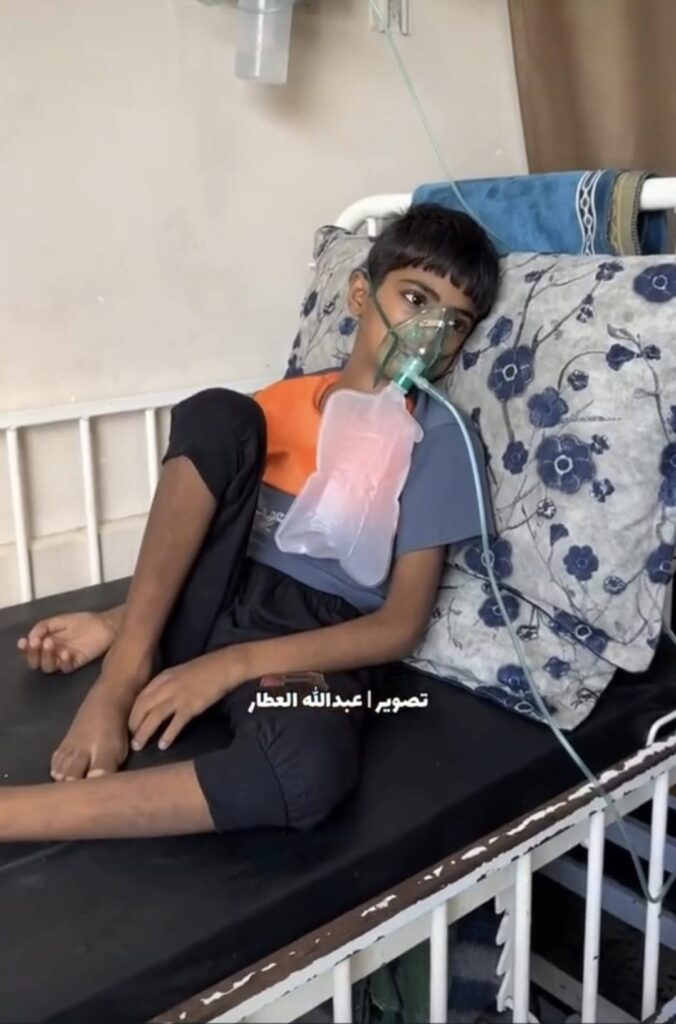
Dawn in Gaza City did not come calmly; it came with a mandate: evacuate the Jordanian Hospital. The military order fell like a collective sentence over corridors flooded with oxygen, over pulsing incubators, over old people on respirators, over mothers clutching unconscious children. Outside, the city was still burning: towers turned into concrete skeletons, streets turned into canals of dust and blood, drones and armored vehicles marking the horizon. The gravity of the instruction — to clear the hospital — is not bureaucracy: it is a direct threat to the lives of the most vulnerable.
Hundreds remain inside the Jordanian Hospital: critically ill patients, those dependent on electrical devices, pregnant women, elderly people, children with open wounds, nurses, and doctors who have chosen to stay beside those who cannot move. Testimonies that have escaped censorship describe health professionals opting to remain next to respirators and infusion pumps when ordered to leave. The question stabs deeply: who is ordered to abandon life?
The previous night left figures the world cannot sugarcoat. Gaza’s medical services reported at least 31 dead, bodies recovered from various bombings inside Gaza City, while columns of armored vehicles advanced and demolitions of residential buildings continued their apocalypse-like pace. This figure — the maximum common verified available — is only the most visible edge of a cataclysm dragging entire families.
The reports from the ground are sound photographs: a mother covering two children with her arms on an improvised stretcher in the hallway; an old man with a tracheotomy tube whose eyes seek someone who cannot receive help; a nurse lighting up a monitor screen with a flashlight when the generator fails; siblings knocking on concrete with knuckles to call the bodies lying under floors that no longer exist. Each verbal image is a scream. Chronicles by local journalists and Arab media recount the discovery of corpses among rubble just meters from the hospital and wounded who still scream beneath tons of concrete, with rescue teams — when they arrive — unable to work safely.
The evacuation order was not sent to a mailbox: it was transmitted by leaflets dropped from the air and military notices amid a landscape where routes are broken and ambulances often cannot move. Asking a city to leave behind its hospitals is equivalent to asking people to leave behind the dying: there are no vehicles to transport those dependent on power, no fuel for generators, no guaranteed safe corridors, nor assurances of passage. The probable outcome — already seen on the ground — is the forced abandonment of the most fragile or the heroic decision of medical personnel to stay by their side, risking their lives for the minimal and human dignity of care.
The official logic does not exempt responsibility: it is argued that operations seek to dismantle enemy military presence within the urban fabric. This claim does not exempt the absolute duty to protect the civilian population nor to respect the principles of international humanitarian law. Demanding evacuation without organizing and guaranteeing safe routes, without securing ambulances, without facilitating fuel and without expressly protecting patients in transit effectively constitutes a death sentence. It is a calculation that weighs lives as if they were pieces on a strategic board.
Today, in Gaza City, bodies still lie under rubble; there are hundreds, entire families missing; women and children who died embraced; elderly who could not be evacuated; electrically dependent people whose lives went out due to lack of generators or impossibility of moving them; medical personnel who have chosen not to obey an order that would be equivalent to letting people die. The testimonies describe scenes for which the word tragedy falls short. Confirmed figures document dozens of deaths (only those possibly counted) in recent hours and repeated damage to shelters and schools serving as shelters for displaced persons; but real figures, we know, are always worse because counting is trapped by war.
Denouncing this is not rhetoric: it is demanding accountability. Making visible the hell means pressuring to stop operations that put at risk the lives of those not fighting. Demanding effective humanitarian corridors with international oversight, demanding protected ambulances, demanding fuel for hospital generators, demanding public lists of those remaining in each healthcare center, demanding the presence of independent observers: these are urgent measures that can save lives right now. The rest is politicking. The rest is silent complicity. The rest is called genocide.
Let it be clear: euphemisms will not be used. What is happening in Gaza City, which awakens today with the order to evacuate an entire hospital — leaving behind those who cannot move or asking staff to abandon them — is a decision with criminal consequences. Saying it is as necessary as it is urgent. There are no innocents on the paper pointing to letting people die by organized inaction.