

by George Banez
Lunch for me these days at home in Florida simply retells the previous night’s dinner. A quick reimagining of leftovers often suffices. Occasionally, I make soup, sometimes Filipino Sinigang, sometimes Japanese Miso. Or I fry me some old rice.
Contrast that to lunch at my sister’s in Manila. They mount a major production every meal. Despite the perpetual summer heat, soup is always on the menu. And at least two other mains, sides, multiple dipping sauces, fruits, and rice grace the table. And we eat together too, a treat!
In one of those epic lunches, my late aunt’s caregiver quizzed me. “What was the pandemic like there in the U.S.?” She wanted to know what “ayuda,” or help, I got. She mentioned the care packages that local governments provided them during lockdown.
In the city of Paranaque, according to her, relief workers drove around neighborhoods to bring food. Through a PA system, they asked each household to put out a chair and their Quarantine Pass, the ID card which one designated person uses to go out shopping for the family. Relief workers wrote down the date of delivery on the pass, then left a 10-kilo sack of rice and canned goods, mostly sardines. In communities of greater need, fresh items like chicken, coffee, and sugar were sometimes included.
Contents of the care package, the timing, frequency, and methods of distributing “ayuda” varied from one municipality to another. Some handed out cash of PhP 500 to PhP 1,500 ($10 – $30 USD), but only to those in dire need. Richer municipalities gave more and with better efficiency.
Endless lines under the sun, plus extra paperwork just to receive “ayuda,” made some in poorer districts doubt they would ever get government assistance. Many felt as though the focus was on withholding aid, not providing it. Beyond the waiting and the bureaucratic red tape–along with the likely pilferage of funds trickling through the system–some simply accepted that life always treated them unfairly.
“If the virus doesn’t kill you, hunger will.”
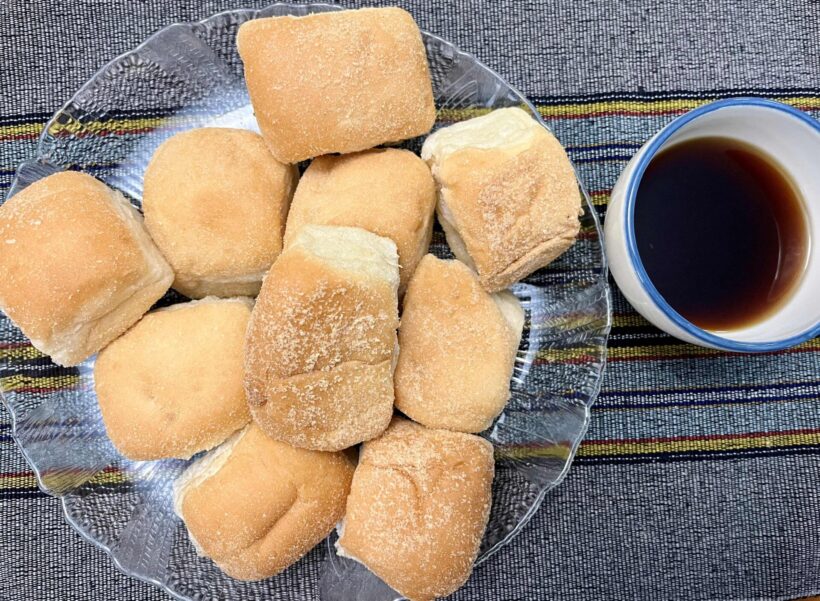
“Let me tell you a story,” said the owner of a store in Tondo, an inner city in Manila. His “Sari-Sari” store, a kiosk right outside his front door, sold a variety of goods, including bread. He narrated that before the pandemic, a man who jogged around the neighborhood stopped by to get some “pandesal” for breakfast. The airy-soft bread rolls sold for PhP 5.00 (10 cents USD) each.
“But in the early days of lockdown, he handed me PhP 500 every morning. He’d tell me to put all the bread his money could buy in individual plastic bags. I saw him give away the bags to whoever he met. When I asked, he said that these one or two pieces of “pandesal” may be all that they have to eat for the day.”
Religious charities and volunteer groups helped. They gathered donations from those with more resources and shared them with the rest. Some of the rich put out food, like an open community pantry, for anyone to pick up. Employers with the means offered to pay a salary, or a portion of it, even to employees who could not take home their work or to those furloughed.
For the desperate daily wage earner, however, putting food on the table became a matter of life and death. The family’s breadwinner snuck out by whatever means possible. Without public transportation running, they walked and knocked on rich peoples’ doors to seek day jobs like landscaping, cleaning, or laundry service. The wealthy, stuck in big houses, needed assistance. So, they used clout to secure them passes and later promoted quack remedies they themselves would not take.
In the early days of the pandemic, the sick got taken to public quarantine facilities. So, everyone opted to stay mum. Neighbors took it upon themselves to hang shopping bags of bread, noodles, and non-perishables on gate or door handles of houses suspected of nursing someone infected. But this only worked if community members had something to spare.
“You’re lucky, you were not here in Manila,” said the Sari-Sari storekeeper.
Looking back, relief in the U.S. came in three rounds of “Stimulus Checks” sent by the federal government to all adults and qualifying children. Checks ranged from $500 to $1400 USD and were sent from April 2020 to December 2021.
I did not receive in-kind “ayuda” or any care packages of food. For groceries, I relied on masked personal shoppers working for the Instacart app. They shopped from a nearby grocery store and delivered, for a fee, my week’s supply of food to my doorstep.
Before the pandemic, I volunteered a few times to serve donated food, mostly surplus from bakeries or grocery stores, to feed the houseless. A local church set up that soup kitchen. And I was just part of the group asked to help on a particular day of the week. I know that food pantries across America provided food assistance to even more people during the pandemic.
This question on “ayuda” hits me with the truth that not everyone has access to life sustaining food. Under normal circumstances, it is already hard to imagine how others live. But in the shock of major upheavals, it becomes almost impossible to notice others suffering. Concern for self-preservation eclipses awareness of everyone else’s needs.
But people worldwide went hungry during the pandemic. The World Health Organization (WHO) reported in July of 2022 that: “The number of people affected by hunger globally rose to as many as 828 million in 2021, an increase of about 46 million since 2020 and 150 million since the outbreak of the COVID-19 pandemic.”
In July 2025, the headline read, “Global Hunger Declines but Rises in Africa and Western Asia: UN report.” The WHO wrote that: “An estimated 8.2 percent of the global population, or about 673 million people experienced hunger in 2024, down from 8.5 percent in 2023 and 8.7 percent in 2022.”
“Acute Hunger”
The World Food Programme (WFP), the UN agency that leads the fight against hunger, reports that 319 million people in 67 countries in the world face acute hunger. “The scale of the current global hunger and malnutrition crisis is enormous. A total of 1.9 million people are in the grips of catastrophic hunger – primarily in Gaza and Sudan but also in pockets of South Sudan, Haiti, and Mali. They are teetering on the brink of famine.”
Meanwhile, the United Nations Environment Programme’s (UNEP) Food Waste Index Report of 2024 indicated that “one-fifth (1/5) of food produced for human consumption is lost or wasted globally,” amounting to one billion meals a day. And “sixty percent (60%) of the food waste happens at household level.”
According to the WFP 2024 article, “5 Facts About Food Waste and Hunger,” rich countries waste food by leaving them uneaten and spoiling in refrigerators or kitchen cabinets. In developing countries, food waste happens at harvest time. Poor storage facilities lead to pest infestations and molds. More food is also wasted in hotter countries. Food spoils faster in higher temperatures.
Also in the report: “Food loss and waste generate up to 10 percent of global greenhouse gas emissions.” Carbon released from energy used in food production, cold storage, transport, and distribution contributes to climate change. Another greenhouse gas, methane, emitted when food waste decomposes in land fills heats up the planet some more.
Conversely, Climate Change impacts food production. The science journal Nature published in June 2025 the findings of the research consortium, Climate Impact Lab, in the open access article, “Impacts of Climate Change on Global Agriculture Accounting for Adaptation.”
Researchers projected how a warming planet would affect the global crop yields (in calories) of six staple crops – maize, soybean, rice, wheat, cassava, sorghum. They also considered adjustments made by farmers to adapt to changing climates across 12,658 regions in 54 countries. Contrary to previous projections of enhanced global crop yields, researchers estimated that a 1o C rise in global mean surface temperature (GMST) reduces yield by 120 kilocalories (kcal) per person per day, or a 4.4% decline in daily recommended consumption. That is, despite economic development and adaptation.
Stanford University Doer School of Sustainability explained: “In terms of food production capacity from staple crops, the analysis finds (that) yield losses may average 41% in the wealthiest regions and 28% in the lowest income regions in 2100.”
One of the senior authors, Solomon Hsiang, mentioned that: “When global production falls, consumers are hurt because prices go up and it gets harder to access food and feed families.” He added, “If the climate warms by 3 degrees, that’s basically like everyone on the planet giving up breakfast.”
What awaits every rice and “pandesal” consuming Filipino? Will “ayuda” be enough to mitigate, for all, the impacts of global upheavals?
About the Author:

George Banez is a writer of Filipino descent and is a retired non-profit professional living in Florida.



