

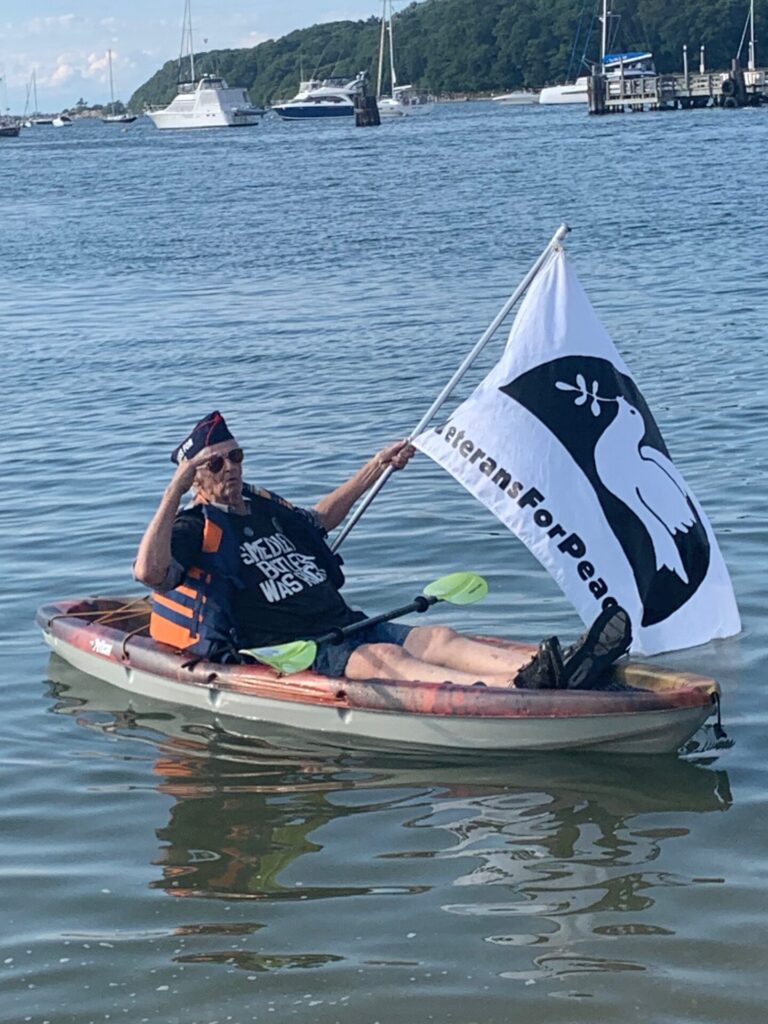
His Veterans for Peace flag flying, 90-year-old veteran and peace activist Bill McNulty joined the final stretch of a 22-mile cross-Long Island Sound kayak event that drew attention to the fact that 22 military veterans commit suicide every day. Sponsored by the group 22 PAC, about 20 veterans participated in last Friday’s annual “22 PTSD Awareness Challenge,” paddling from Bridgeport, CT, to Port Jefferson, NY.
Assisted by family members, the Setauket, NY, resident and Stony Brook University radio show host launched a kayak into Port Jefferson Harbor a few hours before the convoy of kayakers appeared, hoping to converse with them about how they might work together to heal the wounds of war, advocate for peace and prevent other men and women from going to war. It was his first time in a kayak.
Wearing his Vets for Peace hat and a black T-shirt with the words “Smedley Butler Was Right,” Bill greeted the fast-moving kayakers about a mile offshore and carefully made his way to the small beach where the others had landed, the entire time calling out to the veterans on shore and addressing them as “brothers.” Smedley Butler is the Marine major general who, after retiring, saw his entire military career as one serving the protection of money profited from war-making.
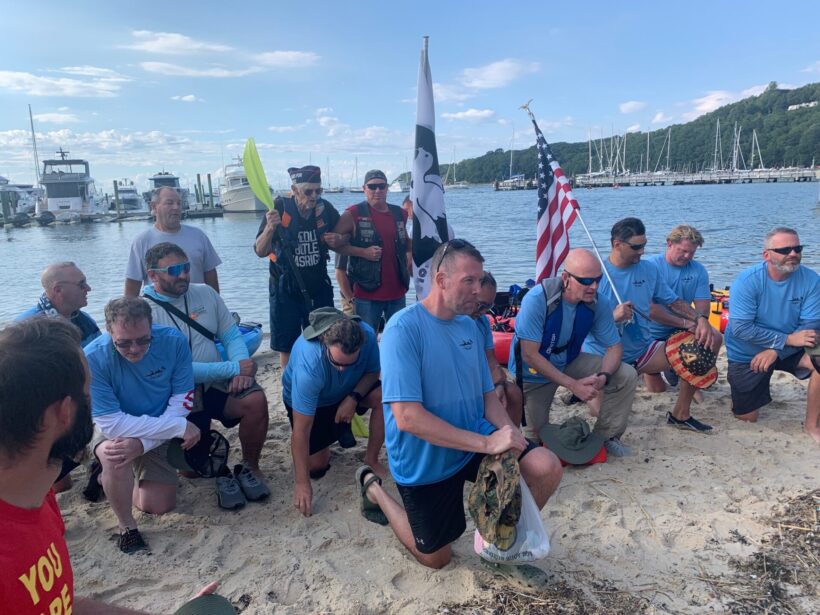
“Out of the blue, the convoy arrived from a completely different direction than what I anticipated,” Bill recounted. About 10 minutes after the last kayak was pulled ashore, he navigated his boat toward the crowd of veterans and supporters who started cheering him on. Several veterans hurried to help him out of his kayak.
“Suddenly, I was on the sand and in the midst of their prayer circle,” Bill said. “A big Marine also named Bill took my arm and called me brother. I start to cry now thinking of it. From then on it was one revelation after another representing full reception and mutual understanding.”
On shore, an emotional Bill posed for photos and was interviewed by local media. Over the next hour he told veterans why he had come. He knew he was risking the ire of veterans who sometimes view peace activists as unpatriotic and anti-veteran and was “shocked” at how warmly he was received.
“There was potential strife involved but I was willing to risk it with the hope that good would emerge from it,” Bill explained. “The hope is always that we can ultimately heal and reconcile.”
A former Army artillery officer, Bill joined ROTC programs at his Catholic military high school and at Fordham University in the Bronx. Upon graduation, he was commissioned a second lieutenant and following active duty served in the Army reserves until his honorable discharge in 1964. Years later he became a peace activist and served time in prison for crossing the line at the U.S. Army School of the Americas in protest.
Bill called last week’s experience “life changing.”
“The reality is that another world is possible,” he said. “And the way to bring that about was present there on that beach that day.”