

Like many during the pandemic, I cooked to bring back delightful culinary memories of distant lands. I once recreated “Idiyappam” following a recipe I found in a 296-page cookbook, “The Food of India,” published in Canada. The photo appeared familiar and doable: white noodles dressed in tomato and soy sauce then topped with peas, cashew nuts, and slices of hard-boiled eggs.
No sooner had I posted my creation on Facebook than a reaction came. A friend from South India wrote: “Idiyappam is traditionally eaten plain with a coconut milk-based vegetable stew. I don’t know what that is.” I replied that both recipe and cookbook looked “legit” to me. And “Idiyappam,” also called nool puttu noodles, is made with rice flour. So, I naively assumed I could substitute Filipino “Bihon” rice noodles and call it “Idiyappam.”
This reminded me again that food names can be deceiving. They do not necessarily reflect provenance. A favorite of mine, “Chicken Tikka Masala,” a staple of Indian restaurants in the U.S., is an example. The dish “Chicken tikka,” or boneless chicken meat marinated in yogurt and roasted in a tandoori oven, originated from South Asia. But the tomato-based creamy masala sauce with aromatic Indian spices is British or Scottish. So, I must remember not to order it in India.
In Cuba, I did just that. I asked my hosts, organizers of the science meeting in the State of Cienfuegos about the “Cuban Sandwich.” Here in Florida, “Cubano” is a pressed sandwich made with baguette-shaped white bread filled with slices of roast pork, ham, and Swiss Cheese. The recipe calls for dill pickles and mustard dressing. But strong tradition says, “No mayonnaise, please.”
Given the big Cuban immigrant populations in Florida, I assumed some connection. I asked my hosts what the “inspiration” might be. They laughed, perplexed. The friend who invited me to the 2017 conference could not come up with anything. Every morning break, they served us “bocadillo,” or their version of sandwich. And it did not look nor taste anywhere near Florida’s “Cuban Sandwich.”
Cultural Food Web
In the early 2000s, one of the perks I enjoyed running the international internship program of a botanical garden in Florida was listening to food stories. The program brought American interns together with students and professionals from all over the world. They trained with the garden’s research scientists and horticulturists.
Participants came from as far as Cameroon in Africa and Nepal in Asia. But since the garden specialized in tropical plants, most hailed from Costa Rica, Brazil, Ecuador, or Peru. After much wrangling with paperwork, we welcomed a participant from Cuba. He spent over two months observing how botanical gardens were marketed in Florida.
Working in public relations at Cienfuegos Botanical Garden, he was naturally charismatic. So, he quickly adjusted to American life. Once he mentioned that he planned to bring home McDonald’s burgers, “because they tasted delicious!”
But when we talked about food he missed from home, he eagerly said, “Arroz Congris or Congri.” Not just any beans-and-rice, the recipe requires cooking rice together with the black beans in the rich bean broth. Base flavor comes from “sofrito,” or garlic, onion, and bell pepper sautéed in pork fat. Cumin and bay leaf add depth to the one-pot dish.
Some associate the name “Arroz Congris” with its gray hue. But “Congri” can also be made with red beans, giving it a different color. In fact, the name came from the Haitian Creole word, “congo,” for beans and French, “riz,” for rice. Colonial Cuba’s enslaved Africans brought this culinary tradition from West Africa. They carried with them black-eyed peas, Vigna unguiculata, on their journey across the Atlantic. So, this cultivar of cowpea was used first in the beans-and-rice of the New World.
Another student of the program, a young orchid enthusiast from Costa Rica also raved about their beans-and-rice, “Gallo Pinto.” This national dish is cooked with black beans, Phaseolus vulgaris, like the Cuban cousin. But the name, “spotted rooster,” comes from the speckled appearance of beans on white rice. In this recipe, they add pre-cooked beans and leftover rice to sautéed garlic, onions, bell pepper, and Salsa Lizano seasoning. Costa Rica’s popular sweet and tangy sauce, this light brown condiment is likened to Worcestershire.
Craving for Rice too
Filipinos also show enthusiasm for a distant beans-and-rice relative — thick soup of mung beans, Vigna radiata, and rice. Although similar in taste to the split-pea, mung beans are boiled only until tender enough to burst but not mushy. Commonly consumed on meatless Fridays by the predominantly Catholic population, “Munggo,” the dish known only by its ingredient, is a delicious and affordable meat protein substitute.
It is, however, rice that Filipinos cannot live without. Within days after arriving in the bread or potato-eating West, most start seeking a rice fix. In cities without Filipino grocery stores that double as diners, they hunt down rice at a Chinese Take Out. In the U.K., that would be at an Indian restaurant, and in the Netherlands, an Indonesian restaurant.
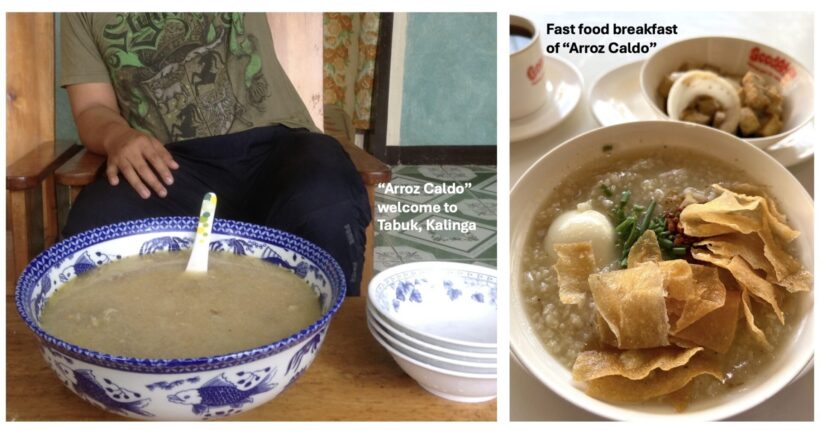
In 2025, the PBS public television reality cooking show, “The Great American Recipe,” displayed this passion for rice. Finalist Rex Alba showcased a Filipino rice comfort dish with the Spanish name, “Arroz Caldo.” As a Philippine-born physical therapist practicing in Ohio, Alba knows craving for rice firsthand. So, he said he cooks a big cauldron of “Arroz Caldo” to welcome newly arrived Filipino immigrant nurses for a little taste of home.
The “Arroz Caldo” appellation, meaning “rice and broth,” distinguishes it from “Lugaw” the word for rice porridge. An adaptation of the Chinese congee, Filipino “lugaw” uses sticky rice to produce a creamy porridge texture without the glue-like consistency of starch.
“Arroz Caldo” works like chicken noodle soup for those under the weather. The combination of soft rice, chicken, and ginger flavors in the savory porridge is soothing. Sautéing garlic and onion aromatics with chicken meat creates the base flavors. While fish sauce or white pepper packs in umami. For more nutrition, chicken liver or gizzard can also join the party.
When not resting the palate or gut, diners can jazz up or customize “Arroz Caldo” with toppings like hard-boiled eggs, fried garlic, scallions or pork cracklings. Calamansi citrus juice adds another dimension to the experience. But homemade “Arroz Caldo” for someone sick can be kept unadorned or barely seasoned, like plain “lugaw.”
Conversely, “lugaw” can be supercharged with flavors. Offal, fish, or dried fish can be deployed for that. Blanching, draining and repeatedly discarding the water while tenderizing internal organ meats help reduce gaminess. Pre-cooked “isaw” or pork intestines can then be added as topping. The “lugaw” enhanced with tenderized beef tripe has its own appellation– “Goto.”
“In Name Only”
Like the American beans-and-rice dishes – Cuba’s “Arroz Congri” and Costa Rica’s “Gallo Pinto” – which trace their roots back to Africa, the Filipino “Arroz Caldo” may be Spanish only in name.
In the ‘90s, while I was in Indonesia for a month-long training program, a local participant invited a few of us to spend an afternoon at his grandmother’s house in Bogor. She welcomed us warmly and immediately had helpers fill individual bowls of hot rice porridge for a midafternoon snack.
Grandmother invited us to embellish our own porridge. Laid out, buffet style, were toppings of shredded fried chicken, fried shallots, spring onions, hard boiled eggs and more toppings I did not recognize. “Kerupuk” or shrimp crackers, typically present in Indonesian meals may have been served.
Yes, I tasted the flavors of “Arroz Caldo” in the Indonesian chicken congee. They call theirs, “Bubur Ayam.” And Malaysians too have “Bubur Lambuk Ayam,” chicken porridge cooked with coconut milk.
Deep Roots
Archeological and DNA evidence point to the Yangtse valley in Central China as the likely region of rice domestication, starting from 8,000-6,000 BCE, or around 10,000 years ago. Humans there began selectively cultivating beneficial mutations of the wild rice species, Oryza rufipogon. And that gave rise to Oryza sativa, the species that dominates today. Its subspecies, japonica, spread to Japan, Thailand, Vietnam, and eventually the Philippines. While the subspecies indica flourished in the Ganges basin, present-day India, from around 6,500 – 2,000 BCE.
West Africans independently domesticated the rice species, Oryza glaberrima, from its wild ancestor, Oryza barthii, around 1,475- 475 BCE, or some 2,500 to 3,500 years ago. But Oryza glaberrima may have been overshadowed by the higher-yielding Asian Oryza sativa, 500 years ago.
So, West Africans made beans-and-rice long before Portuguese, Spanish, and English colonialists transported them and their culinary traditions to the Americas. Likewise, the ancestors of today’s Filipinos have, perhaps, enjoyed “Arroz Caldo” long before it was called that.
About the Author:

George Banez is a writer of Filipino descent and is a retired non-profit professional living in Florida.



