

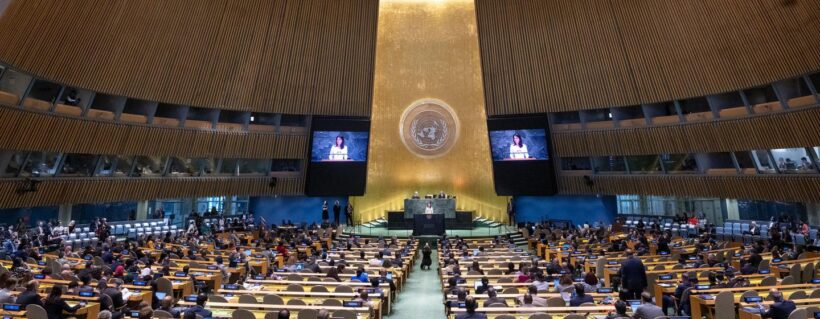
September 2025 will be remembered as the month when the United Nations General Assembly faced its greatest test in the face of the genocide in Palestine. There is no longer room for euphemisms or diplomatic caution: testimonies, statistics, and the pressure of a global majority demand calling genocide by its name, as UN Special Rapporteur Francesca Albanese insists for Palestine. The numbers are brutal and must be named: at least 680,000 dead in Gaza after nearly a year under siege, more than half of them children. Every number is an extinguished story, an irreplaceable absence for a society whose very foundations are being devastated.
Hard facts, no anesthesia
The Palestinian Ministry of Health and international organizations confirm that there are over 65,000 recovered and documented deaths, but the real figure exceeds 680,000 when including bodies under rubble and the disappeared.
More than 1.5 million internally displaced people lack access to water, food, or safe shelter.
Seventy percent of urban infrastructure has been destroyed, including hospitals and schools, as confirmed by UN data and agencies on the ground.
Relentless reports document the systematic violence against detained Palestinian children—stripped, beaten, blindfolded, subjected to continuous abuse by the Israeli army—leaving an open wound on the world’s conscience, as shown in the latest Save the Children report.
The press and humanitarian personnel are also direct targets: nearly 1,600 health workers, 250 Palestinian journalists, and over 340 UN employees have been killed in Gaza, an unprecedented figure.
The turning point at the UN: the battle for truth and rights
The 80th session of the UN General Assembly witnessed a historic shift in the correlation of forces. 145 countries voted in favor of Palestinian participation in the plenary, with just 5 against (United States, Israel, Paraguay, Nauru, and Palau) and 6 abstentions. President Mahmoud Abbas and the Palestinian delegation will participate by videoconference, given the unprecedented US visa denial—a move underscoring the deepening diplomatic isolation of both Tel Aviv and Washington.
The vote is more than symbolic: it legitimizes the Palestinian demand, undermines the US veto power, and draws a new diplomatic map where the Global South, Latin America, Europe, and Africa align with Palestinian rights, opening an irreversible divide in the impunity pact that has sustained Israeli exceptionality for decades.
The global context and social pressure
Portugal has just officially recognized the State of Palestine, and other European and Latin American countries are set to join in the coming weeks, consolidating a critical mass of 154 countries that have already taken this step.
Mass protests by anti-Zionist Jews, human rights movements, and progressive sectors around the world are setting the tone in New York and other cities: silent complicity is over, and there is a demand for action, sanctions, and justice.
Figures like Japanese lawmaker Mari Kushibuchi are challenging their heads of state to stop worrying about angering the US and to make bold decisions in recognition of Palestine.
Truth as an ethical mandate
The most elementary achievement of this Assembly is the triumph of truth. The brutality of the genocide in Gaza is finally acknowledged from the dignity of the victims rather than from the geopolitical needs of the powers. The narrative of neutrality or “conflict” can no longer be accepted when it comes to the systematic extermination of a society, of an entire generation of children lost forever.
The UN faces a crossroads: either act upon the truth and build justice, or relinquish its historic mandate and the trust of the world’s peoples in the multilateral system. New planetary majorities demand concrete sanctions, an international tribunal, and reparations for victims and their families. International law is being reconfigured by the pressure of civil society, the victims, and the states courageous enough to say “enough.”
Responsible decisions and the future
Today, politicians, diplomats, and social leaders must understand that only truth brings light. The counting of victims is also the reckoning of those who must be honored, repaired, and protected. Every number, every testimony, every lost life is a reason for ethical urgency: what is at stake is not just the Palestinian cause, but the very meaning of universal justice, dignity, and the international system.
This September, the UN General Assembly marks the beginning of a new era: the only light can come from unvarnished truth, without concessions or silences. Taking responsible decisions in the face of genocide is to shake the global conscience, and it is the only path that can, in the long run, restore meaning, peace, and future to Palestine and the world.



